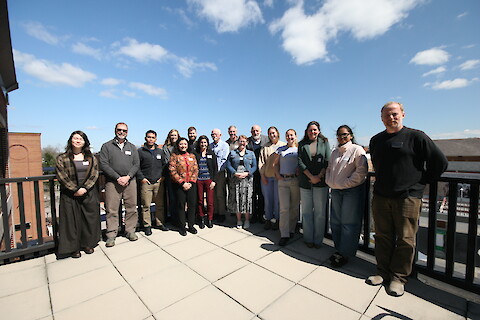
Ricky Arnold, a former graduate student at Horn Point Laboratory, University of Maryland Center for Environmental Science, stopped by Cambridge, Maryland on his way to the Wallops Island NASA facility. Ricky’s last time in Cambridge was his thesis defense, nearly twenty years ago. Since his thesis defense, Ricky has lived in several countries, including Indonesia [...]
Continue Reading »April 29, 2010
April 28, 2010
Discussion following Heath Kelsey seminar on beach and shellfish forecasts using integrated data from monitoring programs, remote sensing, and observing systems
This blog post discusses the seminar given by Dr Heath Kelsey, of EcoCheck, at the IAN Seminar Series on April 22, 2010. A wide ranging discussion of bacteria, viruses and contaminants in water and shellfish followed the seminar. Typical of discussions of bacteria in water or shellfish, the issue of the different methods was raised. [...]
Continue Reading »April 26, 2010
IAN Science Communication Intern Program
IAN has developed an intern program: a short-term, immersive and experiential education in science communication applications. IAN interns typically come from a diversity of good undergraduate programs and many of them go on to a diversity of good graduate programs following their IAN internship. IAN interns develop a range of job skills, master various software, [...]
Continue Reading »April 23, 2010
April 22, 2010
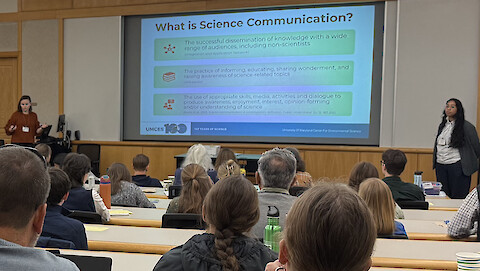
Science Communication Course
A group of Integration and Application Network staff taught a one day science communication course at the Oxford Cooperative Laboratory on April 19. Bill Dennison, Jane Thomas, Jane Hawkey and Caroline Wicks covered the principles of science communication and provided lectures, activities, demonstrations and exercises for creating conceptual diagrams, PowerPoint presentations, and design/layout of posters [...]
Continue Reading »April 19, 2010
April 13, 2010
April 6, 2010
Environmental report card grading system
The grading system used in the EcoCheck environmental report cards is a simple, systematic ranking scale. The one hundred point scale is divided into five equal categories; A (80-100), B (80-60), C (60-40), D (40-20) and F (20-0). Furthermore, the grades have a plus and minus scale, so that the upper 5 points of the [...]
Continue Reading »April 2, 2010
Chesapeake literacy
The concept of Chesapeake literacy derives from a series of programs that have established various literacy principles, for example, ocean literacy (www.coexploration.org). These programs have distilled the essence of what an informed person needs to know, thus informing both formal (e.g., classroom) and informal (e.g., museums) educators. The literacy principles form the overall outline presented [...]
Continue Reading »