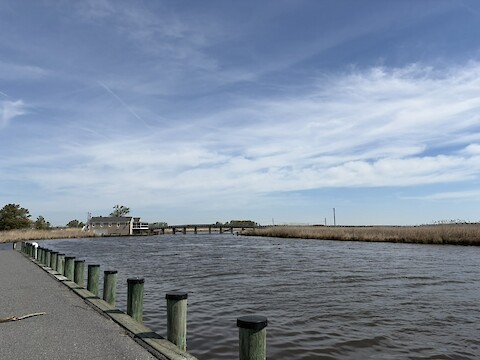
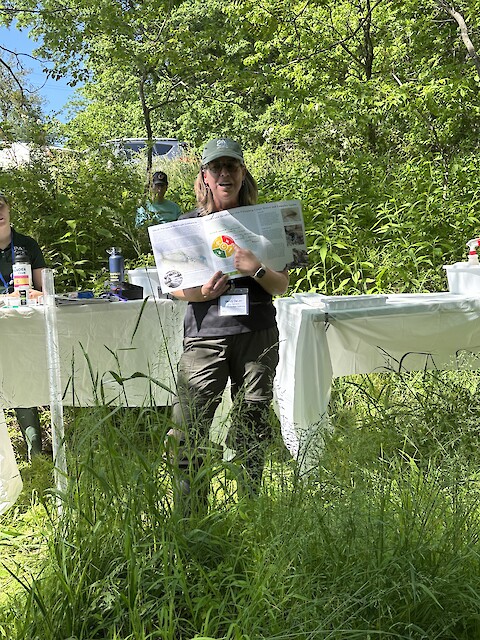
Uncovering a lost lagoon The Sandringham lagoon case study was described by Tim Marsden from the Queensland Department of Employment, Economic Development and Innovation (DEEDI). Standing in front of the lagoon, Tim showed before and after photos and described the process of clearing the weeds that completely choked the lagoon. The lagoon had become completely [...]
Continue Reading »April 29, 2011
April 27, 2011
“Rainbow Literature”: Peer reviewed, colorful science communication products
The gold standard for scientific publication is known as ‘peer review’. This refers to the established practice of sending manuscripts to appropriate experts who critically review the data, the analysis of the data, the conclusions drawn from the results and even the style and manner of communicating the findings. Scientific manuscripts are submitted to an [...]
Continue Reading »April 25, 2011
New conceptual diagram worksheet developed
In order to guide people interested in creating a conceptual diagram, a worksheet has been developed by the Integration and Application Network. This worksheet is designed to aid in the assembly of relevant information needed for drafting a new conceptual diagram. The worksheet helps hone the message, prioritize the features and processes being depicted, and [...]
Continue Reading »April 22, 2011
Dashboard books on fire: Communicating fire management creatively
Reef Catchments in Mackay, working with a range of partners, has produced a superb set of ‘dashboard books’ designed to ride around on the dashboards in volunteer rural fire brigade trucks or landholder trucks (utes) and provide easily accessible fire management information. Andrew Houley with Reef Catchments, a self-avowed firebug, produced these high quality books, [...]
Continue Reading »April 20, 2011
TERN, TERN, TERN
Based on a passage from the Bible in the book of Ecclesiastes, Bob Seeger combined words and music for the song “Turn, Turn, Turn”, which was popularized by the musical group the Byrds. This song was adapted for the Terrestrial Ecosystem Research Network (TERN), based on what we learned at the TERN Symposium 2011. To [...]
Continue Reading »April 18, 2011
TERN workshop
I was asked by Prof. Stuart Phinn from the University of Queensland to give a keynote lecture at the Terrestrial Ecosystem Research Network (TERN) Symposium 2011 in Melbourne, Victoria. There were approximately 100 scientists and resource managers at the symposium held at a conference center near the University of Melbourne. The other keynote speaker was [...]
Continue Reading »April 15, 2011
Storyboarding to generate a science newsletter
As part of the Healthy Waterways Alliance launch in Mackay, Queensland, a science newsletter was drafted as part of a Science Communication Workshop. The process of taking a group of people from varied backgrounds through a storyboard exercise is broken down into components and explained as a) workshop preparation, b) workshop introduction, c) an activity [...]
Continue Reading »April 13, 2011
Launching the Healthy Waterways Alliance in Mackay
Sal Gray and Carl Mitchell from Reef Catchments invited me to participate in the launch of the Healthy Waterways Alliance in Mackay, on the central Queensland coast. We agreed on a plan for me come up the day before with a Science Communicator, Kate Moore, and run a half-day training session in which we would [...]
Continue Reading »April 11, 2011
Dr. John Snow and Jack Maple, kindred spirits
Dr. John Snow (1813-1858) was a doctor who lived in London, England and Jack Maple (1952-2001) was a policeman who lived in New York City, USA. In spite of their wide geographical and generational differences, these two remarkable men were kindred spirits in combining insights and good maps to solve compelling problems. Following their premature [...]
Continue Reading »April 6, 2011
Sea turtles, dugong and a major city skyline
Moreton Bay, adjacent to Brisbane, the Capital of Queensland, Australia, supports large populations of green sea turtles (Chelonia mydas) and dugong (Dugong dugon). The turtles and dugong feed on seagrasses growing on the shallow sand banks of Eastern Moreton Bay. These shallow sand banks are flushed with clean ocean water that enters and exits Moreton [...]
Continue Reading »