IAN Press is committed to producing practical, user-centered communications that foster a better understanding of science and enable readers to pursue new opportunities in research, education, and environmental problem-solving. Our publications synthesize scientific findings using effective science communication techniques.
Publications
- Australia
- Brisbane
- Darwin Harbour
- Great Barrier Reef
- Moreton Bay
- Southwest Western Australia
- Caribbean
- Eastern Caribbean Sea
- Mesoamerican Reef
- Chesapeake Bay
- Anacostia River
- Baltimore Harbor
- Chesapeake Bay
- Chester River
- Choptank River
- Elizabeth River
- James River
- Lower Bay
- Lower Eastern Shore (Tangier)
- Lower Western Shore (MD)
- Magothy River
- Mid Bay
- Monie Bay
- Nanticoke River
- Patapsco and Back Rivers
- Patuxent River
- Potomac River
- Rappahannock River
- Sassafras River
- Severn River
- South River
- Tangier and Pocomoke Sounds
- Upper Bay
- Upper Eastern Shore
- Upper Western Shore
- West and Rhode Rivers
- Wheel Creek
- York River
- Gulf of Mexico
- Apalachee Bay
- Apalachicola Bay
- Aransas Bay
- Atchafalaya and Vermilion Bays
- Baffin Bay
- Barataria Bay
- Brazos River
- Breton and Chandeleur Sound
- Calcasieu Lake
- Caloosahatchee River
- Charlotte Harbor
- Choctawhatchee Bay
- Coastal Louisiana
- Corpus Christi Bay
- East Mississippi Sound
- Florida Bay
- Galveston Bay
- Gulf of Mexico
- Lake Borgne
- Lake Pontchartrain
- Lower Laguna Madre
- Matagorda Bay
- Mermentau River
- Mississippi and Atchafalaya Plume
- Mississippi River
- Mobile Bay
- North Ten Thousand Islands
- Pensacola Bay
- Perdido Bay
- Rookery Bay
- Sabine Lake
- San Antonio Bay
- Sarasota Bay
- South Florida
- South Ten Thousand Islands
- St. Andrew Bay
- Suwannee River
- Tampa Bay
- Terrebonne and Timbalier Bays
- Upper Laguna Madre
- West Mississippi Sound
- Hawaii
- Ala Kahakai National Historic Trail
- Hawaii Volcanos National Park
- Kalaupapa National Historical Park
- Kaloko-Honokohau National Historical Park
- Pu'ukohola Heiau National Historic Site
- Maryland
- Deep Creek Lake
- Maryland Coastal Bays
- Assateague Island
- Assawoman Bay
- Chincoteague Bay
- Isle of Wight Bay
- Maryland Coastal Bays
- Newport Bay
- Sinepuxent Bay
- St. Martin River
- Mexico
- Nichupte Lagoon
- Puerto Morelos Lagoon
- Mid Atlantic
- Antietam National Battlefield Park
- Barnegat Bay
- Buzzards Bay
- Catoctin Mountain Park
- Chesapeake and Ohio National Historical Park
- Connecticut River
- Delaware Bay
- Delaware Inland Bays
- Gardiners Bay
- Great South Bay
- Hudson River and Raritan Bay
- Integration and Application Network
- Long Island Sound
- Monocacy National Battlefield Park
- Narragansett Bay
- New Jersey Inland Bays
- Rock Creek Park
- UMCES Center Administration
- Mid West
- Northern Great Plains
- North Atlantic
- Blue Hill Bay
- Boston Harbor
- Cape Cod Bay
- Casco Bay
- Damariscotta River
- Englishman and Machias Bay
- Great Bay
- Hampton Harbor
- Kennebec and Androscoggin River
- Massachusetts Bay
- Merrimack River
- Muscongus Bay
- Narraguagus Bay
- Penobscot Bay
- Plum Island Sound
- Saco Bay
- Sheepscot Bay
- St. Croix River and Cobscook Bay
- Waquoit Bay
- Wells Bay
- North Pacific
- Airai Bay, Palau
- War in the Pacific National Historical Park, Guam
- Pacific Coast
- Alamitos Bay
- Alsea River
- Anaheim Bay
- Bellingham and Padilla and Samish Bays
- Central San Francisco and San Pablo and Suisun Bays
- Columbia River
- Coos Bay
- Coquille River
- Drakes Estero
- Eel River
- Elkhorn Slough
- Grays Harbor
- Hood Canal
- Humboldt Bay
- Klamath River
- Mission Bay
- Monterey Bay
- Morro Bay
- Nehalem River
- Netarts Bay
- Newport Bay
- Port Orchard Sound
- Puget Sound
- Rogue River
- San Diego Bay
- San Francisco Bay
- San Pedro Bay
- Santa Monica Bay
- Sequim and Discovery Bays
- Siletz Bay
- Siuslaw River
- Skagit Bay and Whidbey Basin
- South Puget Sound
- Tijuana Estuary
- Tillamook Bay
- Tomales Bay
- Umpqua River
- Willapa Bay
- Yaquina Bay
- Panama
- Bocas del Toro
- Philippines
- Verde Island Passage
- South Atlantic
- Albemarle Sound
- Altamaha River
- Biscayne Bay
- Bogue Sound
- Broad River
- Cape Fear River
- Charleston Harbor
- Indian River
- Neuse River
- New River
- North and South Santee Rivers
- North Carolina Outer Banks
- Ossabaw Sound
- Pamlico and Pungo Rivers
- Pamlico Sound
- Savannah River
- South Carolina Beaches
- St. Andrew and St. Simons Sounds
- St. Catherines and Sapelo Sounds
- St. Helena Sound
- St. Johns River
- St. Marys River and Cumberland Sound
- Stono and North Edisto Rivers
- Winyah Bay
- South Caucasus
- Kura River basin
- South Pacific
- National Park of American Samoa
- Virginia
- George Washington Memorial Parkway
- Manassas National Battlefield Park
- Prince William Forest Park
- Wolf Trap National Park for the Performing Arts
- West Virginia
- Harpers Ferry National Historical Park
agricultural aquatic assessment australia battlefield chesapeake bay chester climate change coastal coastal bays communication conceptual diagrams conference conservation coral creek dissolved oxygen document ecological ecosystem environmental estuarine federation fisheries flood forecast global habitat harbor health impacts implementation indicators loading maps marine menhaden monitoring nitrogen nutrient ocean overall oyster park partners patuxent pollution predicted reef report card restoration river seagrass sediment spatially studies study threats tidal tributary water quality watershed workshop zone
You are browsing all 80 communication products for Chesapeake Bay, Chesapeake Bay
Focus Group Evaluation of Tributary Report Cards (Report)

Publisher: OpinionWorks
The Chesapeake Bay Trust, West/Rhode Riverkeeper, and OpinionWorks have conducted an audience evaluation of tributary report cards, conducted through focus groups. This report provides the findings and recommendations that arise from this research. The report also serves as a best management guide for creating report cards that not only report on water quality, but also engage the public in the work of protecting the Bay and its tributaries.
2011 Chesapeake Bay Report Card (Report card)

Prepared by EcoCheck and the Integration and Application Network
This report card provides a transparent, timely, and geographically detailed assessment of Chesapeake Bay. The overall health of Chesapeake Bay, determined using water quality and biotic indicators, declined slightly in 2011. The overall grade of D+ was a decrease for the second year in a row, down from a C- in 2010. Only two reporting regions, the Patapsco and Back Rivers, and the Lower Western Shore (MD), had improved grades in 2011. The highest-ranked region for the second year in a row was the Upper Bay, with a grade of C. For further details, visit the Report Card website.
Chesapeake and Atlantic Coastal Bays Trust Fund (Newsletter)

The Chesapeake and Atlantic Coastal Bays Trust Fund was created in 2007 in an effort to reduce nutrient and sediment pollution to these bays. The Trust Fund has focused its financial resources on the implementation of effective non-point (i.e., diffuse) source pollution control projects in high priority watersheds. This newsletter details examples of projects supported by the Trust Fund including stream channel restorations, stormwater retrofits, and cover crops.
Assessing the ecological and human health status of Baltimore's Inner Harbor (Poster)

Presented at the Coastal and Estuarine Research Federation's Biennial Conference
Baltimore's Inner Harbor and its watershed is a highly urbanized area in the mid-Atlantic region of the United States. This study assessed water quality and biotic parameters as ecological health indicators. Bacteria and trash were assessed as human health indicators. Most water quality indicators were either poor (D) or very poor (F) in the Inner Harbor. Bacteria and trash levels in the Inner Harbor were rated as poor (D). Middle Branch region: Bacteria levels were rated as fair but no water quality data available. The watershed health was better, with water quality indicators and bacteria scoring from good (B-) to poor (D). This study is a component of the Waterfront Partnership of Baltimore's Healthy Harbor Initiative, which includes a set of goals and implementation actions to make the Harbor swimmable and fishable by 2020.
2011 Chesapeake Bay Dissolved Oxygen Forecast (Report)

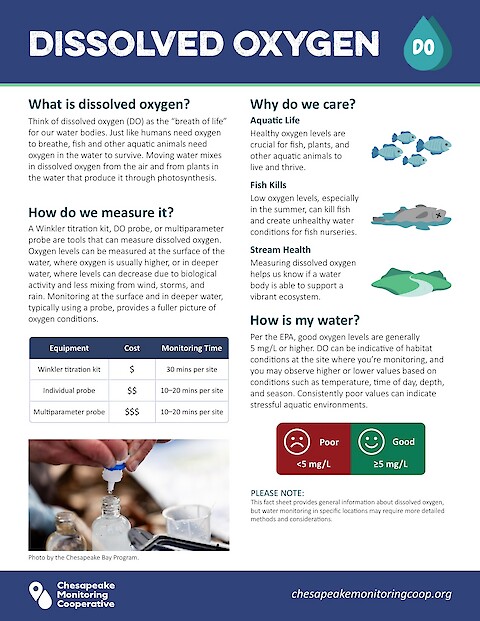
For the past several years, Chesapeake Bay scientists have collaborated with EcoCheck to forecast summer dissolved oxygen conditions, based on flow and nutrient loading conditions through May. The 2011 anoxia forecast is supported through research at Johns Hopkins University, Old Dominion University, UMCES-Horn Point Lab, and the Chesapeake Bay Program. This forecast uses the same basis as previous anoxia forecasts—nitrogen loads—but adds other elements that may provide a better understanding of anoxia in the mainstem Bay. The forecast was divided into early summer and late summer predictions because for the past several years there has been a noticeable change in anoxic volume following wind events in late June and early July. The early summer anoxia forecast predicts moderate to poor conditions, based on nitrogen loads from January to April as well as high flow in May.
2010 Trust Fund Water Quality Monitoring Strategy (Report)

This Monitoring Strategy was designed to identify nutrient reduction efficiencies of best management practices (BMPs) and provide information to determine what type of monitoring is needed by Trust Fund recipients to evaluate the effectiveness of BMP implementation. The main objective is to provide a comprehensive protocol that serves all water quality assessment needs when monitoring urban and agricultural non-point nutrient and sediment fluxes. The methods and results of several intensively monitored case studies indicate that BMP implementation can be highly effective at reducing nutrient and sediment fluxes to receiving waters.
Chesapeake Bay Report Card 2010 (Report card)

Prepared by EcoCheck and the Integration and Application Network
This report card provides a transparent, timely, and geographically detailed assessment of 2010 Chesapeake Bay health. The overall health of Chesapeake Bay, assessed using water quality and biotic indicators, declined slightly in 2010. The overall grade decreased from a C in 2009 to C- in 2010. Only two reporting regions (James River and York River) had improved grades in 2010, three were unchanged, and nine declined. The highest-ranked region in previous years, the Upper Western Shore, decreased to fourth highest. The Upper Bay (C+) became the top-ranked region in 2010. For further details, visit the Report Card website.
Blue Crab Status Report (Newsletter)

Blue crabs are one of the best-known and most celebrated symbols of the Chesapeake. Their populations in the Bay have hovered near historic lows for much of the last decade, but have recently begun to show signs of improvement. This newsletter reviews the current status of the blue crab population in the Chesapeake Bay as well as the management systems in place to monitor and protect this iconic species.
Nitrogen in the Chesapeake Bay: A Retrospective (Newsletter)

Produced by EcoCheck (NOAA-UMCES partnership)
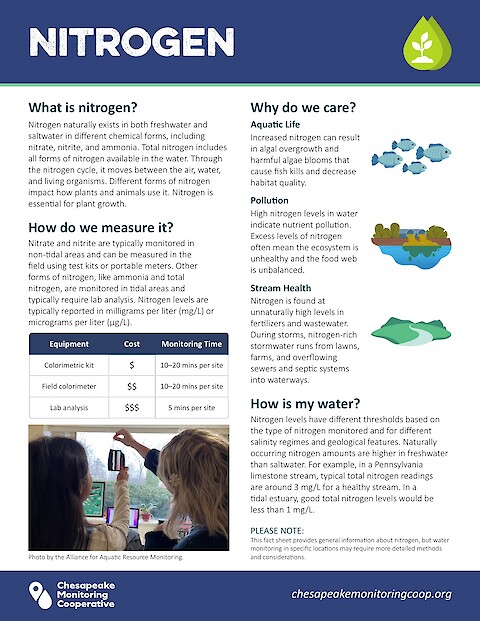
Nitrogen pollution has been a primary cause of a degraded Chesapeake Bay ecosystem for over a century. Since the Clean Water Act of 1972, Bay monitoring programs have measured the amount of nitrogen coming from human activities and on land (urban, suburban, rural, and industrial) and from natural cycling in the water column. This information is used to evaluate management actions for nutrient reduction. This newsletter summarizes monitoring data and describes nitrogen trends in both the non-tidal and tidal areas of the Chesapeake Bay.
2010 Chesapeake Bay Forecast (Report)

This summer it is predicted that the anoxic condition (no dissolved oxygen) in the Bay's mainstem will be moderately poor, with the average anoxic volume forecast to be 0.8 ± 0.3 km3. Compared to the previous 25 summers, 2010 could have the 5thsmallest anoxic volume if this prediction holds true.
CheckOut
Your shopping cart is empty. You can add items from the publications tab.
Subscribe
There are a couple of different ways that you can receive details of new additions to IAN Press. The most comprehensive and timely, is via our IAN Press RSS Feed.
Subscribe to the IAN Press RSS Feed.
Subscribe to our newsletter and email subscription service to receive notification of new publications
(via our enewsletters), and/or have hardcopies mailed to you.
About
"Writing crystallizes thought and thought produces action." Paul J. Meyer
Goals
A goal of IAN Press is to empower scientists to directly communicate their ideas and concepts. Publications from IAN Press are designed to transform the uninterested to interested; the interested to involved and the involved to engaged.
IAN Press products are designed to be examples of good science communication principles, and the hope is that others will employ these principles so that scientific understanding can be disseminated widely as possible. The production of IAN Press communication publications involves experimentation with communication techniques and, as such, provides various ideas for science communication that can be emulated.
The comparisons and contrasts that IAN Press provides on environmental subjects intend to stimulate scientists, managers, practitioners, policy makers, students and other readers to think more broadly and expansively about the region and issues that they face. The extensive use of visual elements accesses a broader cultural diversity as well, which allow for more global perspectives.
The conclusions and recommendations presented in IAN Press publications are crafted to empower actions, plant seeds of ideas and provide justification for people to take appropriate action to find solutions to environmental problems. The conclusions are made as explicit as possible by employing active titles and featuring them prominently (e.g., front section of books or back cover of newsletters).
On costs
IAN Press does not provide author royalties and the design and layout of the publications conducted by a talented team of Science Communicators is underwritten by various grants and contracts. Marketing is limited to the internet and word-of-mouth, also reducing costs. Thus, the price of IAN Press publications is solely to reimburse the actual printing costs entailed. The intent is to provide the broadest possible readership, thus keeping costs as low as possible is paramount. Typically, full color is used, virtually on every page, which does increase print costs, however, the use of color is a key element in providing accessible information to a wide audience and the lack of author royalties or design/layout charges.
Peer review
IAN Press undertakes a rigorous review process by both peer scientists and resource managers. In addition, Integration and Application Network Science Integrators and Science Communicators read, edit and review all aspects of IAN Press publications, including text, conceptual diagrams, photographs, maps, figures and tables. Many IAN Press publications are multi-authored, and each author contributes to the review and editing of the entire publication. This is not the classical peer review system of a limited number of anonymous reviewers working with an editor to recommend changes, rather a larger number of non-anonymous reviewers that develop consensus on each word, visual element and recommendation. The review process is often accelerated by IAN Press to accommodate timely publication.
Authorship
IAN Press attempts to be as authorship inclusive as possible and to provide attribution to each visual element. Authorship is not ranked or ordered, and the credibility of the IAN Press product should be based on the scientific data presented and the collective effort of a multiple of contributors, both with and without formal academic training.
Science Communicators are the key element in the production of IAN Press documents. They design the layout of the document, obtain and edit the visual elements, designate the amount and style of text, and orchestrate the review and editing process. IAN Press documents are produced using a 'storyboard' approach, in which the central message(s) are identified and various visual elements selected to support the central message(s). This is in contrast to the more traditional method of writing text and adding in visuals subsequently. In video and film production, storyboards are used and the producer is key to assembling the visual elements. Science Communicators serve in an equivalent role in terms of assembling all the pieces that go into the publication.
Color
IAN Press relies extensively on color for photographs, maps, conceptual diagrams, figures and even text and tables to a limited degree. The use of color allows for an increased data density and provides a bigger visual impact considering the amount of the human brain devoted to visual discrimination of colors. Color allows for greater discrimination of visual elements and in data presentation, a closer juxtaposition of different elements and greater comparative utility. The preponderance of color printers and the ability of electronic versions to be displayed in color promote the inexpensive dissemination of full color documents. In order to help color-blind people compensate, an effort is made to provide other visual clues in graphics, such as symbols with different shapes or map delineations with different shading or texture, but some of the visual impact will be compromised.
Audience
IAN Press does not target a narrow, specific audience, rather attempts to be as inclusive as possible. As the world becomes more specialized, with marketing forces that promote highly targeted advertising campaigns, IAN Press products attempt to reach the broadest audience possible. IAN Press attempts to raise the bar rather than dumb down the message by using non-technical language, defining all terms and reducing acronym use. By providing synthesis, visualizations and context, we feel that relatively sophisticated concepts can be grasped by a non-technical audience. In fact, science has become highly specialized and often the language, tools and approaches used in various scientific disciplines are relatively incomprehensible to specialists in other disciplines. Thus, one audience of IAN Press is scientists from other specialties to encourage inter-disciplinary thinking and approaches.
Why use print media?
With the growing popularity of electronic media, the carbon footprint involved in producing and distributing paper products, and the ability to provide infinite resources via the web, it could be argued that IAN Press should disseminate entirely via electronic means. While IAN Press provides downloadable, web accessible materials, IAN Press continues to produces written products for the following reasons:
- There is rigor and discipline required in producing science communication products that have limited 'real estate', that, is limited amounts of space to convey a message. A paper product maintains focus, while web links can lead to tangential issues. The priority setting required to establish the final layout and include various communication elements is important in conveying information. Fixed 'real estate' forces condensation, synthesis and integration. Every visual element is uniquely created for the purpose of conveying the specific information intended, rather than repurposed from other sources.
- The written product invites non-linear reading, and a quick scan allows readers to delve into the visual elements most interesting to them. If a reader is most attracted to photographs, maps, conceptual diagrams, or figures, they can migrate to these elements and the figure legends should be self explanatory. Alternatively, if reading text is the preferred way of obtaining information, the text is designed to be self sufficient. The juxtaposition of text and various visual elements also conveys important information, something that can be lost via hyperlinks on the web. In addition, electronic books with the current technology do not support color graphics.
- Since various IAN Press products are intended to inform a broad community from policy makers to the general public, the weight of scientific support that can be marshaled can be a factor in empowering people to action. In order to make an impact, the difference between hundreds of web pages and hundreds of printed pages is one reason to provide print versions of IAN products. In addition, internet access is not equally applied globally or socially, and in some societies and sectors of society, a written product provides a more accessible source, particularly through libraries and schools.
- Printed materials provide a 'time stamp', a fixed point of time when the data are assembled and the conclusions are reached. Rather than constantly updating the data and conclusions, drawing the line in the sand as to what is known at a particular time point is what printed products do. The shelf life of science communication products should be somewhat limited due to the increased scientific understanding based on ongoing research, yet the record of what is known, and when it is known, provides an important archival body of information.
- "The product drives the collaborative process"; in that the science communication product forces an intensely collaborative process of obtaining and refining visual elements, drafting and editing text, and experimenting with layout and design. While this collaborative process can be conducted with the production of web materials, print deadlines are a good way to insure timely delivery. In addition, to obtain buy-in from many scientists whose training and experience are in producing printed papers and books, printed copies are often necessary.