IAN logo IAN logo
  • UMCES HOME
  • DONATE

Search form

  • Work with Us
    • Science communication services
    • Environmental report card production
    • Training and capacity building
    • Stakeholder Engagement
    • Careers
  • Media Library
    • Symbols
    • Graphics
    • Photos
    • Videos
  • Report cards
  • Education
    • Professional Certificate
    • MEES Graduate Program
    • Short Courses
    • Initiatives
  • Blog
  • Enewsletter
  • Publications
    • Books
    • Report Cards
    • Newsletters
    • Reports
    • Brochures
    • Posters
    • Papers
  • Projects
  • About
    • Who we are
    • What we do
    • Our Mission
    • History
    • Partnerships
    • Contact
    • Land Acknowledgment Statement
    • Project Videos
  • Home
  • Media Library

Lightbox (0)

Symbol Package
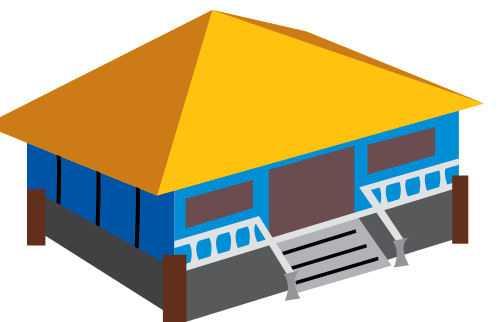
An above view of the square blue house, shows two of the structures walls and three side of the yellow pyramid roof. The house is elevated on stilts and has a set of stairs that lead up to the front entrance.
Fale: enclosed 4 (Samoa)
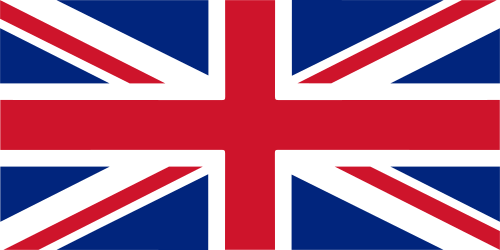
Illustration of the UK flag.
Flag: United Kingdom
Illustration of the flag for the United States of America
Flag: United States of America
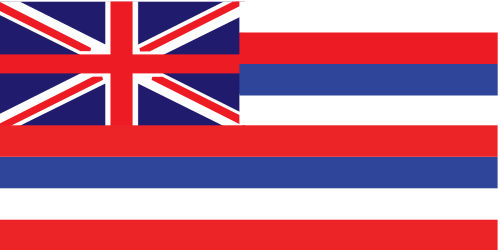
This symbol shows a flattened view of the official flag of Hawaii. The flag comprises of red, white, and blue stripes and includes the British flag in the top left-hand corner.
Flag: USA Hawaii
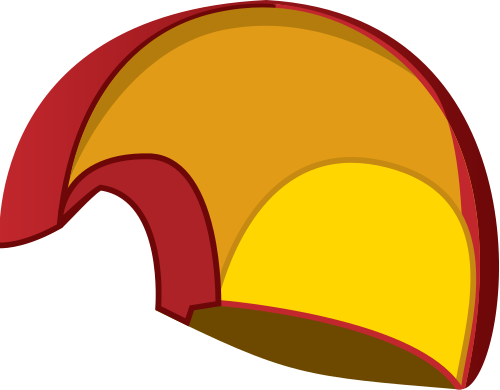
A side view of a three dimensional headdress colored yellow, red, and orange.
Hawaiian Royalty Headdress
A stylized red hibiscus flower with an orange style protruding from the center of the flower. The hibiscus is the state flower of Hawaii.
Hibiscus Flower
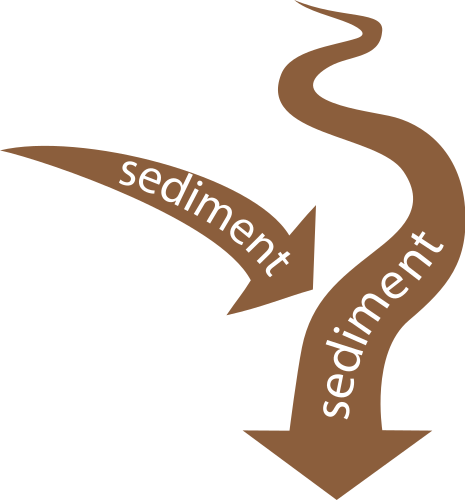
Illustration of excess sediment running off the land into the water.
Inputs: sediments 2
A stylized Hi'a Lehua flower shows the green leaves and base and long, upward reaching red petals.
Metrosideros Polymorpha (Hi'a Lehua)
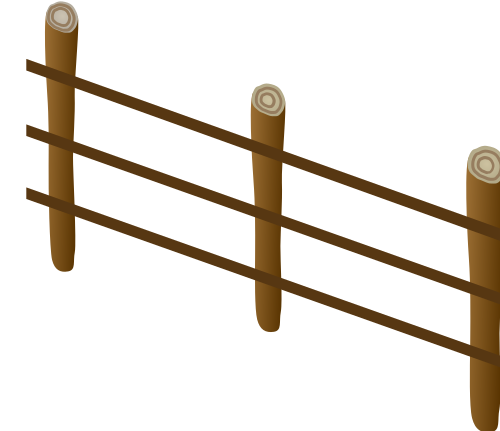
A wooden fence is depicted from raised side view. The fence is made out of brown logs and has large gaps in the fence slates.
Wood-split fencing 02
A downward pointing yellow arrow labeled
Inputs: sewage
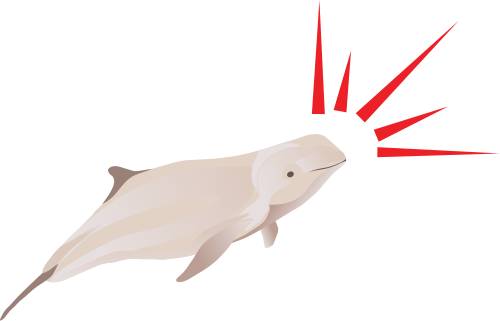
Vessel strike of irrawaddy dolphin as it surfaces to breathe.
Vessel strike of marine mammal
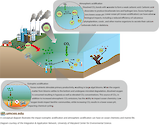
A diagram illustrates the way in which carbon dioxide dissolves in the ocean and the impacts acidification can have on marine life.
Atmospheric and Eutrophic Acidification
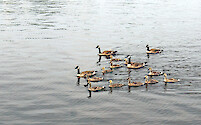
Adult geese and juvenile goslings paddle around a river cove off Lake Michigan.
Canada geese (Branta canadensis) with goslings
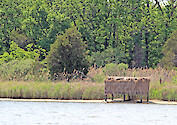
Goose and duck hunters build these blinds on the calm waterways of Chesapeake Bay tributaries.
Duck blind
Tree roots are underminded by wave action and eventually succumb while the shoreline is eroded.
Eroded shoreline with tree snags
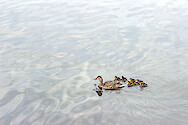
Mother duck and ducklings paddle around a river cove off Lake Michigan.
Female mallard (Anas platyrhynchos) and ducklings
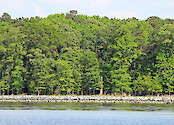
Stone rip-rap installed by the property owners in an attempt to prevent shoreline erosion. Hardened edges along the Chesapeake Bay and its rivers reduces natural shoreline habitat that fish and other marine animals depend on for food and shelter.
Hardened shoreline prevents erosion
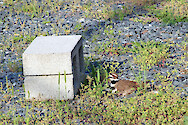
Found on golf courses or vacant gravell parking lots, this noisy plover is best known for its
Killdeer (Charadrius vociferus) nest in busy…
This emergent aquatic, with its leaves and flowers above water and portions of the stem under water, is found typically in shallow, quiet water. The seeds can be eaten like nuts and the young leaf-stalks cooked as greens. Deer also feed on these plants. The common name suggests that this plant, as well as the fish known as pickerel, occupy the same habitat.
Pickeral rush (Pontederia cordata)
This emergent aquatic, with its leaves and flowers above water and portions of the stem under water, is found typically in shallow, quiet water. The seeds can be eaten like nuts and the young leaf-stalks cooked as greens. Deer also feed on these plants. The common name suggests that this plant, as well as the fish known as pickerel, occupy the same habitat.
Pickeral rush (Pontederia cordata) occupies…
The oldest type of net used by the Chesapeake Bay watermen is called a pound net. Wooden stakes are pushed into the bottom of the Bay, spaced apart in a line that runs across the tide. Nets are strung between the stakes and along the bottom of the river, making a fish trap. In late February the pound netter starts to put in the stakes. By the middle of March he will set his nets and start fishing. Each day the waterman goes out to the pound net and scoops the fish out with a hand net. He will not remove the pound net, except for many repairs, until November.
Pound net
These traditional boats tended to the oyster fleets working the beds in the Bay, buying harvested oysters from the oystermen in the afternoon, and running those oysters to faraway markets and rail centers in Norfolk, Crisfield, Baltimore, and Washington DC, and to local shucking houses and canneries around the Bay.
Restored Chesapeake Bay oyster buy boat
A graph depicts the low oxygen levels and high ammonium concentrations in 2005 that caused large algae blooms. This put more stress on the ecosystem, resulting in the fish kill.
2005 Corsica River Fish Kill
A conceptual diagram illustrates the factors that can stimulate the growth of harmful algal blooms in brackish rivers and how these blooms can negatively impact other species within the ecosystem.
Algal Bloom Causation and Impacts in Brackish…
  • Prev
  • 1
  • …
  • 24
  • 25
  • 26
  • 27
  • 28
  • 29
  • 30
  • 31
  • 32
  • 33
  • …
  • 324
  • Next

UMCES Links

  • Home
  • About
  • Campuses
  • News & Events
  • Directory
  • Employment
  • Research
  • Press Room

Contact Info

115 West Street, Annapolis, MD 21401

410-221-2048

Contact

Enewsletter

Subscribe to our enewsletter

Copyright 2026 UMCES | Privacy/Terms of Use | An Institution of the University System of Maryland