Assessing Streams in the Chesapeake Bay Watershed to Guide Conservation and Restoration Activities
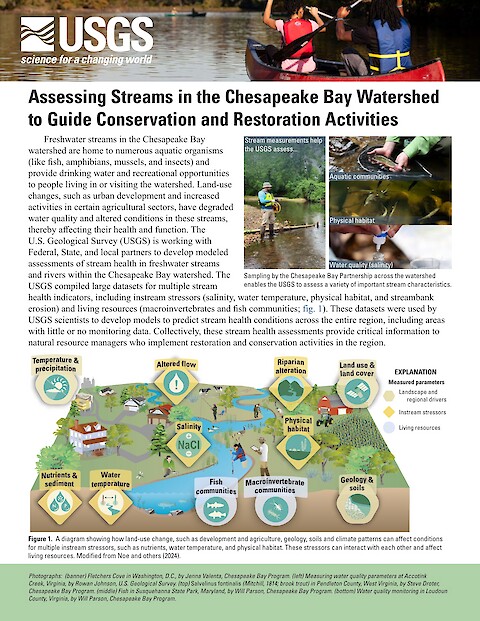
Freshwater streams in the Chesapeake Bay watershed are home to numerous aquatic organisms (like fish, amphibians, mussels, and insects) and provide drinking water and recreational opportunities to people living in or visiting the watershed. Land-use changes, such as urban development and increased activities in certain agricultural sectors, have degraded water quality and altered conditions in these streams, thereby affecting their health and function. The U.S. Geological Survey (USGS) is working with Federal, State, and local partners to develop modeled assessments of stream health in freshwater streams and rivers within the Chesapeake Bay watershed. The USGS compiled large datasets for multiple stream health indicators, including instream stressors (salinity, water temperature, physical habitat, and streambank erosion) and living resources (macroinvertebrates and fish communities; fig. 1). These datasets were used by USGS scientists to develop models to predict stream health conditions across the entire region, including areas with little or no monitoring data. Collectively, these stream health assessments provide critical information to natural resource managers who implement restoration and conservation activities in the region.
The fact sheet can also be found here on the USGS website.
Keywords: