Publications about South East Queensland

IAN is committed to producing practical, user-centered communications that foster a better understanding of science and enable readers to pursue new opportunities in research, education, and environmental problem-solving. Our publications synthesize scientific findings using effective science communication techniques.
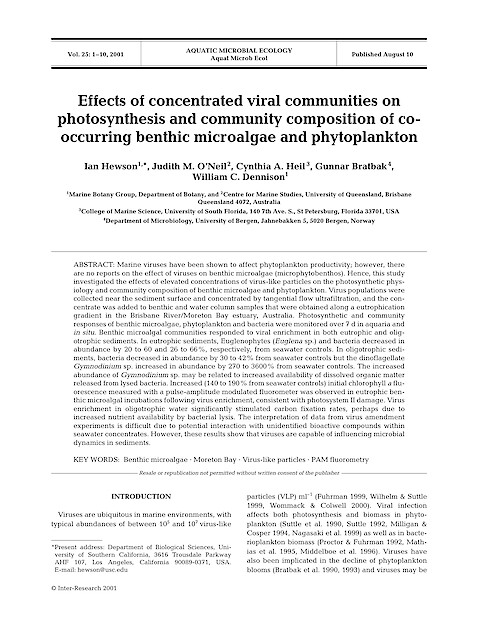
Effects of concentrated viral communities on photosynthesis and community composition of co-occurring benthic microalgae and phytoplankton (Page 1)

Effects of concentrated viral communities on photosynthesis and community composition of co-occurring benthic microalgae and phytoplankton

Hewson I, O'Neil JM, Heil CA, Bratbak G, and Dennison WC ·

Marine viruses have been shown to affect phytoplankton productivity; however, there are no reports on the effect of viruses on benthic microalgae (microphytobenthos). Hence, this study investigated the effects of elevated concentrations of virus-like particles on the photosynthetic physiology and community composition of benthic microalgae and phytoplankton.

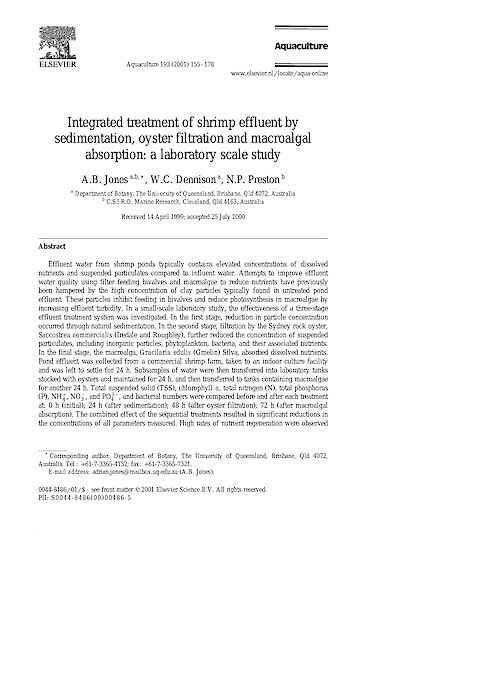
Integrated treatment of shrimp effluent by sedimentation, oyster filtration and macroalgal absorption: a laboratory scale study (Page 1)

Integrated treatment of shrimp effluent by sedimentation, oyster filtration and macroalgal absorption: a laboratory scale study

Jones AB, Dennison WC, and Preston NP ·

Effluent water from shrimp ponds typically contains elevated concentrations of dissolved nutrients and suspended particulates compared to influent water. Attempts to improve effluent water quality using filter feeding bivalves and macroalgae to reduce nutrients have previously been hampered by the high concentration of clay particles typically found in untreated pond effluent. These particles inhibit feeding in bivalves and reduce photosynthesis in macroalgae by increasing effluent turbidity.

Physiological responses of five seagrass species to trace metals (Page 1)

Physiological responses of five seagrass species to trace metals

Prange JA and Dennison WC ·

Trace metal run-off associated with urban and industrial development poses potential threats to seagrasses in adjacent coastal ecosystems, Seagrass from the largest urban (Moreton Bay) and industrial (Port Curtis) coastal regions in Queensland, Australia were assessed for metal concentrations of iron (Fe), aluminium (Al), zinc (Zn), chromium (Cr) and copper (Cu), Trace metal concentrations in seagrass (Zostera capricorni) leaf and root-rhizome tissue had the following overall trend:

The impact of the herbicide diuron on photosynthesis in three species of tropical seagrass (Page 1)

The impact of the herbicide diuron on photosynthesis in three species of tropical seagrass

Haynes D, Ralph P, Prange J, and Dennison WC ·

The impact and recovery from exposure to the herbicide diuron [DCMU; 3-(3′,4′-dichlorophenyl)-1,1-dimethylurea] was assessed for three tropical seagrasses, maintained in outdoor aquaria over a 10-day period. Photosynthetic stress was detected using chlorophyll a fluorescence, measured with a Diving-PAM (pulse amplitude modulated fluorometer).

Blooms of the cyanobacterium Lyngbya majuscula in coastal waters of Queensland, Australia (Page 1)

Blooms of the cyanobacterium Lyngbya majuscula in coastal waters of Queensland, Australia

Dennison WC, O'Neil JM, Duffy EJ, Oliver PE, and Shaw GR ·

Several coastal areas in southeast Queensland, Australia have been affected by blooms of the cyanobacterium Lyngbya majuscula Gomont ("Mermaid hair"). Lyngbya majuscula blooms have caused respiratory irritation, eye inflammation and severe contact dermatitis in fisherman and swimmers as well as causing reduced fish catch, seagrass loss and localized inputs of nitrogen through nitrogen fixation.

Effects of light deprivation on the survival and recovery of the seagrass Halophila ovalis (RBr) Hook (Page 1)

Effects of light deprivation on the survival and recovery of the seagrass Halophila ovalis (RBr) Hook

Longstaff BJ, Loneragan NR, O'Donohue MJ, and Dennison WC ·

Survival and recovery of the seagrass Halophiln ovalis (R.Br.) Hook during and after light deprivation was investigated to assist in the interpretation of recent losses of Halophiln spp. in Queensland, Australia. Light deprivation experiments were conducted in outdoor aquaria and in situ at two water depths. Halophiln ovalis plants were deprived of light for a maximum of 30 days, and recovery processes were investigated for up to 18 days following 15 days of light deprivation.

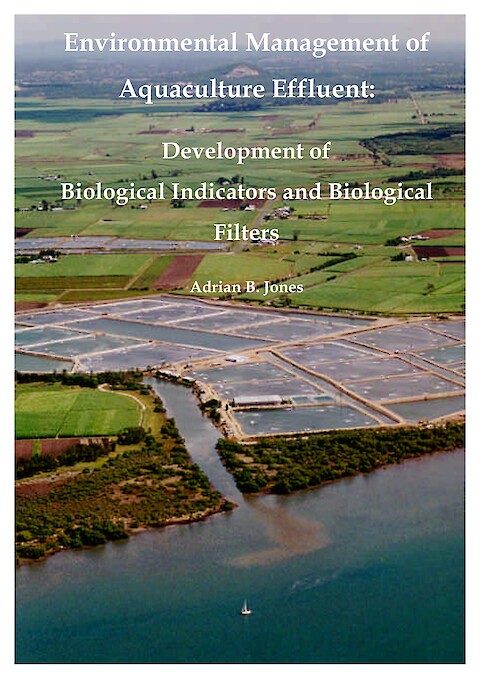
Environmental Management of Aquaculture Effluent: Development of Biological Indicators and Biological Filters (Page 1)

Environmental Management of Aquaculture Effluent: Development of Biological Indicators and Biological Filters

Jones AB ·

Rapid global expansion of the aquaculture industry has prompted the need for development of techniques for effective environmental management. In intensively farmed regions, aquaculture effluent has resulted in environmental degradation of receiving waters. The issues to be addressed include analysis of effluent water quality, determination of the ecological impact of effluent on the ecosystem, and development of remediation strategies to reduce these impacts.