IAN is committed to producing practical, user-centered communications that foster a better understanding of science and enable readers to pursue new opportunities in research, education, and environmental problem-solving. Our publications synthesize scientific findings using effective science communication techniques.
Towle EK, Donovan EC, Kelsey RH, Allen ME, Barkley H, Blondeau J, Brainard RE, Carew A, Couch CS, Dillard MK, Eakin CM, Edwards K, Edwards PET, Enochs IC, Fleming CS, Fries AS, Geiger EF, Grove LJ, Groves SH, Gorstein M, Heenan A, Johnson MW, Kimball J, Koss JL, Kindinger T, Levine A, Manzello DP, Miller N, Oliver T, Samson JC, Swanson D, Vargas-Ángel B, Viehman TS and Williams ID ·
National Oceanic and Atmospheric Administration’s Coral Reef Conservation Program supports the National Coral Reef Monitoring Program (NCRMP) in the United States Pacific, Atlantic, Caribbean, and Gulf of Mexico.
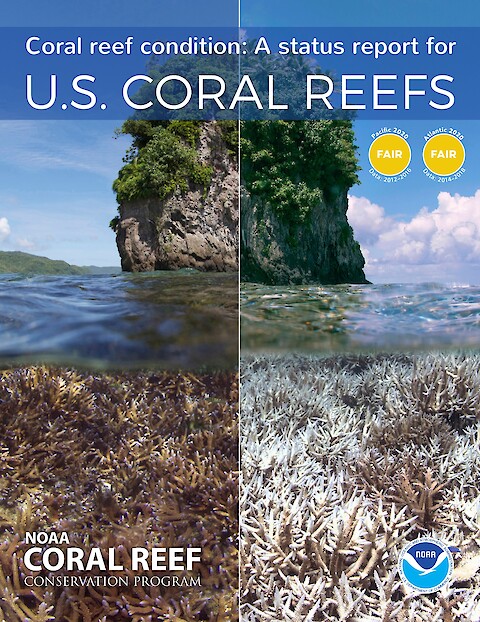
Donovan EC, Towle E, Kelsey RH, Allen M, Barkley H, Besemer N, Blondeau J, Eakin M, Edwards K, Enochs I, Fleming C, Geiger E, Grove LJ, Groves S, Johnson M, Johnston M, Kindinger T, Manzello D, Miller M, Oliver T, Samson J, and Viehman S. ·
Pacific and Atlantic data from 2012–2018 indicate that U.S. coral reefs are in fair condition. Most themes did not meet their historical references, meaning they are moderately to very impacted. There are exceptions, but overall, the data suggest that reefs are vulnerable to further decline due to threats from ocean warming and acidification, coral disease, and fishing impacts. Download the document to learn more about U.S. Coral Reef condition.
Donovan EC, Towle EK, Blondeau J, Eakin M, Edwards K, Edwards P, Enochs I, Fleming C, Formel N, Geiger E, Gorstein M, Grove J, Groves S, Johnson M, Kelsey RH, Manzello D, Miller N, and Viehman S ·
The primary purpose of this document is to describe the scoring process used for all the Atlantic jurisdictions: Florida, the United States Virgin Islands (USVI), Puerto Rico, and the Flower Garden Banks.
Jeremiah Blondeau, Marilyn Brandt,
Mark Eakin, Kimberly Edwards, Kitty Edwards, Peter
Edwards, Ian Enochs, Mike Feeley, Chloe Fleming, Nate
Formel, Erick Geiger, Matt Gorstein, Jay Grove, Sarah
Groves, Leslie Henderson, Marlon Hibbert, Nathaniel
Holloway, Matt Johnson, Thomas Kelley, Heath Kelsey,
Jennifer Koss, Derek Manzello, Caroline
Pott, Tyler Smith, Erica Towle, Shay Viehman. ·
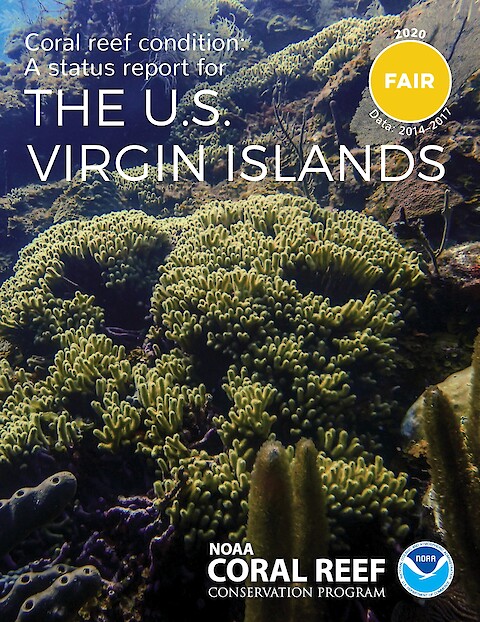
Effective coral reef conservation cannot be accomplished without an informed and engaged public. This status report is part of an ongoing series of documents to track the status and trends of coral reefs across the U.S. and its territories. The USVI coral status report is part of a larger effort to provide the public and decision-makers with information about managing and conserving coral reef ecosystems.
In 2015, the National Climate Adaptation Science Center began working with each regional Climate Adaptation Science Center (CASC) to implement a network-wide initiative aimed at identifying what we know about the impacts of drought on ecosystems across the country. A key component of this initiative was the implementation of eight regional ecological drought workshops.
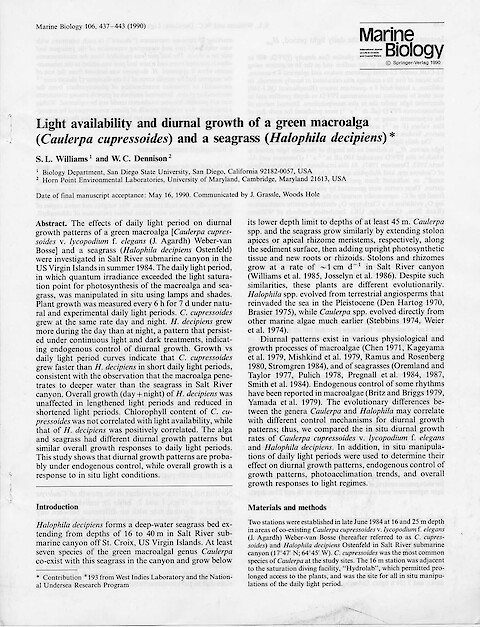
The effects of daily light period on diurnal growth patterns of a green macroalga [Caulerpa cupressoides v. lycopodium f. elegans (J. Agardh) Weber-van Bosse] and a seagrass (Halophila decipiens Ostenfeld) were investigated in Salt River submarine canyon in the US Virgin Islands in summer 1984. The daily light period, in which quantum irradiance exceeded the light saturation point for photosynthesis of the macroalga and seagrass, was manipulated in situ using lamps and shades.