Publications about Worldwide

IAN is committed to producing practical, user-centered communications that foster a better understanding of science and enable readers to pursue new opportunities in research, education, and environmental problem-solving. Our publications synthesize scientific findings using effective science communication techniques.
Measuring and Reporting on Seagrass as an Essential Ocean Variable for Science and Management

Duffy JE, Appeltans W, Benson A, Connolly RM, de la Torre-Castro M, Dierssen HM, Fortes MD, Fourqurean JW, Hessing-Lewis M, Jarvis JC, Kenworthy WJ, Krause JR, Lopez AL, Lefcheck JS, Lizcano-Sandoval L, Lonneman M, McKenzie L, Muller-Karger FE, Nakaoka M, Nordlund LM, Provoost P, Roelfsema CM, and Unsworth RKF ·

To effectively manage and protect ocean life and the people who depend on it, we need coordinated, comparable observations of ocean biodiversity. Seagrass cover and composition is an essential ocean variable (EOV) of the Global Ocean Observing System because seagrasses are the foundation of coastal ecosystems worldwide, and support diverse marine life and ecosystem services.

Evaluating Methods to Enhance Oyster Production with Alternative Substrates, Retrofits, and Hatchery Holding Times

A Report to the Maryland General Assembly, Governor, and Secretary of Natural Resources in Response to Senate Bill 830 (2022)

North, E., M. W. Gray, M. Fabra, J. Shaner, C. Keitzer, and R. Nair-Gonzalez ·

This report is in response to Senate Bill 830 (2022) that instructed the University of Maryland Center … for Environmental Science (UMCES) to evaluate the following topics in collaboration with Smithsonian … Environmental Research Center, Virginia Institute of Marine Science, appropriate State and federal … agencies, and industry and other stakeholders:

Key controls on nutrient retention efficiency in vegetated buffer strips: A global meta-analysis (Page 1)

Key controls on nutrient retention efficiency in vegetated buffer strips: A global meta-analysis

Pan Y, Zhang Z, Cheng Z, Pan Z, Zhou J, Hu M, Zhang Q, and Chen D ·

Vegetated buffer strips (VBS) are widely used to mitigate agricultural non-point source pollution yet reported retention efficiencies vary considerably across different landscapes. We synthesized 409 observations extracted from 91 peer-reviewed publications to evaluate critical determinants of VBS retention efficiency for agricultural runoff, focusing specifically on total nitrogen (TN), total phosphorus (TP), and total suspended solids (TSS).

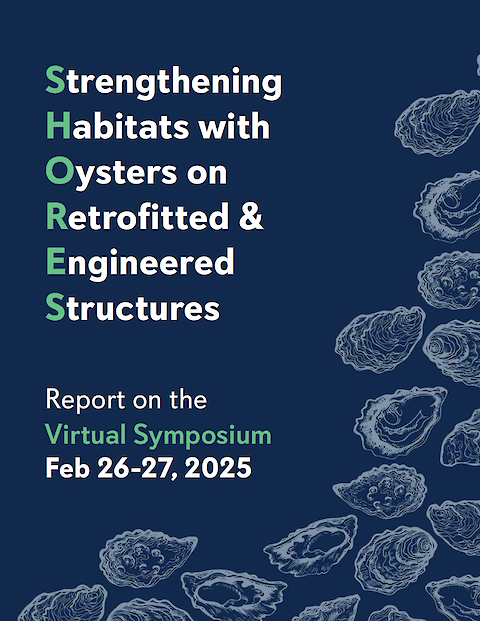
Strengthening Habitats with Oysters on Retrofitted & Engineered Structures

Report on the Virtual Symposium Feb 26-27, 2025

Matthew Gray, Elizabeth North, William Nardin, Monica Fabra, Kurt Florez, Conor Keitzer, Roshni Nair-Gonzalez, and David Nemazie ·

Structures (SHORES) is part of an effort to fill key knowledge gaps in support of Maryland’s … oyster resource and oyster industries. Chesapeake Bay is home to thriving commercial fishing and … aquaculture industries and one of the largest oyster restoration efforts in North America. The lack of … fresh shell substrate has become a major impediment to all of these activities and alternatives are … being considered for large-scale use in restoration and industry efforts.

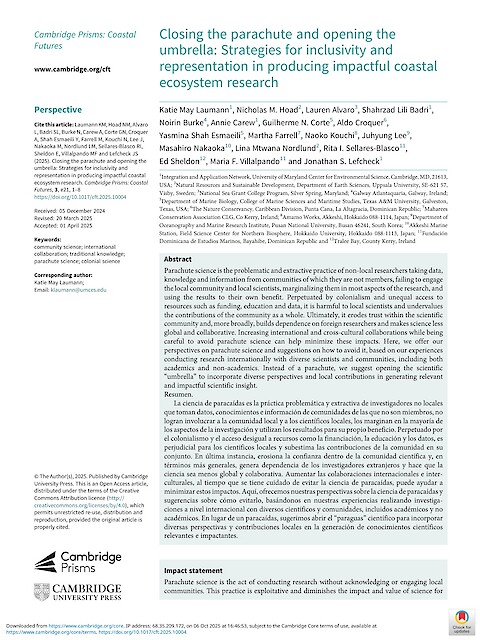
Closing the parachute and opening the umbrella: Strategies for inclusivity and representation in producing impactful coastal ecosystem research (Page 1)

Closing the parachute and opening the umbrella: Strategies for inclusivity and representation in producing impactful coastal ecosystem research

Laumann KM, Hoad NM, Alvaro L, Badri SL, Burke N, Carew A, Corte GN, Croquer A, Shah Esmaeili Y, Farrell M, Kouchi N, Lee J, Nakaoka M, Nordlund LM, Sellares-Blasco RI, Sheldon E, Villalpando MF, and Lefcheck JS ·

Parachute science is the problematic and extractive practice of non-local researchers taking data, knowledge and information from communities of which they are not members, failing to engage the local community and local scientists, marginalizing them in most aspects of the research, and using the results to their own benefit.

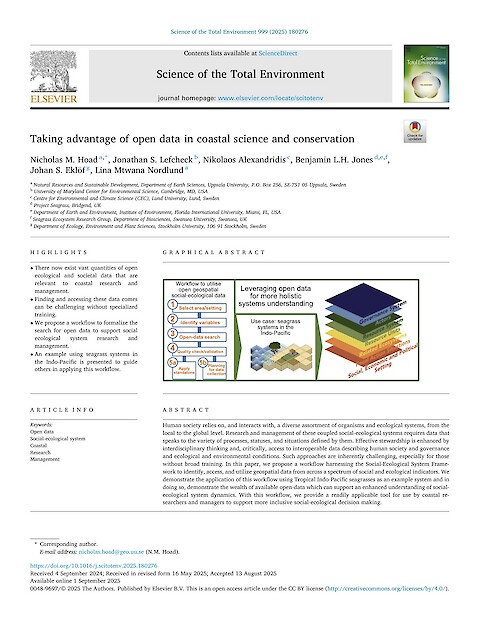
Taking advantage of open data in coastal science and conservation (Page 1)

Taking advantage of open data in coastal science and conservation

Hoad NM, Lefcheck JS, Alexandridis N, Jones BLH, Eklöf JS, and Nordlund LM ·

Human society relies on, and interacts with, a diverse assortment of organisms and ecological systems, from the local to the global level. Research and management of these coupled social-ecological systems requires data that speaks to the variety of processes, statuses, and situations defined by them. Effective stewardship is enhanced by interdisciplinary thinking and, critically, access to interoperable data describing human society and governance and ecological and environmental conditions.

OLIGOTREND, a global database of multi-decadal chlorophyll a and water quality time series for rivers, lakes, and estuaries (Page 1)

OLIGOTREND, a global database of multi-decadal chlorophyll a and water quality time series for rivers, lakes, and estuaries

Minaudo C, Abonyi A, Alcaraz C, Diamond J, Howden NJK, Rode M,Romero E, Thieu V, Worrall F, Zhang Q, and Benito X ·

Many waterbodies undergo nutrient decline, called oligotrophication, globally, but a comprehensive dataset to understand ecosystem responses is lacking. The OLIGOTREND database comprises multi-decadal chlorophyll a and nutrient time series from rivers, lakes, and estuaries with 4.3 million observations from 1894 unique measurement locations. The database provides empirical evidence for oligotrophication responses with a spatial and temporal coverage that exceeds previous efforts.

Biotic Mechanisms Strengthen Functional and Phylogenetic Convergence of Reef Fish Assemblages at Higher Latitudes (Page 1)

Biotic Mechanisms Strengthen Functional and Phylogenetic Convergence of Reef Fish Assemblages at Higher Latitudes

Bosch NE, Stuart-Smith RD, Laumann KM, Edgar GJ, Waldock C, Duffy JE, and Lefcheck JS ·

How communities of organisms come together has long fascinated scientists, with renewed interest in using functional and evolutionary patterns to infer mechanisms of community assembly. Ecological theory predicts that biotic interactions could lead to either divergence in the event of niche partitioning or convergence through the exclusion of competitively inferior species, but most macroecological studies attribute the latter to environmental influences.