Publications about Worldwide

IAN is committed to producing practical, user-centered communications that foster a better understanding of science and enable readers to pursue new opportunities in research, education, and environmental problem-solving. Our publications synthesize scientific findings using effective science communication techniques.
A Global Crisis for Seagrass Ecosystems (Page 1)

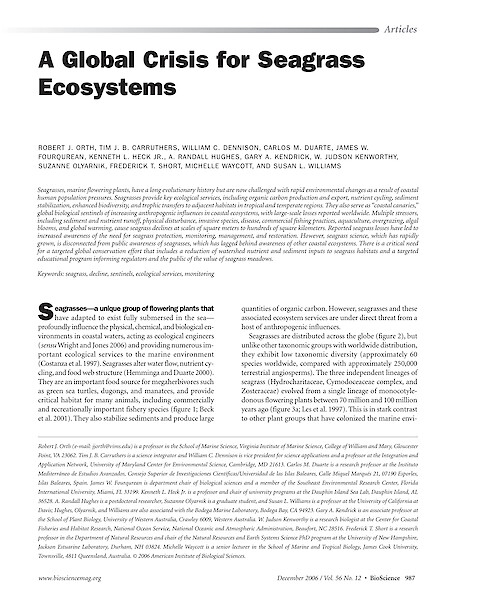
A Global Crisis for Seagrass Ecosystems

Orth RJ, Carruthers TJB, Dennison WC, Duarte CM, Fourqurean JW, Heck KL Jr, Hughes AR, Kendrick GA, Kenworthy WJ, Olyarnik S, Short FT, Waycott M, and Williams SL ·

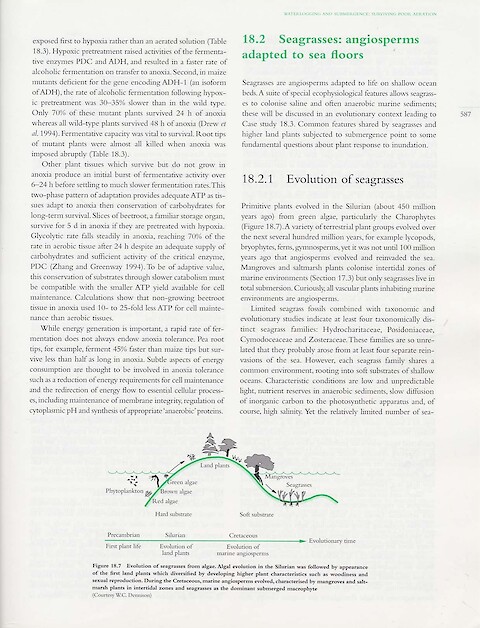
Seagrasses, marine flowering plants, have a long evolutionary history but are now challenged with rapid environmental changes as a result of coastal human population pressures. Seagrasses provide key ecological services, including organic carbon production and export, nutrient cycling, sediment stabilization, enhanced biodiversity, and trophic transfers to adjacent habitats in tropical and temperate regions.

Communicating Science Effectively: A Practical Handbook for Integrating Visual Elements

Thomas JE, Saxby TA, Jones AB, Carruthers TJB, Abal EG, and Dennison WC ·

This is a practical handbook on how to communicate science effectively. The first part is an introduction to the principles of science communication-what effective science communication is, why it is important, and how effective science communication can change societal paradigms and make one a better scientist.

NFCC Consensus Statement on Integrating Marine Reserve Science and Fisheries Management (Page 1)

NFCC Consensus Statement on Integrating Marine Reserve Science and Fisheries Management

Boesch, D ·

The National Fisheries Conservation Center convened the meeting (chaired by Dr. Don Boesch, president of the University of Maryland Center for Environmental Science) to bring together modelers, ecologists, fishermen, stock assessment scientists and other analysts to try to produce a more integrated theoretical basis for designing, managing and monitoring marine reserves as part of the fishery management system.

Phragmites: Native or Introduced (Page 1)

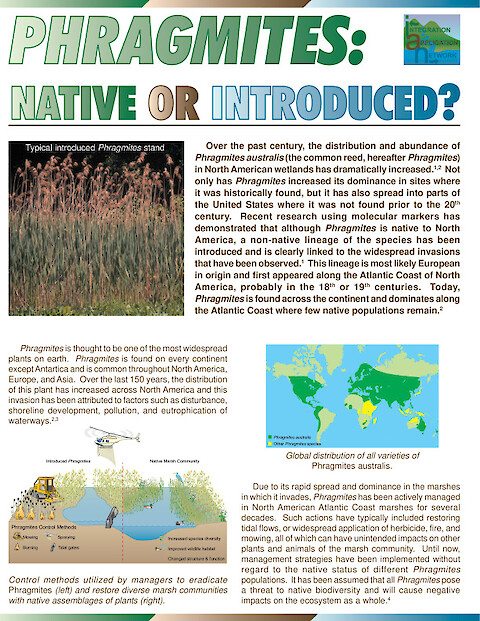
Phragmites: Native or Introduced

Tracey Saxby ·

This newsletter describes the historical distributions of both native and introduced Phragmites. It details the invasion of the introduced type in North America (determined through genetic analysis), and morphological differences between the native and introduced types, as well as some commonly used control methods and their associated problems. Phragmites is thought to be one of the most widespread plants on earth.

Coastal and marine ecosystems: Potential Effects on U.S. Resources & Global climate change (Page 1)

Coastal and marine ecosystems: Potential Effects on U.S. Resources & Global climate change

Kennedy VS, Twilley RR, Kleypas JA, Cowan JH Jr. and Hare SR ·

This is the eighth in a series of Pew Center reports examining the potential impacts of climate change on the U.S. environment. It details the likely impacts of climate change over the next century on U.S. coastal and marine ecosystems, including estuaries, coral reefs, and the open ocean. Coordinator: Dr Victor Kennedy … • Temperature changes in coastal and marine ecosystems will influence organism metabolism and alter ecological processes such as productivity and species interactions.