IAN is committed to producing practical, user-centered communications that foster a better understanding of science and enable readers to pursue new opportunities in research, education, and environmental problem-solving. Our publications synthesize scientific findings using effective science communication techniques.
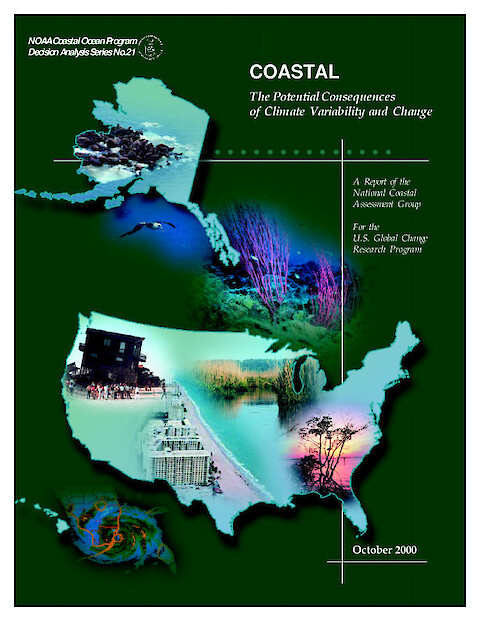
This report, released by the Coastal Ocean Program of the National Oceanic and Atmospheric Administration (NOAA) as part of the U.S. National Assessment on global climate change, details the potential impacts of climate change on coastal and marine resources of the United States. Coordinator: Dr. Donald F. Boesch.
Zhang X, Roman M, Sanford A, Adolf H, Lascara C, and Burgett R ·
The Optical Plankton Counter (OPC) has been used in oceanic and fresh waters to estimate zooplankton abundance and biovolume. However, it is not clear whether the OPC can produce accurate estimates of zooplankton abundance and biovolume in waters with high detritus.
Hansen JW, Udy JW, Perry CJ, Dennison WC, and Lomstein BA ·
The effect of the seagrass Zostera capricorni on sediment microbial processes was studied in a tank experiment, where vegetated and unvegetated control sediments were incubated in 10 and 50% of incident light. Leaf and root-rhizome biomass, shoot density, and leaf productivity were significantly higher when plants were incubated in 50 % than in 10 % of incident Light.
Trace metal run-off associated with urban and industrial development poses potential threats to seagrasses in adjacent coastal ecosystems, Seagrass from the largest urban (Moreton Bay) and industrial (Port Curtis) coastal regions in Queensland, Australia were assessed for metal concentrations of iron (Fe), aluminium (Al), zinc (Zn), chromium (Cr) and copper (Cu), Trace metal concentrations in seagrass (Zostera capricorni) leaf and root-rhizome tissue had the following overall trend:
Arnold RR, Cornwell JC, Dennison WC, and Stevenson JC ·
A paleo-ecological reconstruction of long-term changes in the distribution of submersed aquatic Vegetation (SAV) in a Chesapeake sub-estuary was made using dated sediment cores on transects going from shallow (< 0.5 m) to deep (> 2 m) waters. Maynedier and Saltworks Creeks, branches of the Severn River, have had substantial losses of SAV, similar to many parts of the upper Chesapeake Bay.
The impact and recovery from exposure to the herbicide diuron [DCMU; 3-(3′,4′-dichlorophenyl)-1,1-dimethylurea] was assessed for three tropical seagrasses, maintained in outdoor aquaria over a 10-day period. Photosynthetic stress was detected using chlorophyll a fluorescence, measured with a Diving-PAM (pulse amplitude modulated fluorometer).
Water samples were collected within river mouths, at river plume sites and at well flushed ocean-influenced sites within Moreton Bay, a shallow subtropical embayment in south-eastern Queensland. Rates of inorganic nitrogen (NH4+ and NO3-) and carbon uptake were determined across temporal and spatial scales by use of N-15 and C-14 incorporation. Phytoplankton productivity, measured as CO2 uptake, was highest at the river mouths.
Baker JE, Boesch DF, Boicourt WC, Boynton WR, Chao SY, Cornwell JC, Fisher TR, Houde ED, Kennedy VS, Mason RP, Mihursky JA, Miller TJ, Sanford LP, Secor DH, Stevenson JC and Wright DA ·
Scientists from the University of Maryland Center for Environmental Science have evaluated the scientific understanding and uncertainty related to five issues regarding the environmental effects of placement of dredged sediments at Site 104, at the head of the deep, natural channel of the Chesapeake Bay. This assessment was based on reviews of relevant studies and impact statements as well as on the scientists’ extensive knowledge and experience concerning the Chesapeake Bay ecosystem.
Dennison WC, O'Neil JM, Duffy EJ, Oliver PE, and Shaw GR ·
Several coastal areas in southeast Queensland, Australia have been affected by blooms of the cyanobacterium Lyngbya majuscula Gomont ("Mermaid hair"). Lyngbya majuscula blooms have caused respiratory irritation, eye inflammation and severe contact dermatitis in fisherman and swimmers as well as causing reduced fish catch, seagrass loss and localized inputs of nitrogen through nitrogen fixation.
Dennison WC, O' Neil JM, Jones AB, Costanzo SD, Hewson I, and Prange JA ·
Soil disturbance in coastal regions could be linked to a variety of deleterious environmental impacts. The existing data are preliminary, but there is sufficient evidence to raise the issue to a higher priority for both research and management.