IAN is committed to producing practical, user-centered communications that foster a better understanding of science and enable readers to pursue new opportunities in research, education, and environmental problem-solving. Our publications synthesize scientific findings using effective science communication techniques.

Developing a Chesapeake Bay Report Card (Page 1)

Developing a Chesapeake Bay Report Card

Adrian Jones, Jane Thomas ·

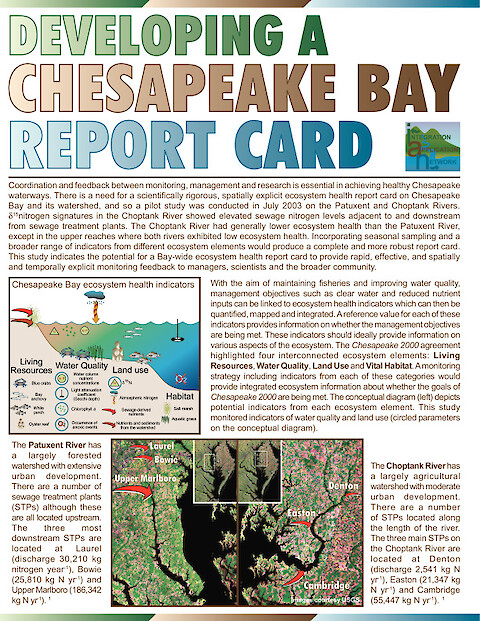
This newsletter details the importance of developing a scientifically rigorous, spatially explicit ecosystem health report card on Chesapeake Bay and its watershed to facilitate coordination and feedback between monitoring, management and research. A pilot study was conducted in July 2003 on the Patuxent and Choptank Rivers using a novel stable isotope technique (see "Assessing Nutrient Sources" newsletter below) together with more traditional water quality monitoring techniques.

Phragmites: Native or Introduced (Page 1)

Phragmites: Native or Introduced

Tracey Saxby ·

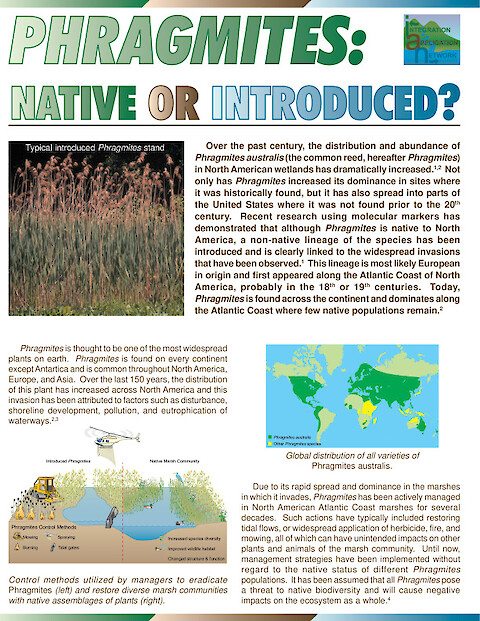
This newsletter describes the historical distributions of both native and introduced Phragmites. It details the invasion of the introduced type in North America (determined through genetic analysis), and morphological differences between the native and introduced types, as well as some commonly used control methods and their associated problems. Phragmites is thought to be one of the most widespread plants on earth.

Conceptual Diagrams: Tools for Science Communication (Page 1)

Conceptual Diagrams: Tools for Science Communication

Adrian Jones, Tracey Saxby ·

This newsletter details the use of symbols as a visual language. Symbols are useful for depicting unequivocal messages that transcend cultures, languages and times. The use of symbols to contruct conceptual diagrams ('thought drawings') can be an effective tool for science communication and problem solving. Conceptual diagrams help to clarify thinking and provide a communication interface between scientists and non-scientists.

Seagrass habitats of Bocas del Toro province: a balance between river, mangrove and coral influences (Page 1)

Seagrass habitats of Bocas del Toro province: a balance between river, mangrove and coral influences

Tim Carruthers ·

This poster summarizes the key features of the seagrass communites in the Bocas del Toro archipelago, Panama. Seagrass meadows within this region are strongly influenced by their proximity to coral reefs, mangrove forests and coastal rivers. Reef, mangrove and river inputs influence sediment type and water clarity, two very important factors affecting the occurrence and abundance of seagrass meadows.

Assessing Nutrient Sources (Page 1)

Assessing Nutrient Sources

Adrian Jones, Tracey Saxby ·

This IAN newsletter explores the assessment of nutrient sources using stable isotope signatures of various marine organisms. This technique was developed in Moreton Bay, Australia for mapping sewage plumes, and was also used to determine the extent of aquaculture effluent (shrimp ponds) and to distinguish agricultural runoff (sugar cane) from other sources. The stable isotope ratio of nitrogen in organisms can be used to determine the influence of different nitrogen sources.

University of Maryland Center for Environmental Science: History, Mission & Accomplishments (Page 1)

University of Maryland Center for Environmental Science: History, Mission & Accomplishments

Dave Nemazie, Bill Dennison, Tracey Saxby ·

This newsletter is a summary of the history, mission and accomplishments of the University of Maryland Center for Environmental Science (UMCES). This summary has been prepared to provide a sense of where we have come from, what we are doing and where we are going. It also serves to identify the collaborative role UMCES plays within the University System and the State of Maryland.

Dynamic parameterization to simulate DIN export due to gypsy moth defoliation

Wang P, Linker LC, and Eshleman KN ·

A module of dynamic parameterization is added into the HSPF watershed software for simulation of dissolved inorganic nitrogen (DIN) export from forest associated with gypsy moth defoliation. It simulates a changing ecosystem following the breakout of defoliation, such as increasing mineralization and nitrification rates and soil temperature, and decreasing interception of precipitation, plant nitrogen uptake rate and evapotranspiration.

Photosynthetic responses of the coral Montipora digitata to cold temperature stress (Page 1)

Photosynthetic responses of the coral Montipora digitata to cold temperature stress

Saxby TA, Dennison WC, and Hoegh-Guldberg O ·

Coral bleaching events have become more frequent and widespread, largely due to elevated sea surface temperatures. Global climate change could lead to increased variability of sea surface temperatures, through influences on climate systems, e.g. El Nino Southern Oscillation (ENSO). Field observations in 1999, following a strong ENSO, revealed that corals bleached in winter after unusually cold weather.

Using multiple antibiotic resistance and land use characteristics to determine sources of fecal coliform bacterial pollutiion (Page 1)

Using multiple antibiotic resistance and land use characteristics to determine sources of fecal coliform bacterial pollutiion

Kelsey RH, Scott GI, Porter DE, Thompson B, and Webster L ·

Multiple Antibiotic Resistance ( MAR) analysis and regression modeling techniques were used to identify surface water areas impacted by fecal pollution from human sources, and to determine the effects of land use on fecal pollution in Murrells Inlet, a small, urbanized, high-salinity estuary located between Myrtle Beach and Georgetown, South Carolina. MAR analysis was performed to identify areas in the estuary that are impacted by human-source fecal pollution.