IAN is committed to producing practical, user-centered communications that foster a better understanding of science and enable readers to pursue new opportunities in research, education, and environmental problem-solving. Our publications synthesize scientific findings using effective science communication techniques.

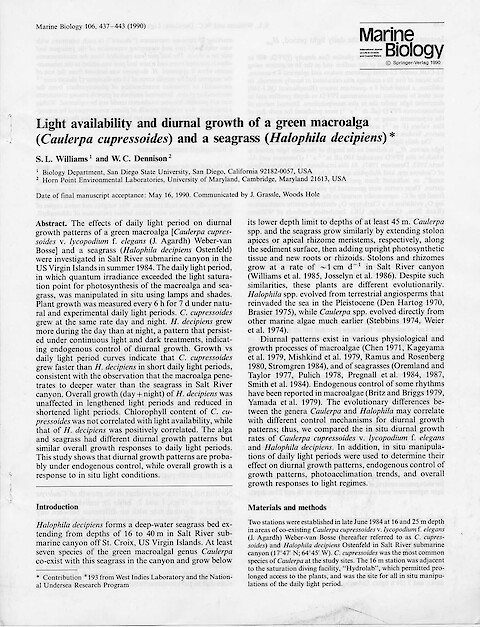
Light Availability and Diurnal Growth of a Green Macroalga (Caulerpa-Cupressoides) and a Seagrass (Halophila-Decipiens) (Page 1)

Light Availability and Diurnal Growth of a Green Macroalga (Caulerpa-Cupressoides) and a Seagrass (Halophila-Decipiens)

Williams SL and Dennison WC ·

The effects of daily light period on diurnal growth patterns of a green macroalga [Caulerpa cupressoides v. lycopodium f. elegans (J. Agardh) Weber-van Bosse] and a seagrass (Halophila decipiens Ostenfeld) were investigated in Salt River submarine canyon in the US Virgin Islands in summer 1984. The daily light period, in which quantum irradiance exceeded the light saturation point for photosynthesis of the macroalga and seagrass, was manipulated in situ using lamps and shades.

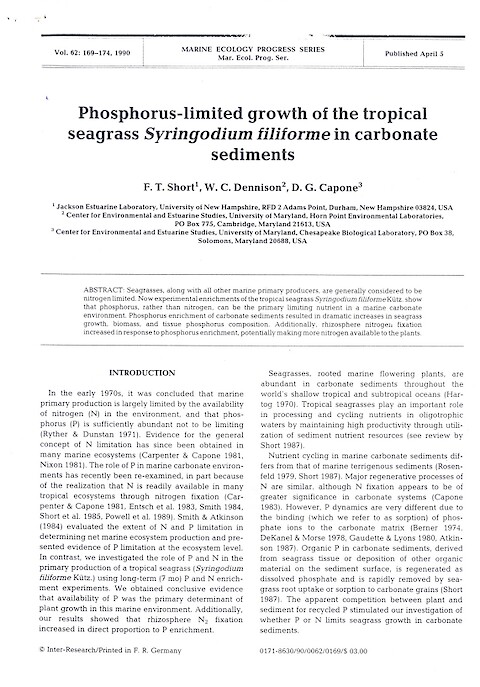
Phosphorus-Limited Growth of the Tropical Seagrass Syringodium-Filiforme in Carbonate Sediments (Page 1)

Phosphorus-Limited Growth of the Tropical Seagrass Syringodium-Filiforme in Carbonate Sediments

Short FT, Dennison WC, and Capone DG ·

Seagrasses, along with all other marine primary producers, are generally considered to be nitrogen limited. Now experimental enrichments of the tropical seagrass Syringodium filiforme Kütz. show that phosphorus, rather than nitrogen, can be the primary limiting nutrient in a marine carbonate environment. Phosphorus enrichment of carbonate sediments resulted in dramatic increases in seagrass growth, biomass, and tissue phosphorus composition.

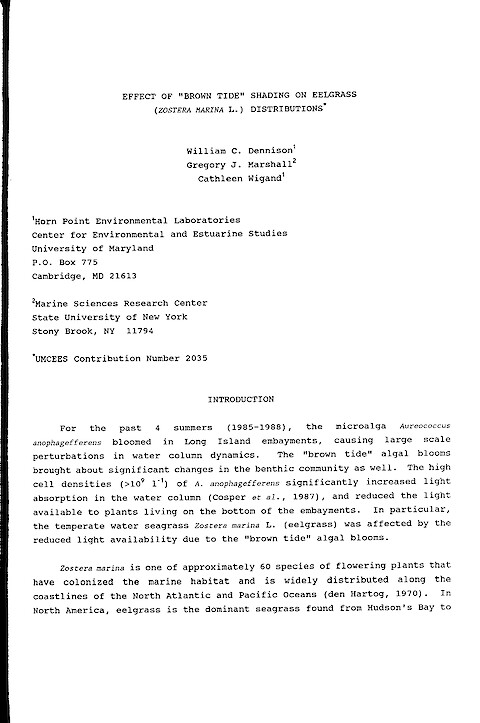
Effect of

Effect of 'brown tide' shading on eelgrass

Dennison WC, Marshall GJ, and Wigand C ·

For the past 4 summers (1985–1988), the microalga Aureococcus anophagefferens bloomed in Long Island embayments, causing large scale perturbations in water column dynamics. The “brown tide” algal blooms brought about significant changes in the benthic community as well. The high cell densities (>109 l-1) of A. anophagefferens significantly increased light absorption in the water column (Cosper et al., 1987), and reduced the light available to plants living on the bottom of the embayments.

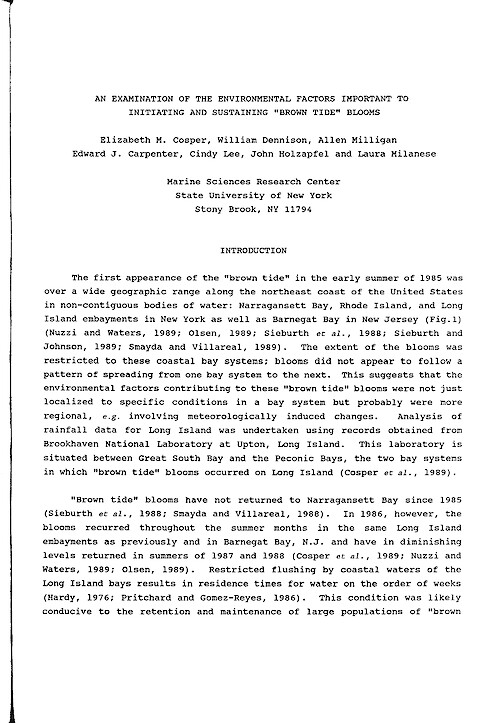
An examination of the environmental factors important to initiating and sustaining

An examination of the environmental factors important to initiating and sustaining 'brown tide' blooms

Cosper EM, Dennison WC, Milligan A, Carpenter EJ, Lee C, Holzapfel J, and Milanese L ·

The first appearance of the “brown tide” in the early summer of 1985 was over a wide geographic range along the northeast coast of the United States in non-contiguous bodies of water: Narragansett Bay, Rhode Island, and Long Island embayments in New York as well as Barnegat Bay in New Jersey (Fig.1) (Nuzzi and Waters, 1989; Olsen, 1989; Sieburth et al., 1988; Sieburth and Johnson, 1989; Smayda and Villareal, 1989).

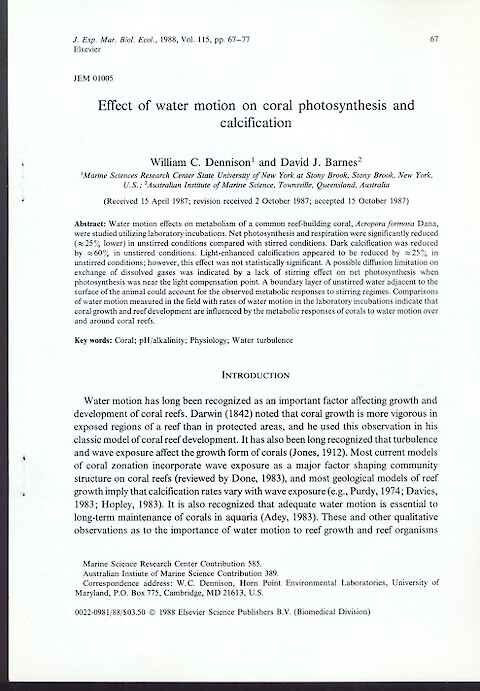
Effect of Water Motion on Coral Photosynthesis and Calcification (Page 1)

Effect of Water Motion on Coral Photosynthesis and Calcification

Dennison WC and Barnes DJ ·

Water motion effects on metabolism of a common reef-building coral, Acropora formosa Dana, were studied utilizing laboratory incubations. Net photosynthesis and respiration were significantly reduced (≈ 25% lower) in unstirred conditions compared with stirred conditions. Dark calcification was reduced by ≈60% in unstirred conditions. Light-enhanced calcification appeared to be reduced by ≈ 25% in unstirred conditions; however, this effect was not statistically significant.

Effects of Light on Seagrass Photosynthesis, Growth and Depth Distribution

Dennison WC ·

The relationships between light regime, photosynthesis, growth and depth distribution of a temperate seagrass, Zostera marina L. (eelgrass), were investigated in a subtidal eelgrass meadow near Woods Hole, MA. The seasonal light patterns in which the quantum irradiance exceeded the light compensation point (Hcomp) and light saturation point (Hsat) for eelgrass photosynthesis were determined.

Sediment Ammonium Availability and Eelgrass (Zostera marina) Growth

Dennison WC, Aller RC, and Alberte RS ·

The interaction of sediment ammonium (NH+4) availability and eelgrass (Zostera marina L.) growth, biomass and photosynthesis was investigated using controlled environment and in-situ manipulations of pore water ammonium concentrations. Sediment diffusers were used to create pore water diffusion gradients to fertilize and deplete ammonium levels in sediments with intact eelgrass rhizospheres.

Photoadaptation and Growth of Zostera marina L (Eelgrass) Transplants Along a Depth Gradient (Page 1)

Photoadaptation and Growth of Zostera marina L (Eelgrass) Transplants Along a Depth Gradient

Dennison WC and Alberte RS ·

Photosynthetic and growth responses were assessed in Zostera marina L. transplants within and beyond the natural extent of an eelgrass meadow in Great Harbor, Woods Hole, MA. Transplant survival and rapid growth inshore of the shallow edge of the meadow (0.5 and 0.8 m water depth) indicated a periodic disturbance factor maintaining the shallow edge of the meadow.