Publications by Qian Zhang

IAN is committed to producing practical, user-centered communications that foster a better understanding of science and enable readers to pursue new opportunities in research, education, and environmental problem-solving. Our publications synthesize scientific findings using effective science communication techniques.
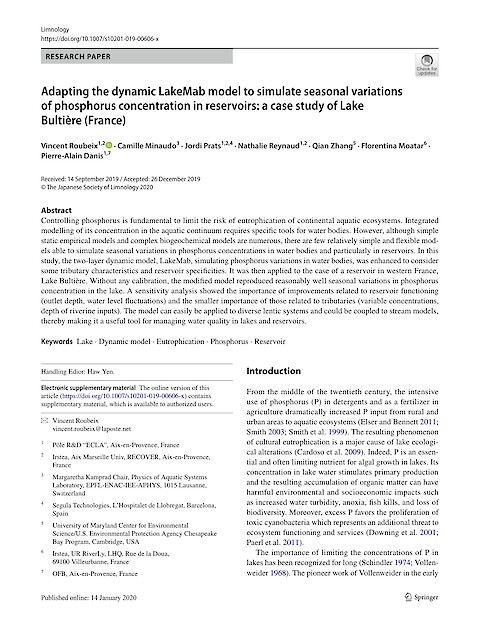
Adapting the dynamic LakeMab model to simulate seasonal variations of phosphorus concentration in reservoirs: a case study of Lake Bultière (France) (Page 1)

Adapting the dynamic LakeMab model to simulate seasonal variations of phosphorus concentration in reservoirs: A case study of Lake Bultière (France)

Roubeix V, Minaudo C, Prats J, Reynaud N, Zhang Q, Moatar F, Danis PA ·

Controlling phosphorus is fundamental to limit the risk of eutrophication of continental aquatic ecosystems. Integrated modelling of its concentration in the aquatic continuum requires specific tools for water bodies. However, although simple static empirical models and complex biogeochemical models are numerous, there are few relatively simple and flexible models able to simulate seasonal variations in phosphorus concentrations in water bodies and particularly in reservoirs.

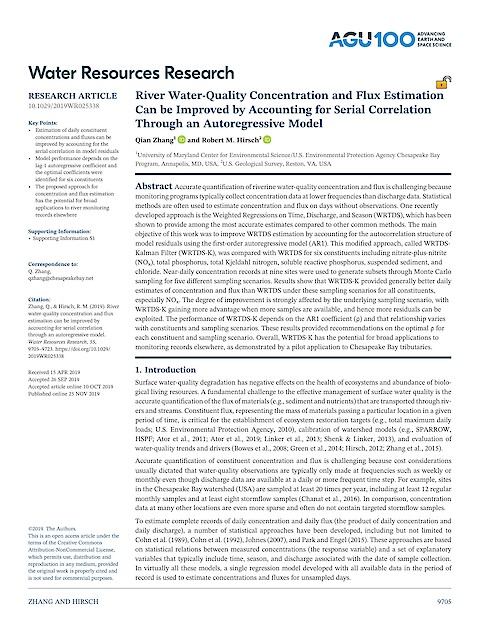
River Water‐Quality Concentration and Flux Estimation Can be Improved by Accounting for Serial Correlation Through an Autoregressive Model (Page 1)

River water‐quality concentration and flux estimation can be improved by accounting for serial correlation through an autoregressive model

Zhang Q, Hirsch RM ·

Accurate quantification of riverine water‐quality concentration and flux is challenging because monitoring programs typically collect concentration data at lower frequencies than discharge data. Statistical methods are often used to estimate concentration and flux on days without observations. One recently developed approach is the Weighted Regressions on Time, Discharge, and Season (WRTDS), which has been shown to provide among the most accurate estimates compared to other common methods.

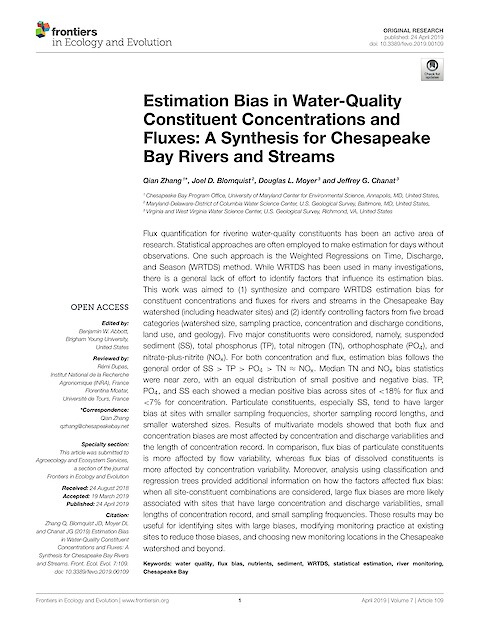
Estimation bias in water-quality constituent concentrations and fluxes: A synthesis for Chesapeake Bay rivers and streams (Page 1)

Estimation bias in water-quality constituent concentrations and fluxes: A synthesis for Chesapeake Bay rivers and streams

Zhang Q, Blomquist JD, Moyer DL, Chanat JG ·

Flux quantification for riverine water-quality constituents has been an active area of research. Statistical approaches are often employed to make estimation for days without observations. One such approach is the Weighted Regressions on Time, Discharge, and Season (WRTDS) method. While WRTDS has been used in many investigations, there is a general lack of effort to identify factors that influence its estimation bias.

Chesapeake Bay Dissolved Oxygen Criterion Attainment Deficit: Three Decades of Temporal and Spatial Patterns (Page 1)

Chesapeake Bay dissolved oxygen criterion attainment deficit: Three decades of temporal and spatial patterns

Zhang Q, Tango PJ, Murphy RR, Forsyth MK, Tian R, Keisman J, Trentacoste EM ·

Low dissolved oxygen (DO) conditions are a recurring issue in waters of Chesapeake Bay, with detrimental effects on aquatic living resources. The Chesapeake Bay Program partnership has developed criteria guidance supporting the definition of state water quality standards and associated assessment procedures for DO and other parameters, which provides a binary classification of attainment or impairment.

Chesapeake Bay

Chesapeake Bay's water quality condition has been recovering: Insights from a multimetric indicator assessment of thirty years of tidal monitoring data

Zhang Q, Murphy RR, Tian R, Forsyth MK, Trentacoste EM, Keisman J, Tango PJ ·

To protect the aquatic living resources of Chesapeake Bay, the Chesapeake Bay Program partnership has developed guidance for state water quality standards, which include ambient water quality criteria to protect designated uses (DUs), and associated assessment procedures for dissolved oxygen (DO), water clarity/underwater bay grasses, and chlorophyll-a. For measuring progress toward meeting the respective states' water quality standards…

Evaluation of statistical methods for quantifying fractal scaling in water-quality time series with irregular sampling (Page 1)

Evaluation of statistical methods for quantifying fractal scaling in water quality time series with irregular sampling

Zhang Q, Harman CJ, Kirchner JW ·

River water-quality time series often exhibit fractal scaling, which here refers to autocorrelation that decays as a power law over some range of scales. Fractal scaling presents challenges to the identification of deterministic trends because (1) fractal scaling has the potential to lead to false inference about the statistical significance of trends and (2) the abundance of irregularly spaced data in water-quality monitoring networks complicates efforts to quantify fractal scaling.

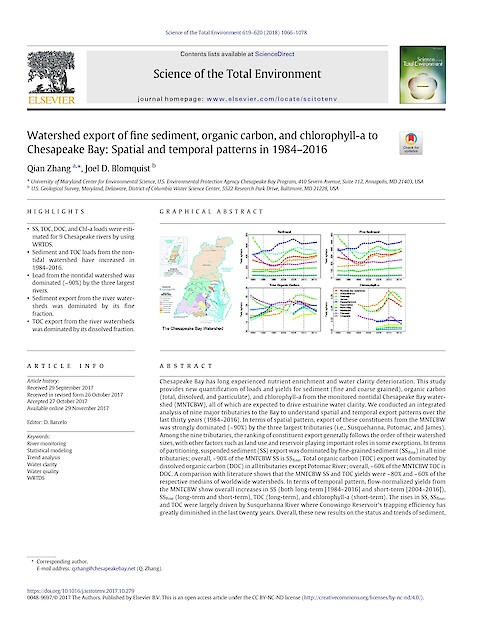
Watershed export of fine sediment, organic carbon, and chlorophyll-a to Chesapeake Bay: Spatial and temporal patterns in 1984–2016 (Page 1)

Watershed export of fine sediment, organic carbon, and chlorophyll-a to Chesapeake Bay: Spatial and temporal patterns in 1984–2016

Zhang Q, and Blomquist JD ·

Chesapeake Bay has long experienced nutrient enrichment and water clarity deterioration. This study provides new quantification of loads and yields for sediment (fine and coarse grained), organic carbon (total, dissolved, and particulate), and chlorophyll-a from the monitored nontidal Chesapeake Bay watershed (MNTCBW), all of which are expected to drive estuarine water clarity.

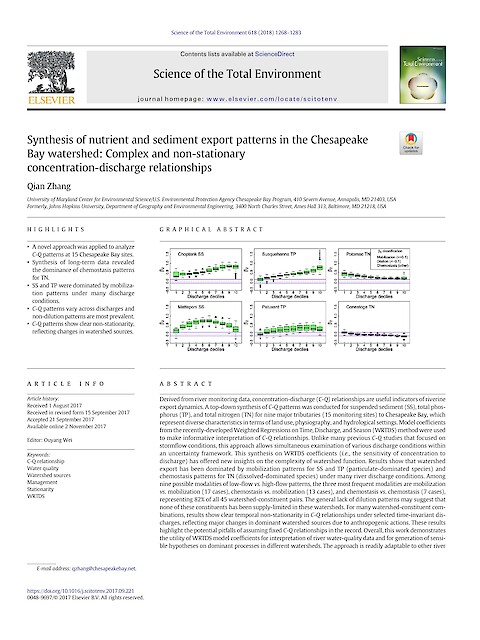
Synthesis of nutrient and sediment export patterns in the Chesapeake Bay watershed: Complex and non-stationary concentration-discharge relationships (Page 1)

Synthesis of nutrient and sediment export patterns in the Chesapeake Bay watershed: Complex and non-stationary concentration-discharge relationships

Zhang Q ·

Derived from river monitoring data, concentration-discharge (C-Q) relationships are useful indicators of riverine export dynamics. A top-down synthesis of C-Q patterns was conducted for suspended sediment (SS), total phos- phorus (TP), and total nitrogen (TN) for nine major tributaries (15 monitoring sites) to Chesapeake Bay, which represent diverse characteristics in terms of land use, physiography, and hydrological settings.

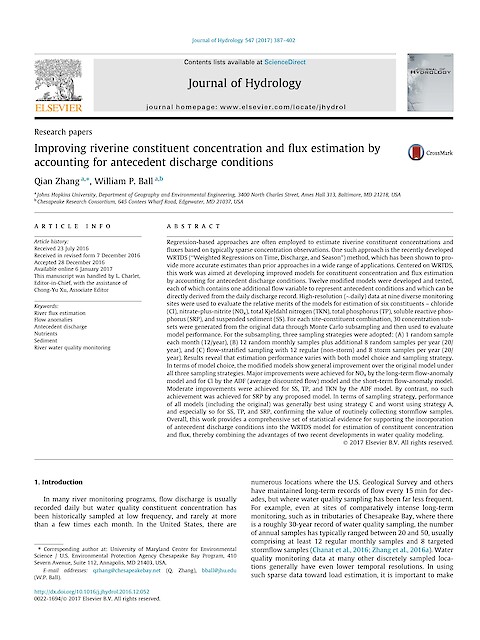
Improving riverine constituent concentration and flux estimation by accounting for antecedent discharge conditions (Page 1)

Improving riverine constituent concentration and flux estimation by accounting for antecedent discharge conditions

Zhang Q, Ball WP ·

Regression-based approaches are often employed to estimate riverine constituent concentrations and fluxes based on typically sparse concentration observations. One such approach is the recently developed WRTDS (“Weighted Regressions on Time, Discharge, and Season”) method, which has been shown to provide more accurate estimates than prior approaches in a wide range of applications.