IAN is committed to producing practical, user-centered communications that foster a better understanding of science and enable readers to pursue new opportunities in research, education, and environmental problem-solving. Our publications synthesize scientific findings using effective science communication techniques.

2016 Chesapeake Bay Report Card (Page 1)

2016 Chesapeake Bay Report Card

Caroline Donovan, Alexandra Fries, Dylan Taillie, Bill Dennison ·

This report card provides a transparent, timely, and geographically detailed assessment of Chesapeake Bay. In 2016, the report card includes five water quality indicators and two biotic indicators. In 2016, the overall grade for Chesapeake Bay is a 54%, a C. This means the Bay is in moderate health. Long term trends of each reporting region health and a fisheries index are also presented. For further details, visit the Report Card Website.

2015 Chesapeake Bay Report Card (Page 1)

2015 Chesapeake Bay Report Card

Caroline Donovan, Alexandra Fries, Bill Dennison ·

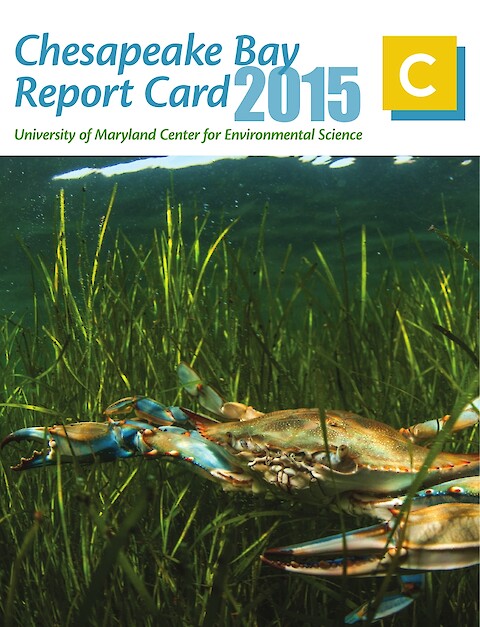
This report card provides a transparent, timely, and geographically detailed assessment of Chesapeake Bay. In 2015, the report card includes five water quality indicators and two biotic indicators. In 2015, the overall grade for Chesapeake Bay is a 53%, a C. This means the Bay is in moderate health. Long term trends of each reporting region health and a fisheries index are also presented. For further details, visit the Report Card website.

2014 Chesapeake Bay Report Card (Page 1)

2014 Chesapeake Bay Report Card

Caroline Donovan, Bill Dennison, Alexandra Fries ·

This report card provides a transparent, timely, and geographically detailed assessment of Chesapeake Bay. In 2014, the report card includes five water quality indicators and two biotic indicators. In 2014, the overall grade for Chesapeake Bay is a 50%, a C. This means the Bay is in moderate health. A fisheries index and climate change resilience index as well as trajectories of reporting region health are also presented. For further details, visit the Report Card website.

2013 Chesapeake Bay Report Card (Page 1)

2013 Chesapeake Bay Report Card

Caroline Donovan, Bill Dennison, Alexandra Fries, Tracey Saxby, Heath Kelsey ·

This report card provides a transparent, timely, and geographically detailed assessment of Chesapeake Bay. In 2013, the report card includes five water quality indicators and two biotic indicators. In 2013, the overall grade for Chesapeake Bay is a 45%, a C. This means the Bay is in moderate health. Fisheries indicators as well as trajectories of reporting region health are also presented. For further details, visit the Report Card website.

2012 Chesapeake Bay Report Card (Page 1)

2012 Chesapeake Bay Report Card

Caroline Donovan, Bill Dennison, Heath Kelsey, Alexandra Fries ·

This report card provides a transparent, timely, and geographically detailed assessment of Chesapeake Bay. In 2012, the methods for the report card have changed to include five water quality indicators and two biotic indicators. In 2012, the overall grade for Chesapeake Bay is a 47%, a C. This means the Bay is in moderate health. Fisheries indicators as well as trajectories of reporting region health are also presented. For further details, visit the Report Card website .

Total Maximum Daily Loads: A citizen

Total Maximum Daily Loads

A citizen's guide to the Chesapeake Bay TMDL

Melissa Andreychek, Sara Powell, Caroline Donovan ·

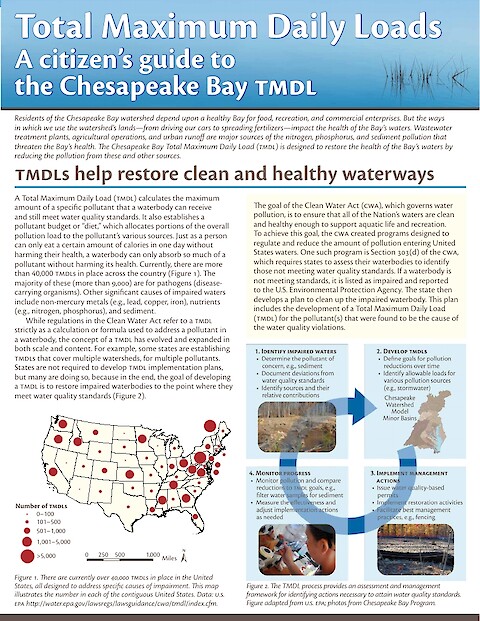
Residents of the Chesapeake Bay watershed depend upon a healthy Bay for food, recreation, and commercial enterprises. But the ways in which we use the watershed’s lands—from driving our cars to spreading fertilizers—impact the health of the Bay’s waters. Wastewater treatment plants, agricultural operations, and urban runoff are major sources of the nitrogen, phosphorus, and sediment pollution that threaten the Bay’s health.

New Stream Health Indicator Being Developed (Page 1)

New Stream Health Indicator Being Developed

Katie Foreman, Caroline Donovan, Emily Nauman, Bill Dennison ·

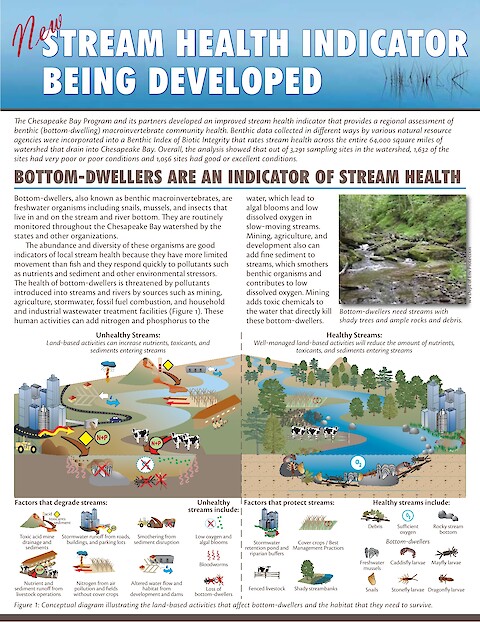
The Chesapeake Bay Program and its partners developed an improved stream health indicator that provides a regional assessment of benthic (bottom-dwelling) macroinvertebrate community health. Benthic data collected in different ways by various natural resource agencies were incorporated into a Benthic Index of Biotic Integrity that rates stream health across the entire 64,000 square miles of watershed that drain into Chesapeake Bay.