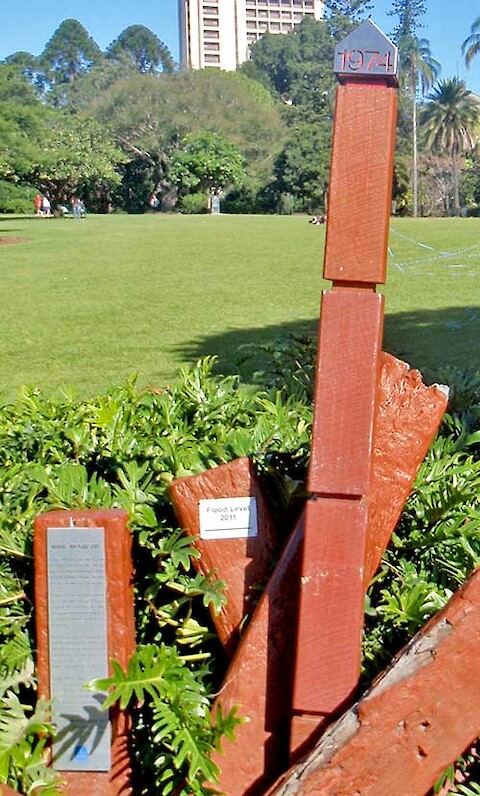
As part of Brisbane's heritage week, a walking tour along the Brisbane River and a concert in historic Customs House was held on May 15. These events were sponsored by Brisbane's Living Heritage Network. The walking tour started in the Botanic Gardens and visited the 1974 flood marker which has been modified to include the 2011 flood levels. We visited the site of the 1893 stranding of the naval ship Paluma, where there is a children's park with a climbing frame in the shape of a ship.
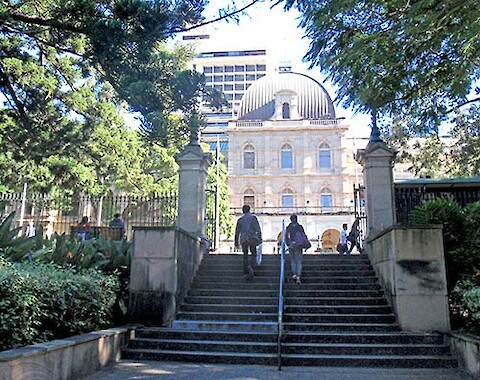
Walking along the front of the Queensland University of Technology (QUT) buildings with the Botanic Gardens on the right, you pass some massive banyan trees, which is an Indian fig tree named for the Bania merchants who would meet between the buttress roots. Just at the entrance to the Botanic Gardens is Parliament House, seat of the Queensland government.
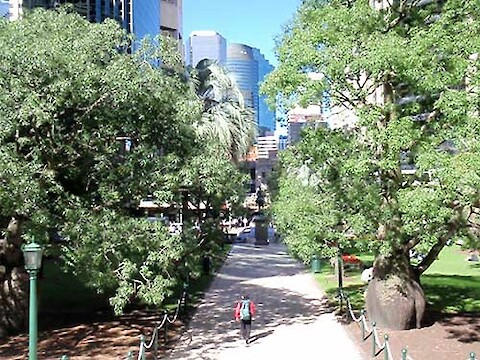
Back to ANZAC Square, the walk down the stairs (from the bottom, 19 stairs, a landing, and 18 stairs to commemorate the end of WWI in 1918) and through the walk lined with baobab (bottle) trees from South Africa to symbolize the Boer Wars. In addition, Middle East date palms are in the square to commemorate ANZAC's role in the Middle East in both WWI and WWII. There are many statues in the square, depicting different wars.
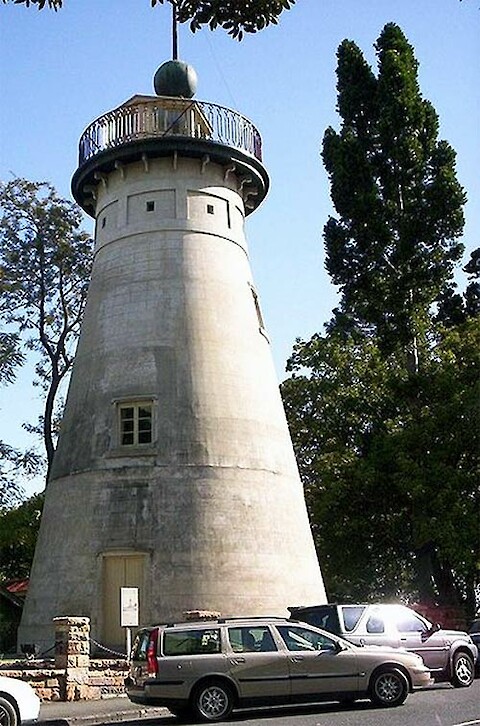
Brisbane is hilly, and I like to start a tour at a high point and work my way down. The Old Windmill on Wickham Terrace is a great place to start for that reason. Another reason for starting here is the fact that the Old Windmill is aptly named, as it is the oldest surviving building in Brisbane, dating back to 1824. It was originally built by convicts for grinding grains, but was subsequently used as a place to hang criminals, as a museum, and as a weather observatory.
Dr. Nigel Erskine, Curator of Exploration at the Australian National Maritime Museum in Sydney, talked about the HMB Endeavour voyage. He explained that the Endeavour was correctly called HM Barque (or Bark), which was what the British Royal Navy designated the Endeavour that Cook sailed in, even though it was ship-rigged (three or more masts, with square sails on each mast). The HMB Endeavour also distinguished it from another ship in the Royal Navy named the HMS Endeavour.
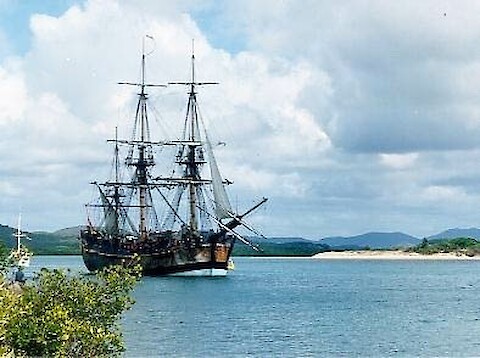
Another observation was the June 11, 1770 'discovery' that the Endeavour had been unknowingly threading through the Great Barrier Reef. This 'discovery' of what is now known as Endeavour Reef almost led to the demise of the ship and crew. Cook wrote ". . .the Ship Struck and stuck fast. Immediately upon this we took in all our Sails, hoisted out the Boats and Sounded round the Ship, and found that we had got upon the South-East Edge of a reef of coral rocks . . .".
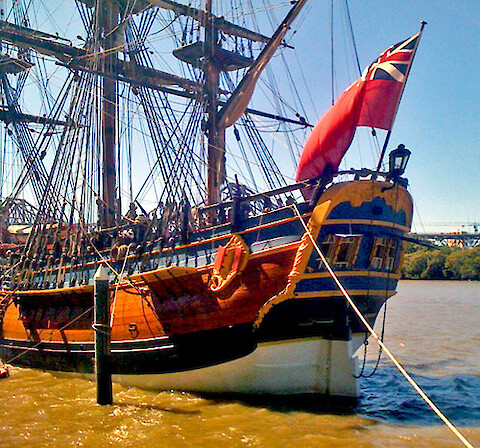
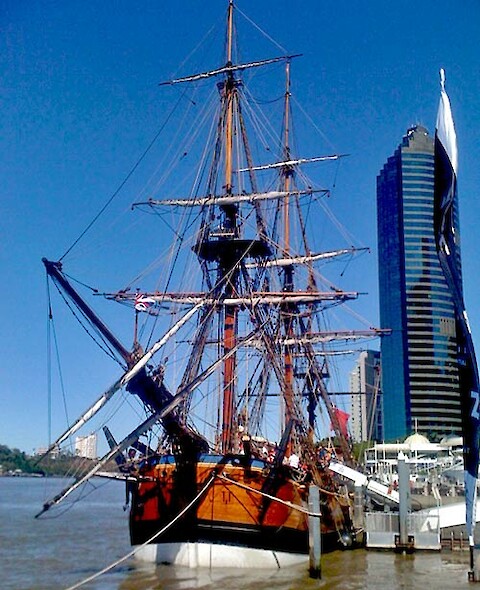
An exact replica of the HMS Endeavour arrived in Brisbane, Australia for a visit of several weeks. The 100 foot three-masted ship was built in Freemantle, Western Australia between 1988 and 1992, and has sailed twice around the world. It is operated by the Australian National Maritime Museum and is based in Sydney Harbour.
When I arrived at the University of Queensland in 1992, someone in the Botany Department mentioned that there was a research station on Stradbroke Island. I had already borrowed the CSIRO boat to scout around Moreton Bay and realized that a research station at Straddie would be a wonderful place to base a field campaign.
This blog post discusses the seminar given by Megan Ward of the Nanticoke Watershed Alliance, at the IAN Seminar Series on September 28, 2010. The Nanticoke River conservation efforts have focused on protection, rather than restoration, reflecting its rural and relatively intact watershed. Megan made it clear that the Nanticoke Watershed Alliance was more interested in building partnerships than direct advocacy.
This blog post discusses the seminar given by Andrew and Diana Muller at the IAN Seminar Series on August 31, 2010. Pierre Henkart noted that the Severn River had persistent anoxia between June and September which includes noticeable hydrogen sulfide and asked why the South River anoxia was not as pronounced or persistent. Andrew and Diana discussed the increased tidal flushing in the South River compared with the Severn River with its shallow and wide sill at the Severn mouth.