My university teaching experience has been quite varied. I have taught first year students in massive lecture halls, graduate students in small groups, and everything in between. At the University of Maryland Center for Environmental Science, we teach using an interactive video network. My attitude about the large lecture setting is that the students forget what I said shortly after I say it, and I forget what I said shortly after I say it.
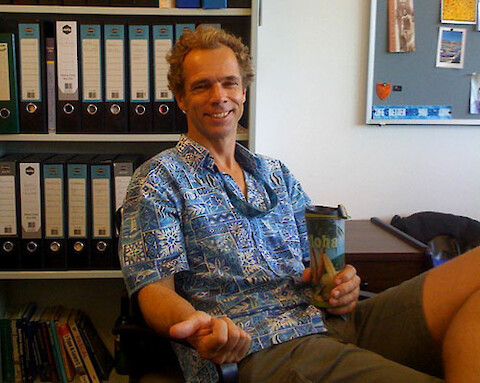
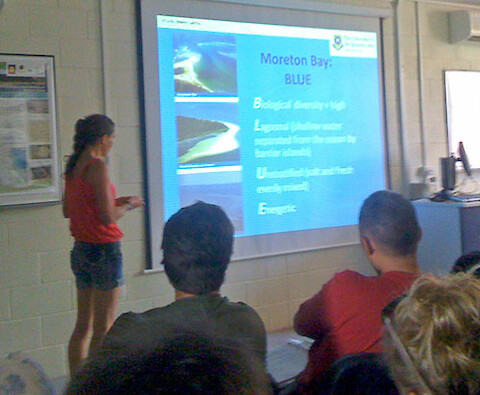
On Monday, I went to the University of Queensland to meet with a former student, Dr. Chris Roelfsema and his student Mitch Lyons. Chris and Mitch, who are part of Professor Stuart Phinn's remote sensing group, had worked up a seagrass risk map for Moreton Bay, based on light attenuation from the flood plume, bathymetry and knowledge of seagrass light requirements.
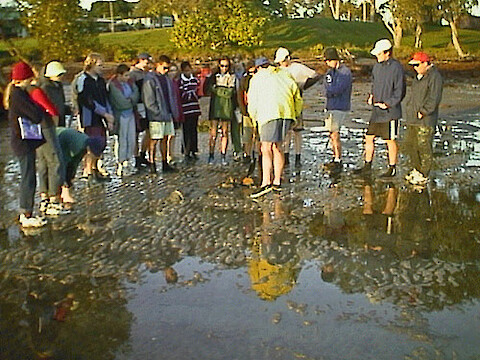
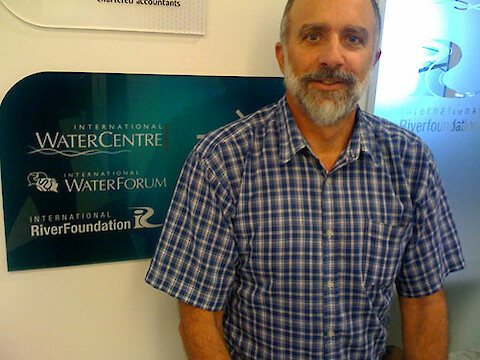
The International WaterCentre, formed as a consortium of four Australian universities, offers a Master's degree program in water management. As part of the 18 month (full time) course, a field trip to North Stradbroke Island is included. I attended two of the three days, and led a field trip to the seagrass beds in One Mile Harbor, near the town of Dunwich. The Moreton Bay Research Station in Dunwich was used in the course.
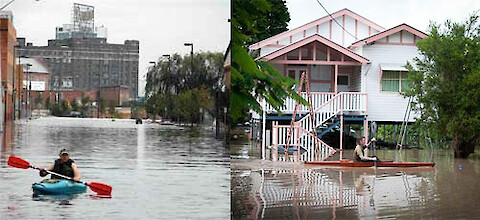
The 2011 floods in Queensland provide a societal learning moment. The intense media attention and the personal experiences that touched so many people have made a broad swath of society receptive to learning more about flooding and flood impacts. The key from the science communication perspective is to generate timely and synthetic products that are targeted to a broad audience.
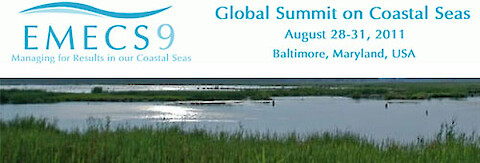
conference banner … The Integration and Application Network and the University of Maryland Center for Environmental Science would like to make you aware of the upcoming Environmental Management of Enclosed Coastal Seas (EMECS) conference entitled "Global Summit on Coastal Seas". The abstract deadline is 25 February. The conference goal is to improve our ability to manage coasts in all their ecological, economic, and cultural dimensions.
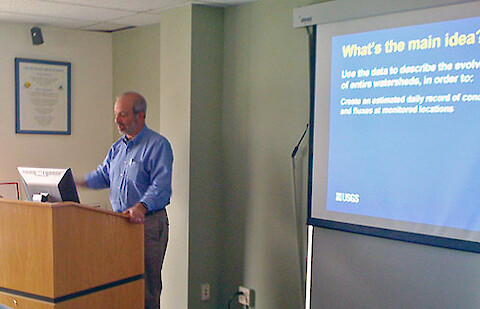
This blog post discusses the seminar given by Bob Hirsch of the US Geological Survey (USGS), at the IAN Seminar Series on November 23, 2010. Bob Hirsch speaking at the IAN Seminar Series … The analytical method used by Bob Hirsch was clarified. Bob explained that he used nutrient concentrations that were estimated daily every day over a 31 year period, and these concentrations were converted to fluxes by multiplying nutrient concentrations by discharge (water flow) rates.
The word 'sabbatical' stems from the concept of the number seven, and it has been co-opted by academia to refer to a break that faculty take from their regular duties at roughly seven year intervals. In Australia, the term used is 'study leave', which is more descriptive and distinguishes it from long service leave or vacation. Sabbaticals are viewed as a way for faculty to rejuvenate careers, learn new techniques and approaches, and/or complete large projects (e.g., books).
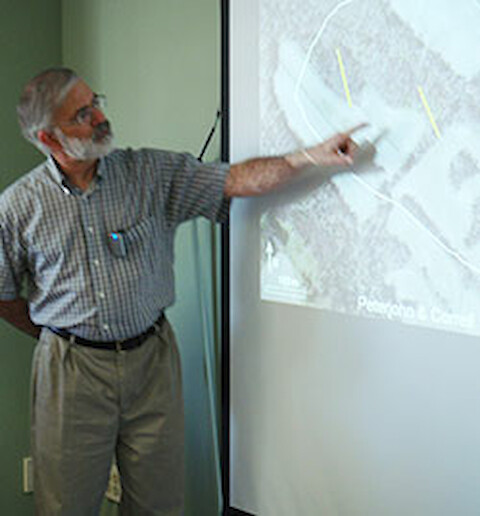
This blog post discusses the seminar given by Don Weller of the Smithsonian Environmental Research Center (SERC), at the IAN Seminar Series on October 28, 2010. The variable proportion of nitrate removed by riparian buffers in the different physiographic regions was noted in the discussion. Also noted was the relative constancy of the absolute amount of nitrate removed by riparian buffers (~10 mg/L) in all physiographic regions.
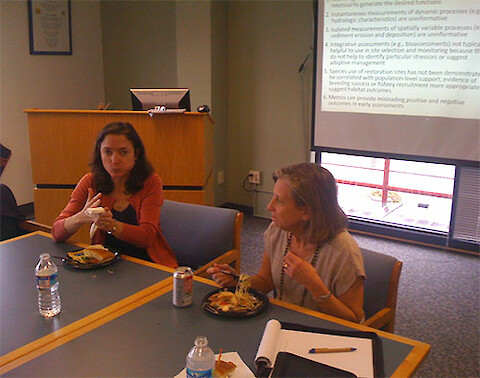
This blog post discusses the seminar given by Margaret Palmer of the Chesapeake Biological Laboratory, at the IAN Seminar Series on September 30, 2010. This seminar was presented by Dr. Margaret Palmer, but both Drs. Palmer and Wainger participated in the discussion following the seminar. The issue that measuring the effectiveness of restoration projects is fundamentally different than tracking ecosystem health through monitoring efforts was discussed.
This blog post discusses the seminar given by Bob Wood of the Cooperative Oxford Laboratory, at the IAN Seminar Series on August 26, 2010. There was a lively discussion following Bob Wood's seminar. The observation was made that several of Bob's slides were 'Tufte' approved, in that they contained a large amount of content, with little 'chart-junk'. The talk was characterized as being both data-rich and idea-rich.