

Stillmeadow Community Fellowship and the Baltimore Ecosystem Study
Meena Toolaabee ·This was my first time attending the Baltimore Ecosystem Study (BES) Annual Meeting, which was hosted at the Stillmeadow Community Fellowship in West Baltimore on October 15th, 2026. At the annual meeting, environmental researchers and professionals gathered to share the projects they’ve been working on, covering a wide array of issues within communities, ecosystems, and green economics. BES has many projects, current and past, in their repertoire, and describes themselves as a multigenerational network. It was discussed how to leverage this multigenerational network as they are transitioning into being a no-new-funding organization that aims to operate independently.
The first half of the meeting included talks discussing how to best use BES as a connecting organization for different communities as well as how to engage with community groups in order to overcome various economic and social barriers involved in environmental work. We even had some speakers from French institutions who discussed their own socio-environmental work as well as how they plan to collaborate with BES in the future. Other talks were more technical, focused on novel remediation methods and the effectiveness of passive sampling.
One talk that really grabbed my attention was from the Baltimore Forest School and discussed the importance of including children in the fight to protect and conserve natural spaces in the city. I also enjoyed the talk focused on the green economics of starting a bird-friendly certified coffee farm, especially because we got to try that delicious coffee during breakfast and lunch! After lunch was a poster session where we could learn more about the research BES members were doing, followed by a second set of talks.
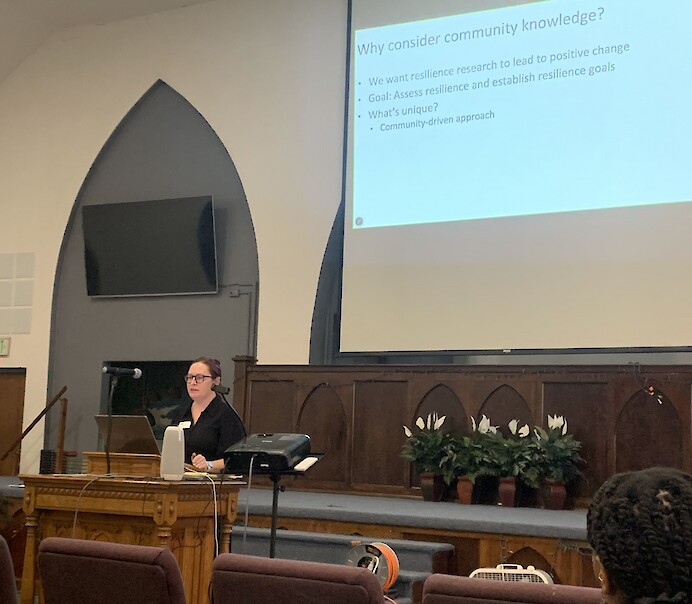
Katie May Laumann introduced a new project focused on baselining Maryland’s resilience to climate change and opened the door for future collaboration with the attendees. With community driven research, it’s always important to recruit a wide range of participants. BES attendees provided wonderful questions and suggestions that can further inform the course of the project.
I mentioned that the annual meeting was held at the Stillmeadow Community Fellowship located in West Baltimore. Walking into a building to be greeted with beautiful woodworking, charmingly colored hallways, and stained-glass windows was a lovely change from the over-air-conditioned and drab conference halls I am used to.
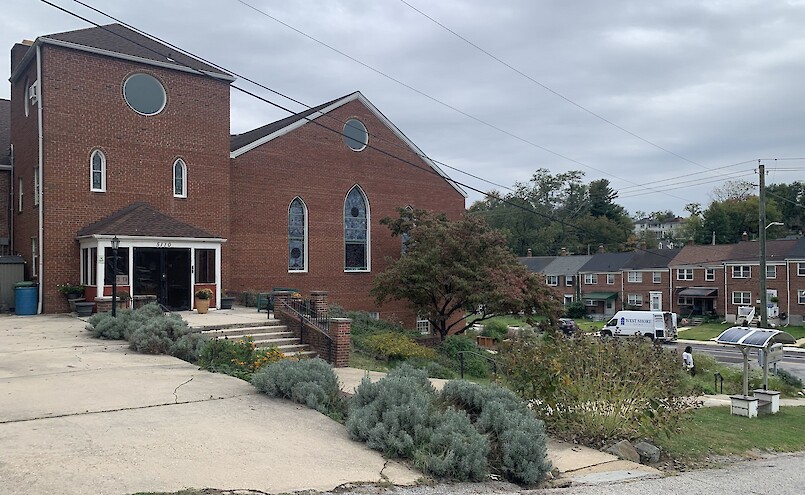
The Stillmeadow Community Fellowship is a unique space in West Baltimore, consisting of 10 acres of land that is privately owned by the fellowship, but open to the public. The land owned by the Fellowship was overgrown and filled with invasives, and they recognized an opportunity to provide a public greenspace to the community. So in 2019, plans were formalized to renew the land and create the Stillmeadow Peace Park.
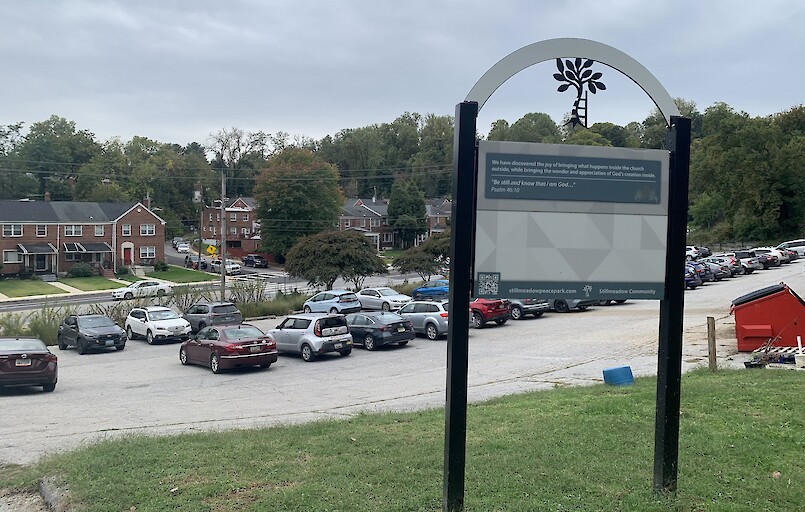
We were able to walk the forest trail within the peace park as part of an after-lunch “field trip” led by a BES member involved in the Peace Park’s creation and management. We learned how invasives are being managed with an approach to identify healthy zones where natives are fully established, prioritize the protection of these areas within the park, and then work outwards from these areas for invasive removal and native replanting.
The Fellowship is a meeting hub for multiple environmental organizations and the site of various research projects. On our forest walk I noticed several plots with these signs.
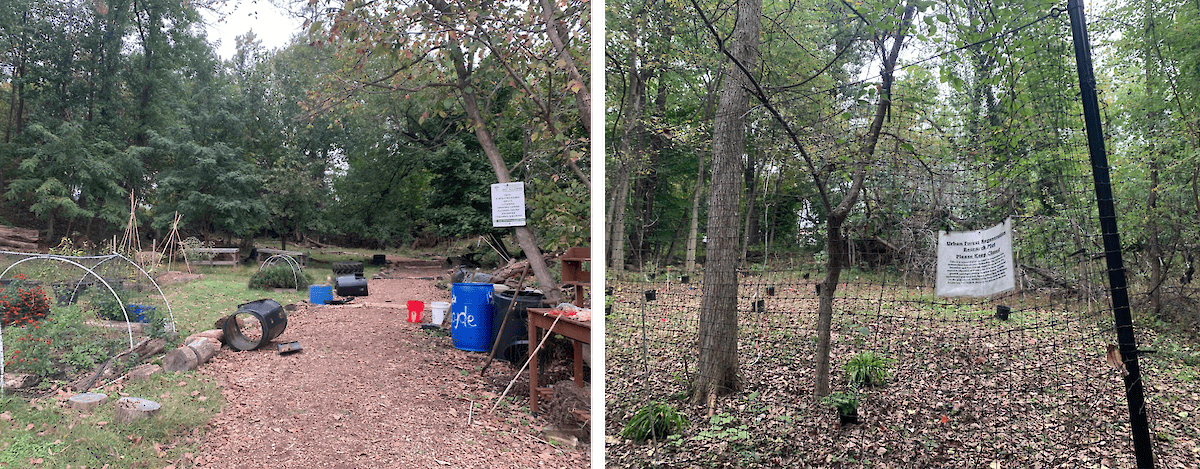
Additionally, we saw volunteers planting trees in under forested areas, as well as multiple community garden plots, compost bins and outdoor education spaces. One of my favorites was the stone sanctuary, in which two upside-down trees were used to create the entrance archway.
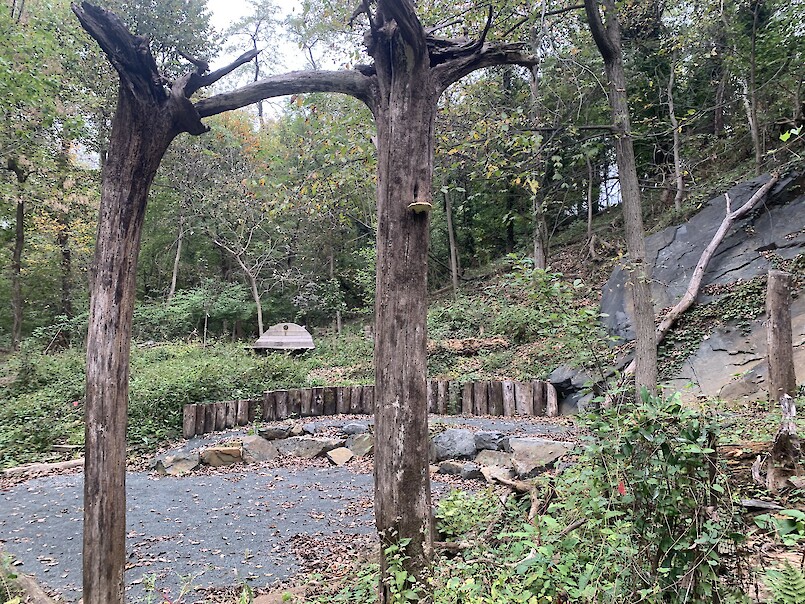
I appreciated how the Peace Park’s conception was uniquely influenced by the Fellowship, as the park functioned not only as a greenspace, but as a space for spiritual reflection and appreciation of nature.
Once we travelled past the stone sanctuary and further down the path which ran along a small stream, we arrived at a tranquil pool of water, the source of the stream we had been walking alongside.
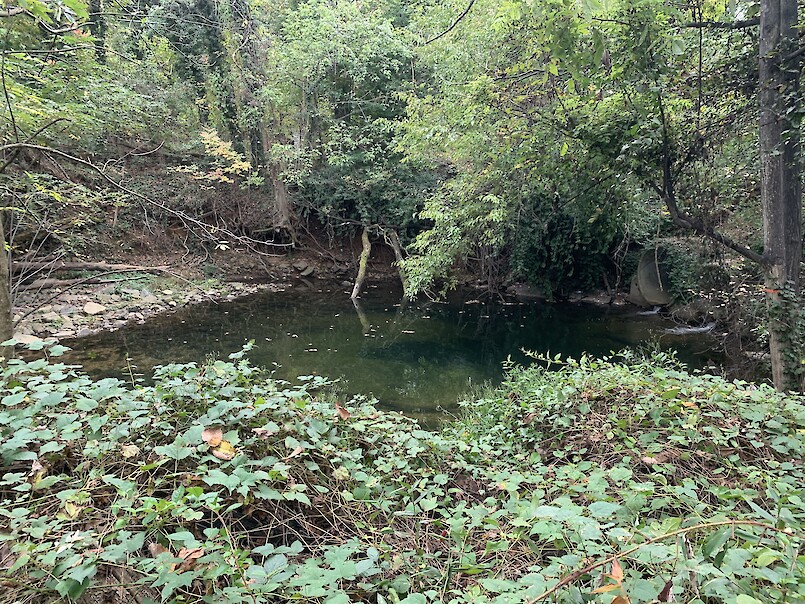
The pool had a sign explaining the path the water took to get there. Its source was the Maiden’s Choice watershed. Learning about this beautiful water feature hidden behind the trees of the city was a wonderful end prize for completing the field trip of the Stillmeadow Community Fellowship.
About the author
Meena Toolaabee
Meena is a climate resilience fellow at UMCES through the Chesapeake Climate and Conservation Corps. She has a bachelors degree from University of Maryland, College Park, in Civil and Environmental Engineering.