IAN is committed to producing practical, user-centered communications that foster a better understanding of science and enable readers to pursue new opportunities in research, education, and environmental problem-solving. Our publications synthesize scientific findings using effective science communication techniques.

Seagrasses of Southwest Australia (Page 1)

Seagrasses of Southwest Australia

Tim Carruthers, Tracey Saxby, Bill Dennison ·

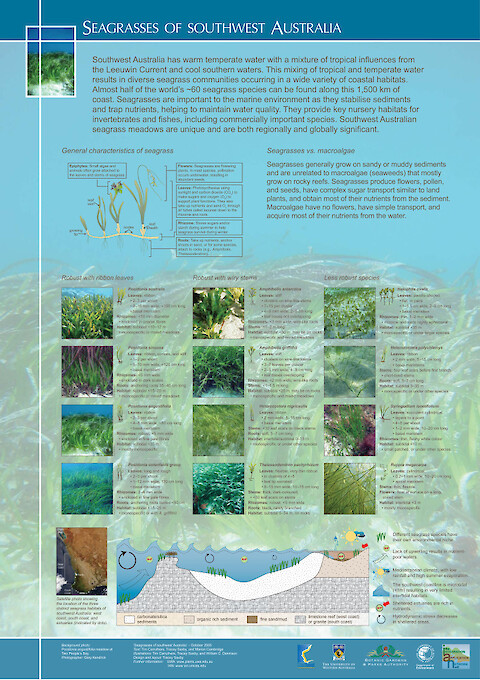
Southwest Australia has warm temperate water with a mixture of tropical influences from the Leeuwin Current and cool southern waters. This mixing of tropical and temperate water results in diverse seagrass communities occurring in a wide variety of coastal habitats. Almost half of the world's ~60 seagrass species can be found along this 1,500 km of coast. Seagrasses are important to the marine environment as they stabilise sediments and trap nutrients, helping to maintain water quality.

Seagrasses of Southwest Australia: Estuaries (Page 1)

Seagrasses of Southwest Australia: Estuaries

Tim Carruthers, Tracey Saxby, Bill Dennison ·

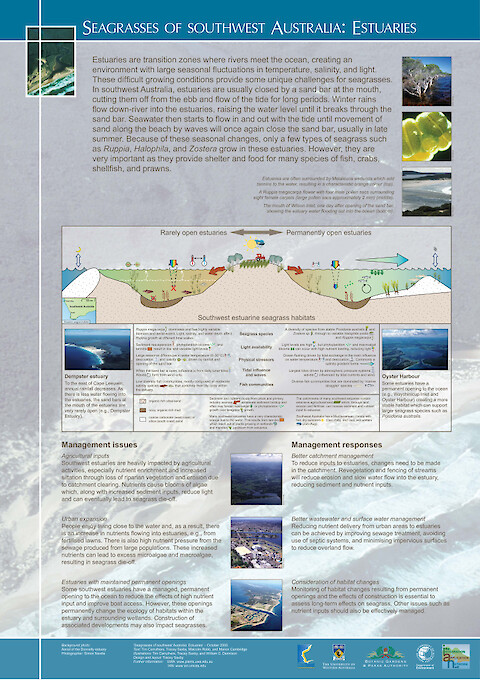
Estuaries are transition zones where rivers meet the ocean, creating an environment with large seasonal fl uctuations in temperature, salinity, and light. These difficult growing conditions provide some unique challenges for seagrasses. In southwest Australia, estuaries are usually closed by a sand bar at the mouth, cutting them off from the ebb and fl ow of the tide for long periods. Winter rains flow down-river into the estuaries, raising the water level until it breaks through the sand bar.

Seagrasses of Southwest Australia: South Coast (Page 1)

Seagrasses of Southwest Australia: South Coast

Tim Carruthers, Tracey Saxby, Bill Dennison ·

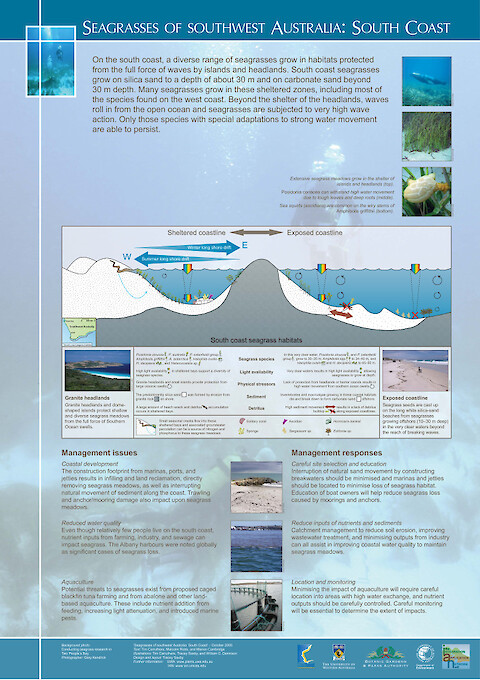
On the south coast, a diverse range of seagrasses grow in habitats protected from the full force of waves by islands and headlands. South coast seagrasses grow on silica sand to a depth of about 30 m and on carbonate sand beyond 30 m depth. Many seagrasses grow in these sheltered zones, including most of the species found on the west coast. Beyond the shelter of the headlands, waves roll in from the open ocean and seagrasses are subjected to very high wave action.

Seagrasses of Southwest Australia: West Coast (Page 1)

Seagrasses of Southwest Australia: West Coast

Tim Carruthers, Tracey Saxby, Bill Dennison ·

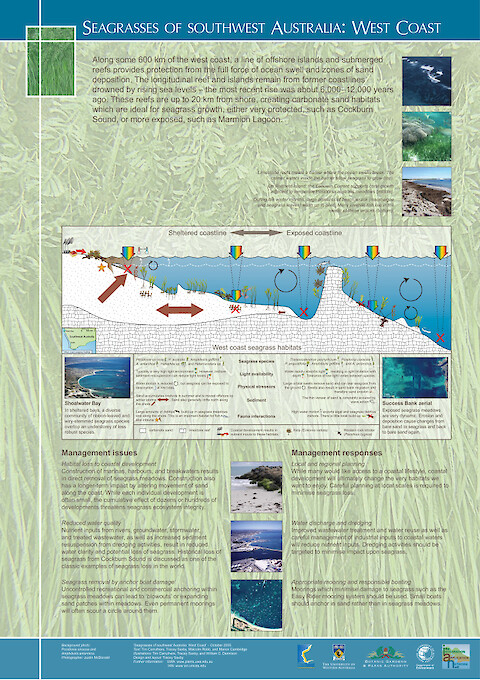
Along some 600 km of the west coast, a line of offshore islands and submerged reefs provides protection from the full force of ocean swell and zones of sand deposition. The longitudinal reef and islands remain from former coastlines drowned by rising sea levels - the most recent rise was about 6,000 - 12,000 years ago.