Publications about Sinepuxent Bay

IAN is committed to producing practical, user-centered communications that foster a better understanding of science and enable readers to pursue new opportunities in research, education, and environmental problem-solving. Our publications synthesize scientific findings using effective science communication techniques.

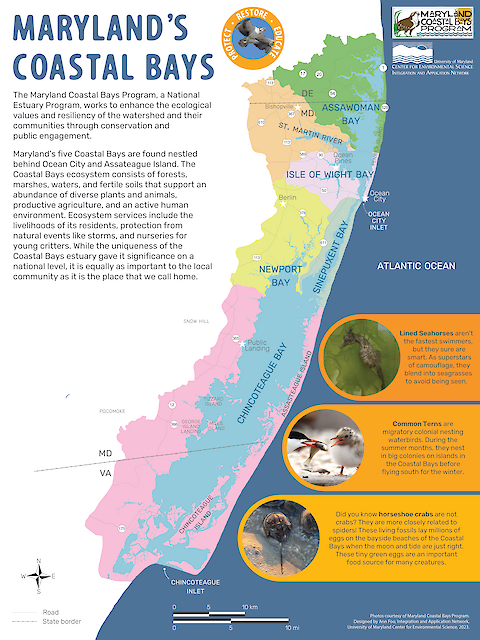
Coastal Bays Classroom Map

Ann Foo, Conor Keitzer ·

This two-sided map poster was developed in conjunction with the Maryland Coastal Bays Program for classrooms in Worcester County. To request a print copy, please contact Liz Wist, MCBP Education Coordinator: lwist@mdcoastalbays.org

2021 Maryland Coastal Bays Report Card (Page 1)

2021 Maryland Coastal Bays Report Card

Dave Brinker, Bill Dennison, Steve Farr, Steve Doctor, Roman Jesien, Katherine Munson, Judy O’Neil, Kevin Smith, Mitch Tarnowski, Catherine Wazniak, Jeff White, Craig Wheedon, and Rich Mason ·

Coastal Bays health is defined as the progress of four water quality indicators (nitrogen, phosphorus, chlorophyll a, dissolved oxygen) and two biotic indicators (seagrass, hard clam) toward scientifically derived ecological thresholds or goals. The Coastal Bays had an overall score of C+, a slight improvement from the previous year. Improved total phosphorus scores contributed to the slightly higher overall health of the bays.

2017 Maryland Coastal Bays Report Card (Page 1)

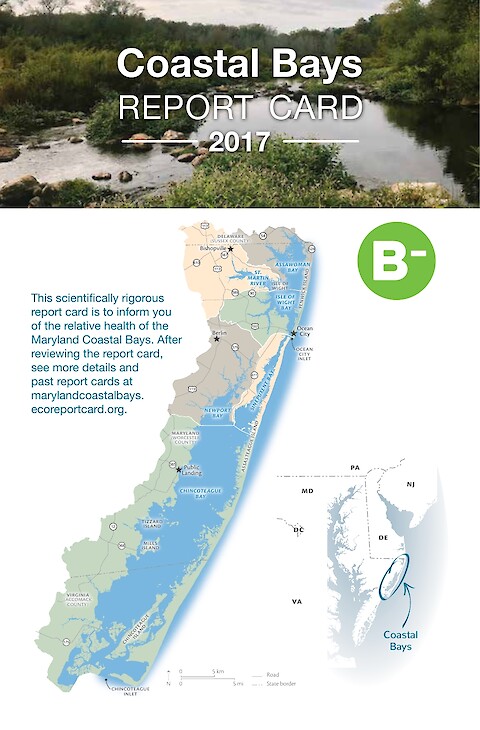
2017 Coastal Bays Report Card

Alexandra Fries, Emily Nastase ·

The aim of this report card is to provide a transparent, timely, and geographically detailed assessment of 2017 Coastal Bays health. Coastal Bays health is defined as the progress of four water quality indicators (total nitrogen, total phosphorus, chlorophyll a, dissolved oxygen) and two biotic indicators (seagrass, hard clams) toward scientifically derived ecological thresholds or goals.

2015 Maryland Coastal Bays report card (Page 1)

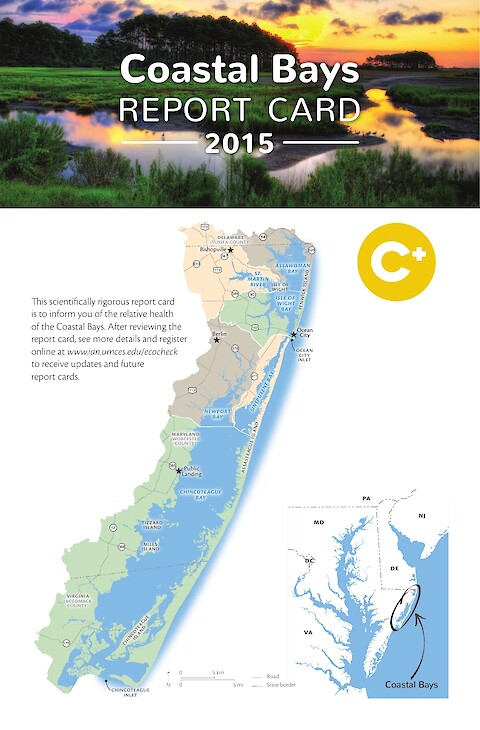
2015 Maryland Coastal Bays report card

Jane Thomas, Bill Dennison ·

The aim of this report card is to provide a transparent, timely, and geographically detailed assessment of 2015 Coastal Bays health. Coastal Bays health is defined as the progress of four water quality indicators (total nitrogen, total phosphorus, chlorophyll a, dissolved oxygen) and two biotic indicators (seagrass, hard clams) toward scientifically derived ecological thresholds or goals.

Maryland Coastal Bays 2016: Bay perspectives (Page 1)

Maryland Coastal Bays 2016: Bay perspectives

Jane Thomas, Bill Dennison, Heath Kelsey ·

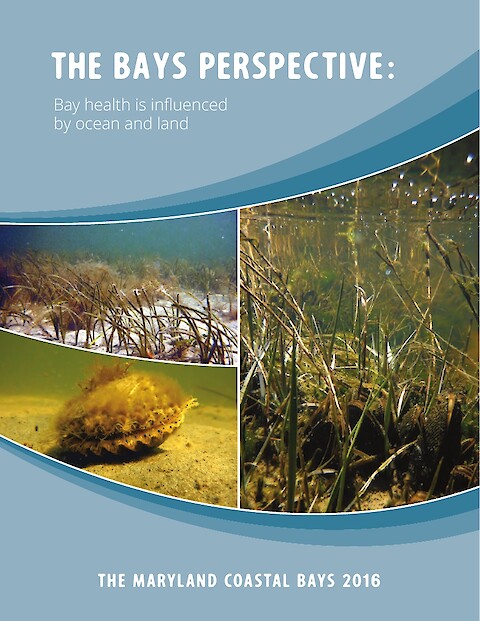
This booklet provides an overview of the current science and management issues in the Maryland Coastal Bays in 2016. The full report (which can be found here) includes two ‘booklets’ in one publication—one intended for those interested in the bay perspective, and the other for those interested in the land perspective. The two documents culminate in a summary centerfold which focuses on both watershed and bay issues.

Maryland Coastal Bays 2016: Land perspectives (Page 1)

Maryland Coastal Bays 2016: Land perspectives

Jane Thomas, Bill Dennison, Heath Kelsey ·

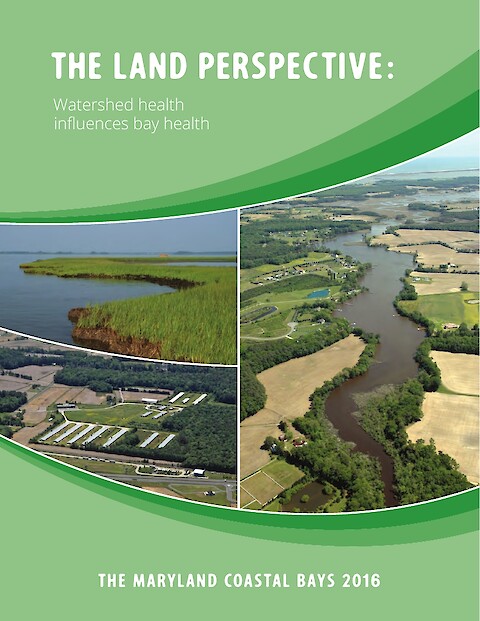
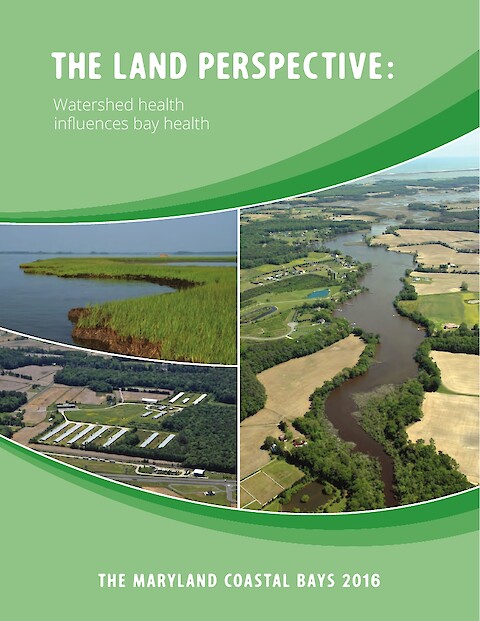
This booklet provides an overview of the current science and management issues in the Maryland Coastal Bays in 2016. The full report (which can be found here) includes two ‘booklets’ in one publication—one intended for those interested in the bay perspective, and the other for those interested in the land perspective. The two documents culminate in a summary centerfold which focuses on both watershed and bay issues.

2014 Maryland Coastal Bays report card (Page 1)

2014 Maryland Coastal Bays report card

Jane Thomas, Bill Dennison ·

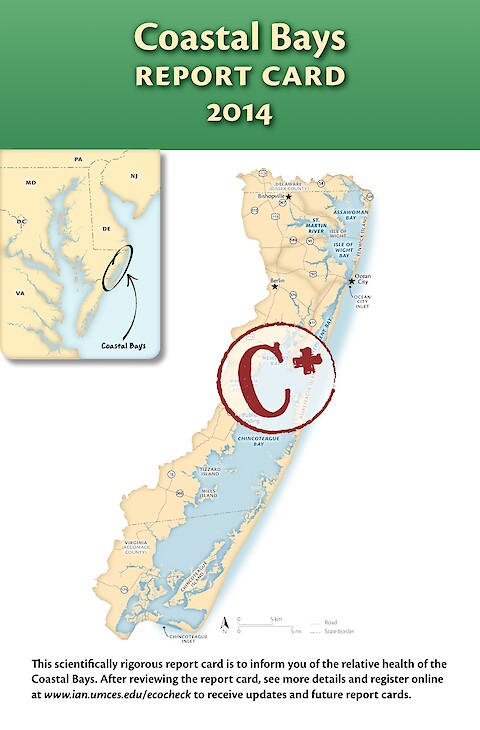
The aim of this report card is to provide a transparent, timely, and geographically detailed assessment of 2014 Coastal Bays health. Coastal Bays health is defined as the progress of four water quality indicators (total nitrogen, total phosphorus, chlorophyll a, dissolved oxygen) and two biotic indicators (seagrass, hard clams) toward scientifically derived ecological thresholds or goals.