IAN is committed to producing practical, user-centered communications that foster a better understanding of science and enable readers to pursue new opportunities in research, education, and environmental problem-solving. Our publications synthesize scientific findings using effective science communication techniques.
Watershed report cards are powerful tools to describe ecosystem status, increase public awareness, and inform and influence decision makers to improve the health of a watershed. This is the first Southeast Michigan Report Card, which provides an overall socio-environmental assessment of Southeast Michigan based on the combined scores from six river watersheds: Clinton, Detroit, Huron, River Raisin, and Rouge.
Bates AE, Davies MA, Stuart-Smith RD, Lazzari N, Lefcheck JS, Ling SD, Mellin C, Mouillot D, Bernard ATF, Bennett S, Brown CJ, Burrows MT, Butler CL, Cinner J, Clausius E, Cooper A, Costello MJ, Denis-Roy L, Edgar GJ, Fuchs YH, Johnson OJ, Gordó-Vilaseca C, Hautecoeur C, Harper LM, Heather FJ, Jones TR, Markey AC, Oh E, Rose M, Ruiz-Ruiz PA, Sanabria-Fernandez JA, Schuster JM, Schmid JK, Baker SC ·
Scientific working groups bring together experts from different disciplines and perspectives to tackle the “wicked problems” facing natural systems and society. Yet participants can feel overwhelmed or inadequate in groups within academic environments, which tends to be most acute at early career stages and in people from systematically marginalized backgrounds.
Canty SWJ, Nowakowski AJ, Cox CE, Valdivia A, Holstein DM, Limer B, Lefcheck JS, Craig N, Drysdale I, Giro A, Soto M, McField M ·
Countries are expanding marine protected area (MPA) networks to mitigate fisheries declines and support marine biodiversity. However, MPA impact evaluations typically assess total fish biomass. Here, we examine how fish biomass disaggregated by adult and juvenile life stages responds to environmental drivers, including sea surface temperature (SST) anomalies and human footprint, and multiple management types at 139 reef sites in the Mesoamerican Reef (MAR) region.
Riechers M, Baumann L, Braun M, Carew A, Chinappa M, Dehm J, Ganachaud A, Holland E, Kelsey H, Lal S, Landemard M, Rocle N, and Stockwell BL ·
This conference report synthesises the discussions and lessons learnt from a workshop with international and local experts and practitioners held in Noum´ea, New Caledonia (France, Oceania) from 17th to 21st of October 2022. The workshop was part of a larger transdisciplinary process aimed to anticipate and react to marine heatwaves, coastal erosion and sea level rise as well as ocean deoxygenation and acidification in Fiji and New Caledonia.
Webber J, Chanat J, Clune J, Devereux O, Hall N, Sabo RD, Zhang Q ·
Many agricultural watersheds rely on the voluntary use of management practices (MPs) to reduce nonpoint source nutrient and sediment loads; however, the water-quality effects of MPs are uncertain. We interpreted water-quality responses from as early as 1985 through 2020 in three agricultural Chesapeake Bay watersheds that were prioritized for MP implementation, namely, the Smith Creek (Virginia), Upper Chester River (Maryland), and Conewago Creek (Pennsylvania) watersheds.
This research assesses Chesapeake Bay’s sustainability in four domains: environment, social, economy, and governance, using the Circles of Coastal Sustainability methodology. Each of the four domains has five categories, and each category is evaluated by the authors’ expert judgment using indicators related to the socio-ecological system and the definition of sustainable development.
Cravotta III CA, Tasker TL, Smyntek PM, Blomquist JD, Clune JW, Zhang Q, Schmadel NM, Schmer NK ·
Nutrient pollution from agriculture and urban areas plus acid mine drainage (AMD) from legacy coal mines are primary causes of water-quality impairment in the Susquehanna River, which is the predominant source of freshwater and nutrients entering the Chesapeake Bay.
Eutrophication has been a major environmental issue in many coastal and inland ecosystems, which is primarily attributed to excessive anthropogenic inputs of nutrients. Restoration efforts have therefore focused on the reduction of watershed nutrient loads, including in the Chesapeake Bay (USA).
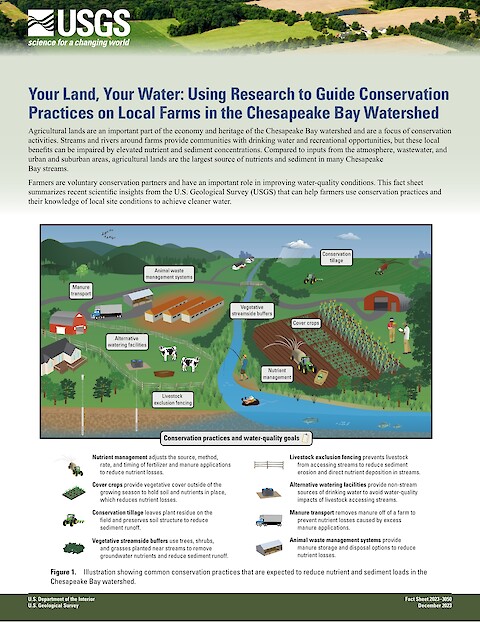
Agricultural lands are an important part of the economy and heritage of the Chesapeake Bay watershed and are a focus of conservation activities. Streams and rivers around farms provide communities with drinking water and recreational opportunities, but these local benefits can be impaired by elevated nutrient and sediment concentrations.
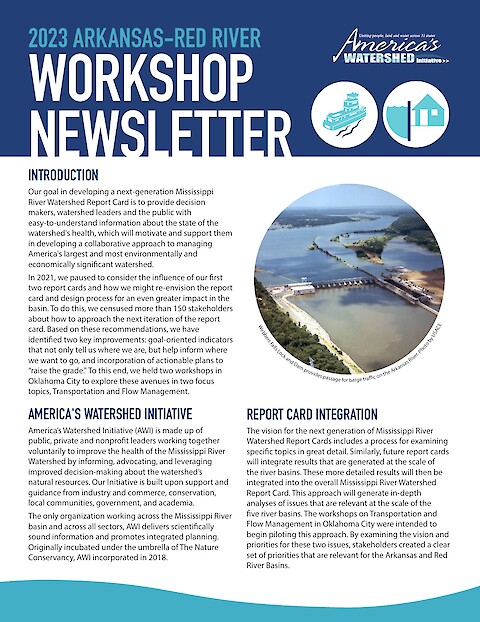
UMCES and America's Watershed Initiative held two workshops in Oklahoma City to examine Transportation and Flow Management in the Arkansas-Red River Basin. This document summarizes the results of the workshops and addresses next steps in the Mississippi River watershed.