Publications by Tim Carruthers

IAN is committed to producing practical, user-centered communications that foster a better understanding of science and enable readers to pursue new opportunities in research, education, and environmental problem-solving. Our publications synthesize scientific findings using effective science communication techniques.
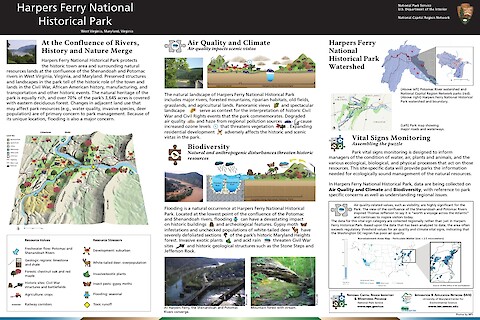
Harpers Ferry National Historical Park (Page 1)

Harpers Ferry National Historical Park

Jane Hawkey, Tim Carruthers, Bill Dennison ·

Harpers Ferry National Historical Park protects the historic town area and surrounding natural resources lands at the confluence of the Shenandoah and Potomac rivers in West Virginia, Virginia, and Maryland. Preserved structures and landscapes in the park tell of the historic role of the town and lands in the Civil War, African American history, manufacturing, and transportation and other historic events.

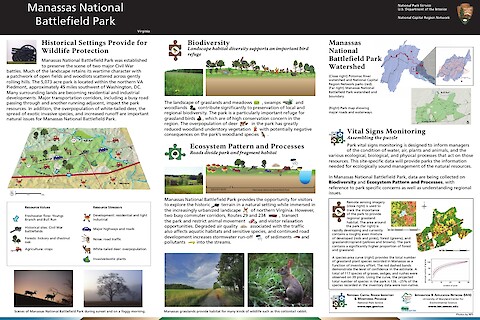
Manassas National Battlefield Park (Page 1)

Manassas National Battlefield Park

Jane Hawkey, Tim Carruthers, Bill Dennison ·

Manassas National Battlefield Park was established to preserve the scene of two major Civil War battles. Much of the landscape retains its wartime character with a patchwork of open fields and woodlots scattered across gently rolling hills. The 5,073 acre park is located within the northern VA Piedmont, approximately 45 miles southwest of Washington, DC. Many surrounding lands are becoming residential and industrial developments.

Monocacy National Battlefield Park (Page 1)

Monocacy National Battlefield Park

Jane Hawkey, Tim Carruthers, Bill Dennison ·

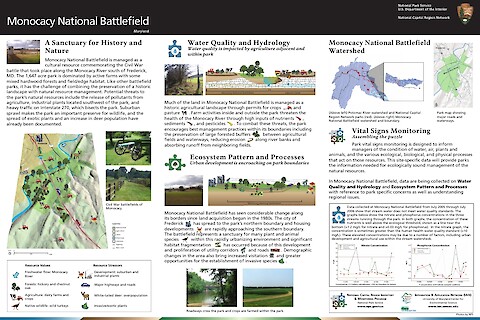
Monocacy National Battlefield is managed as a cultural resource commemorating the Civil War battle that took place along the Monocacy River south of Frederick, MD. The 1,647 acre park is dominated by active farms with some mixed hardwood forests and field/edge habitat. Like other battlefield parks, it has the challenge of combining the preservation of a historic landscape with natural resource management.

National Capital Parks-East (Page 1)

National Capital Parks-East

Jane Hawkey, Tim Carruthers, Bill Dennison ·

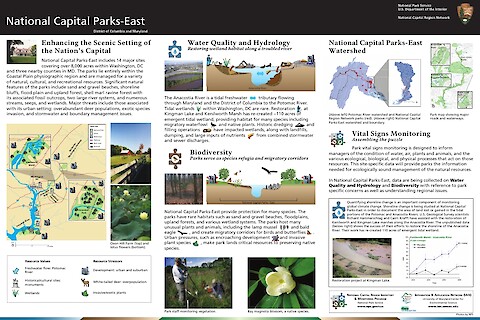
National Capital Parks-East includes 14 major sites covering over 8,000 acres within Washington, DC and three nearby counties in MD. The parks lie entirely within the Coastal Plain physiographic region and are managed for a variety of natural, cultural, and recreational resources.

Prince William Forest Park (Page 1)

Prince William Forest Park

Jane Hawkey, Tim Carruthers, Bill Dennison ·

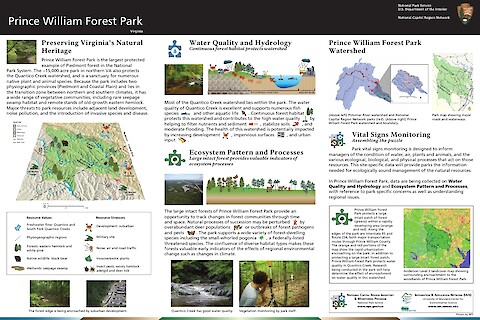
Prince William Forest Park is the largest protected example of Piedmont forest in the National Park System. The ~15,000 acre park in northern VA also protects the Quantico Creek watershed, and is a sanctuary for numerous native plant and animal species.

Rock Creek Park (Page 1)

Rock Creek Park

Jane Hawkey, Tim Carruthers, Bill Dennison ·

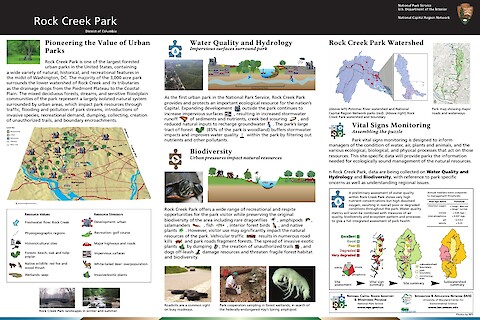
Rock Creek Park is one of the largest forested urban parks in the United States, containing a wide variety of natural, historical, and recreational features in the midst of Washington, D.C. The majority of the 3,000 acre park surrounds the lower watershed of Rock Creek and its tributaries as the drainage drops from the Piedmont Plateau to the Coastal Plain.

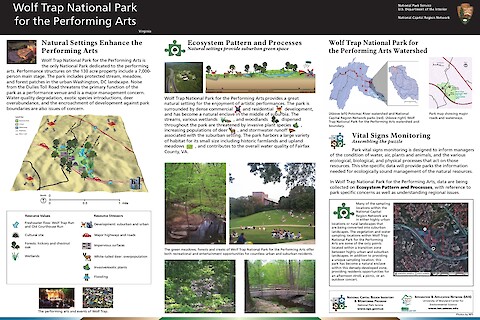
Wolf Trap National Park for the Performing Arts (Page 1)

Wolf Trap National Park for the Performing Arts

Jane Hawkey, Tim Carruthers, Bill Dennison ·

Wolf Trap National Park for the Performing Arts is the only National Park dedicated to the performing arts. Performance structures on the 130 acre property include a 7,000-person main stage. The park includes protected stream, meadow, and forest patches in the urban Washington, DC landscape. Noise from the Dulles Toll Road threatens the primary function of the park as a performance venue and is a major management concern.

Water quality in four regions of the Maryland Coastal Bays: assessing nitrogen source in relation to rainfall and brown tide (Page 1)

Water quality in four regions of the Maryland Coastal Bays: assessing nitrogen source in relation to rainfall and brown tide

Fertig BM, Carruthers TJB, Wazniak C, Sturgess B, Hall M, Jones AB, and Dennison WC ·

Monitoring water quality and determining nutrient inputs is essential to assess ecosystem health. Partnering with the Maryland Coastal Bays Program and the Department of Natural Resources, this study focused on four regions in Maryland's Coastal Bays. These regions, St Martins River, Public Landing, Johnson's Bay, and Chincoteague Island, were found to be nitrogen 'hotspots' by the 2004 water quality assessment study.

Communicating Science Effectively: A Practical Handbook for Integrating Visual Elements

Thomas JE, Saxby TA, Jones AB, Carruthers TJB, Abal EG and Dennison WC ·

This is a practical handbook on how to communicate science effectively. The first part is an introduction to the principles of science communication – what effective science communication is, why it is important, and how to do it. The principles in these chapters include how effective science communication can change societal paradigms and make one a better scientist.

A Conceptual Basis for Natural Resource Monitoring (Page 1)

A Conceptual Basis for Natural Resource Monitoring

Bill Dennison, Tim Carruthers, Jane Hawkey ·

Knowing the condition of natural resources in national parks is fundamental to the National Park Service's (NPS) mission to maintain park resources "unimpaired for the enjoyment of future generations." Most parks are open systems vulnerable to threats such as air and water pollution and invasive species, which originate outside of the park's boundaries.