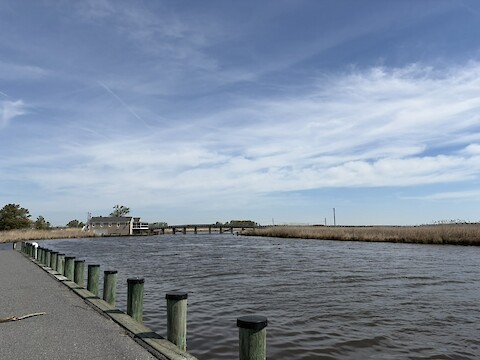
Landscape view of the wildlife refuge that features water, a small bit of road, and a building.

A drive through the early signs of spring

Sidney Anderson ·

As part of a field check for the Chesapeake Monitoring Cooperative, fellow science communicator Ann Foo and I made a trip out to Blackwater National Wildlife Refuge to observe a water monitoring sampling day with an incredibly knowledgeable set of volunteers. Upon learning that I had never visited the refuge before, the volunteers suggested that we spend some time on Wildlife Drive before we left, so Ann and I headed out to do a quick loop after sampling was finished.

Centering People in Conservation

Annie Carew ·

Humans love stories. If we can use science communication tools to construct a compelling narrative around science, we can connect to people on issues that they care about. This level of connection is a powerful motivator. Centering people in our science makes science relevant and actionable.

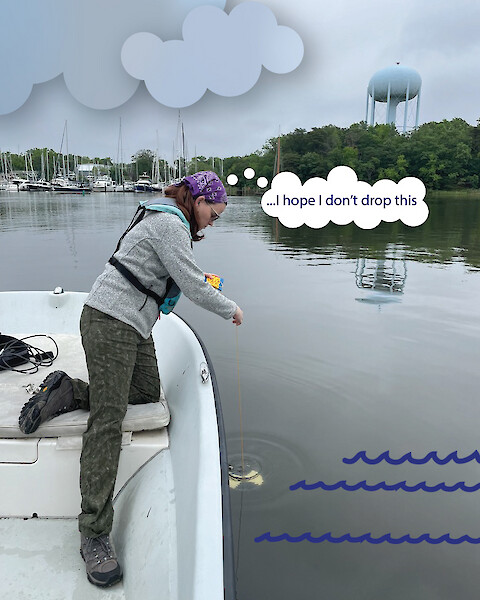
A young woman leans over the side of the boat, dangling a Secchi disk into the water. The black-and-white disk is still visible at this depth. The depth of a Secchi disk tells us how clear the water is. Above the young woman's head, a thought bubble reads, "...I hope I don't drop this"

Clean water sustains life

Annie Carew · Science Communication | 

Living in the Chesapeake Bay Watershed, water is a constant topic of conversation. The health of our waterways is important to the health and happiness of communities, whether you live on the Eastern Shore or in the Appalachians. Clean water impacts everyone. People, plants, and animals all rely on having clean and reliable sources of water. Aquatic food webs—underwater plants, insect larvae, and fishes of all sizes—cannot function if the water is polluted.

Uncovering five values of citizen science at CitSci2019

Suzanne Webster · Science Communication | Learning Science | 

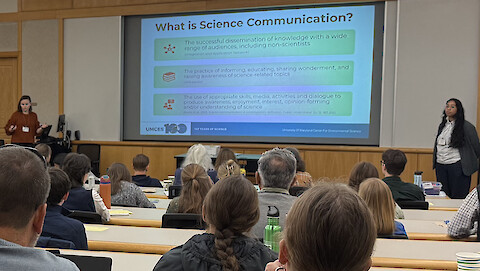
Last month, Caroline, Alex, and I attended the Citizen Science Association (CSA) conference, CitSci2019, from March 13-16th in Raleigh, North Carolina. This conference was a great opportunity for us to learn more about what is happening in the field of citizen science, network with other professionals, and share updates on some of the projects that we are involved in at IAN.

Spanning boundaries at the Society for Applied Anthropology conference

Suzanne Webster · Applying Science | Learning Science |     1 comments

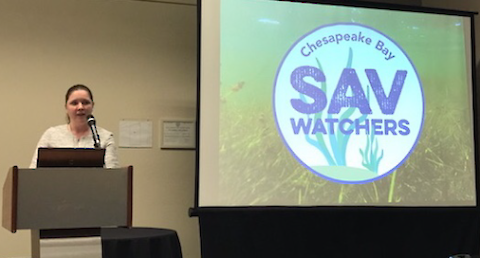
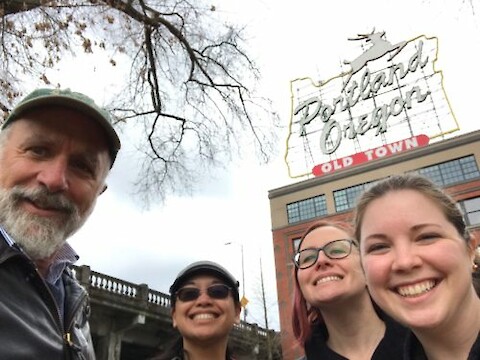
Earlier this month, Bill, Katie May, Vanessa, and I travelled to Portland, Oregon to attend the Society for Applied Anthropology (SfAA) conference from March 19-23. We were all excited for the opportunity to learn from researchers and practitioners who work in the social sciences, and to absorb new ideas and approaches that will help us enhance IAN’s capacity to do work that spans natural and social science disciplines.

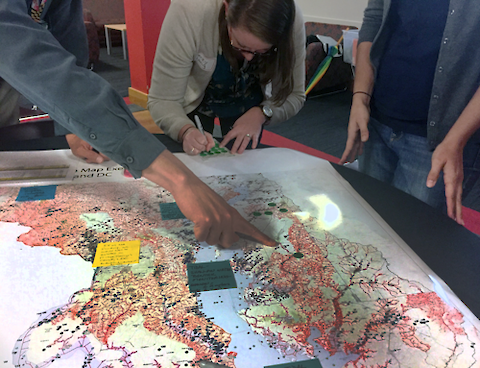
Using maps to prioritize monitoring.

Pursuing prioritization in Pennsylvania: The magic of more monitoring

Alexandra Fries · Science Communication | Applying Science | Learning Science | 

On October 13th, Caroline Donovan and I traveled to Dickinson College in Carlisle, PA for the Prioritization Workshop. This workshop was held as part of the Chesapeake Monitoring Cooperative (CMC) project that UMCES is a partner of as well as Alliance for the Chesapeake Bay, Izaak Walton League of America, and the Alliance for Aquatic Resource Monitoring (ALLARM). The workshop was hosted by ALLARM at Dickinson College.