IAN is committed to producing practical, user-centered communications that foster a better understanding of science and enable readers to pursue new opportunities in research, education, and environmental problem-solving. Our publications synthesize scientific findings using effective science communication techniques.

How to Respond to Changing Ecosystems: Resist, Accept, or Direct? (Page 1)

How to Respond to Changing Ecosystems: Resist, Accept, or Direct?

Yesenia Valverde, Bill Dennison ·

The American Fisheries Society (AFS) and The Wildlife Society’s (TWS) Climate Change and Wildlife Working Group identified ecosystem transformation as a top priority topic to address the emerging climate change issues in natural resource management. A nominated team of experts participated in a workshop on the topic that will result in two synthesis publications.

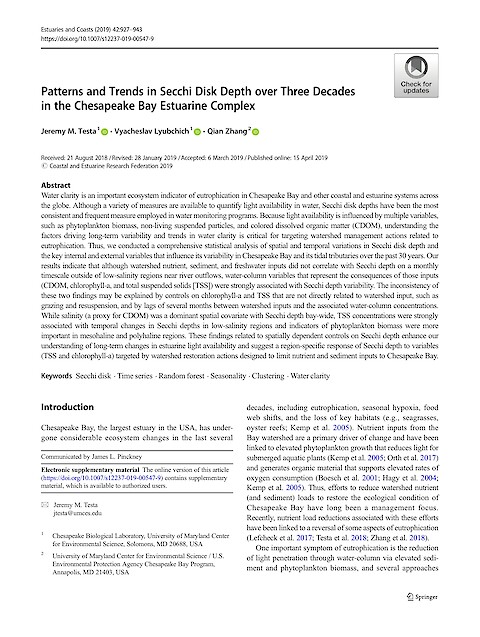
A Generalized Additive Model approach to evaluating water quality: Chesapeake Bay case study (Page 1)

A Generalized Additive Model approach to evaluating water quality: Chesapeake Bay case study

Murphy RR, Perry E, Harcum J, and Keisman J ·

Nutrient reduction efforts have been undertaken in recent decades to mitigate the impacts of eutrophication in coastal and estuarine systems worldwide. To track progress in response to one of these efforts we use Generalized Additive Models (GAMs) to evaluate a diverse suite of water quality constituents over a 32-year period in the Chesapeake Bay, an estuary on the east coast of the United States.

Chesapeake Bay SAV Watchers - Guide to the Introductory Monitoring Program (Tier 1) (Page 1)

Chesapeake Bay SAV Watchers

Guide to the Introductory Monitoring Program (Tier 1)

Suzanne Webster, Bill Dennison ·

This guide includes detailed instructions for volunteers who are using the Water Reporter platform to collect and submit data for the Chesapeake Bay SAV Watchers Introductory Monitoring Program.

Chesapeake Bay SAV Watchers - Pocket Field Guide (Online viewing version) (Page 1)

Chesapeake Bay SAV Watchers - Pocket Field Guide (Online viewing version)

Katie May Laumann, Suzanne Webster, Dylan Taillie, Sky Swanson ·

A pocket-sized SAV species identification guide that also includes a field packing list, protocol reminders, and reference photos of other macrophytes. For use in the field by volunteers participating in the Chesapeake Bay SAV Watchers Introductory and Advanced Monitoring Programs. This version is designed to be viewed on a phone or computer screen.

Tuul River Basin Report Card 2019 (Page 1)

Tuul River Basin Report Card 2019

Simon Costanzo, Dylan Taillie ·

The Tuul River Basin Report Card—the first of its kind in Mongolia—assesses the basin's health through social, environmental and economic values that can be tracked over time in response to management actions and/or external pressures. The Tuul River Basin has been evaluated in this assessment as “moderate” health or ‘C’, meaning urgent management interventions are required to maintain the health of the river.

Conceptual Framework for Assessing Ecosystem Health (Page 1)

Conceptual Framework for Assessing Ecosystem Health

Harwell MA, Gentile JH, McKinney LD, Tunnell Jr JW, Dennison WC, Kelsey RH, Stanzel KM, Stunz GW, Withers K, and Tunnell J ·

Over the past century, the environment of the Gulf of Mexico has been significantly altered and impaired by extensive human activities. A national commitment to restore the Gulf was finally initiated in response to the unprecedented Deepwater Horizon oil spill in 2010. Consequently, there is a critical need for an assessment framework and associated set of indicators that can characterize the health and sustainability of an ecosystem having the scale and complexity of the Gulf.