IAN is committed to producing practical, user-centered communications that foster a better understanding of science and enable readers to pursue new opportunities in research, education, and environmental problem-solving. Our publications synthesize scientific findings using effective science communication techniques.

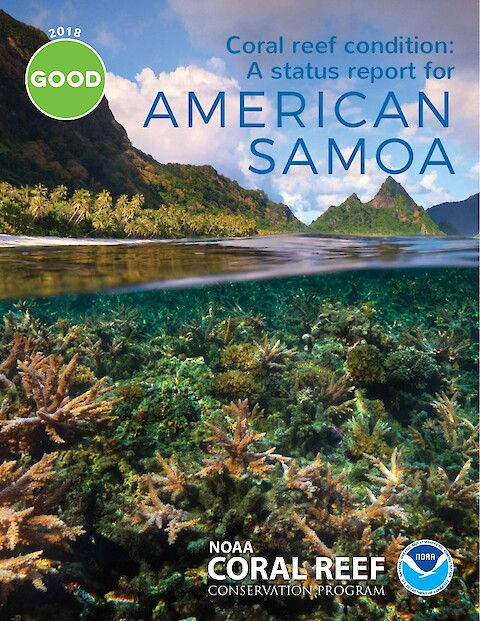
Coral reef condition: A status report for American Samoa (Page 1)

Coral reef condition: A status report for American Samoa

Jane Thomas, Caroline Donovan, Alexandra Fries, Heath Kelsey ·

Effective coral reef conservation cannot be accomplished without an informed and engaged public. The American Samoa coral status report is part of a larger effort to provide communities and decision-makers with information about managing and conserving coral reef ecosystems. The American Samoa status report presents the results of an analysis of indicators that were chosen to reflect key ecosystem processes and values.

Guanabara Bay ecosystem health report card: Science, management, and governance implications (Page 1)

Guanabara Bay ecosystem health report card: Science, management, and governance implications

Fries AS, Coimbra JP, Nemazie DA, Summers RM, Azevedo JPS, Filoso S, Newton M, Gelli G, Nunes de Oliveira RC, R. Pessoa MA, and Dennison WC ·

Guanabara Bay, a natural tropical embayment in Southeast Brazil adjacent to Rio de Janeiro, is important to the Brazilian economy as it provides areas for shipping, industry, recreation, and tourism. But commercial and residential urban development in the watershed results in water quality degradation. In Guanabara Bay, strong water quality gradients as a function of inputs and tidal flushing were evident.

Chesapeake Bay Dissolved Oxygen Criterion Attainment Deficit: Three Decades of Temporal and Spatial Patterns (Page 1)

Chesapeake Bay dissolved oxygen criterion attainment deficit: Three decades of temporal and spatial patterns

Zhang Q, Tango PJ, Murphy RR, Forsyth MK, Tian R, Keisman J, Trentacoste EM ·

Low dissolved oxygen (DO) conditions are a recurring issue in waters of Chesapeake Bay, with detrimental effects on aquatic living resources. The Chesapeake Bay Program partnership has developed criteria guidance supporting the definition of state water quality standards and associated assessment procedures for DO and other parameters, which provides a binary classification of attainment or impairment.

Using Basin Report Cards to support the TDA/SAP process (Page 1)

Using Basin Report Cards to support the TDA/SAP process

Heath Kelsey, Brianne Walsh ·

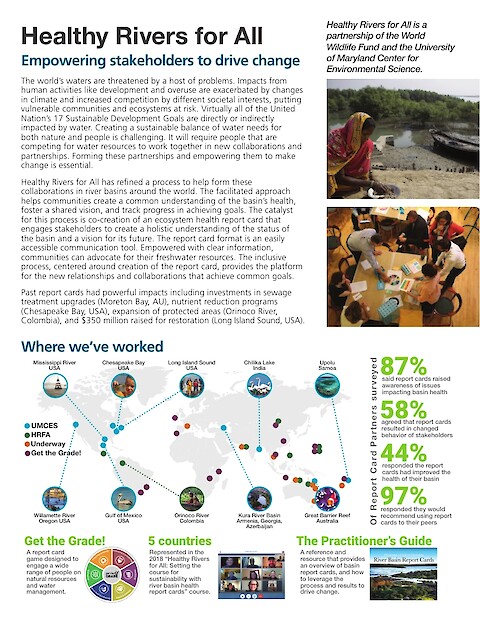
The Healthy Rivers for All partnership has created a process to develop new collaborations and partnerships in river basins to improve holistic management of water. The approach uses an inclusive process that helps communities create a common understanding of basin health, foster a shared vision for the future, and track progress in achieving goals.

2017 Maryland Coastal Bays Report Card (Page 1)

2017 Coastal Bays Report Card

Alexandra Fries, Emily Nastase ·

The aim of this report card is to provide a transparent, timely, and geographically detailed assessment of 2017 Coastal Bays health. Coastal Bays health is defined as the progress of four water quality indicators (total nitrogen, total phosphorus, chlorophyll a, dissolved oxygen) and two biotic indicators (seagrass, hard clams) toward scientifically derived ecological thresholds or goals.