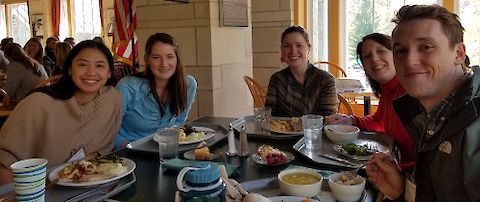
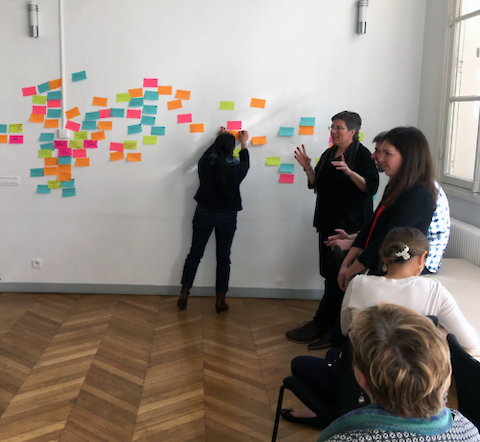
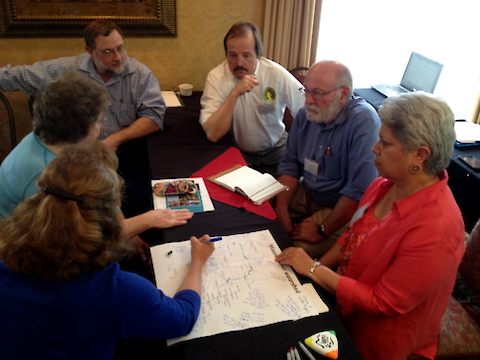
On 2-3 Dec 2017, fourteen Knauss Fellows had a science communication training retreat on the Horn Point Laboratory campus. The Integration and Application Network (IAN) has been training Knauss Fellows annually since 2013 and each year has been a lot of fun. The IAN team this year included Emily Nastase, Jamie Currie, Dylan Taillie, Caroline Donovan, and Bill Dennison. Emily Nastase worked hard at the Knauss Course.
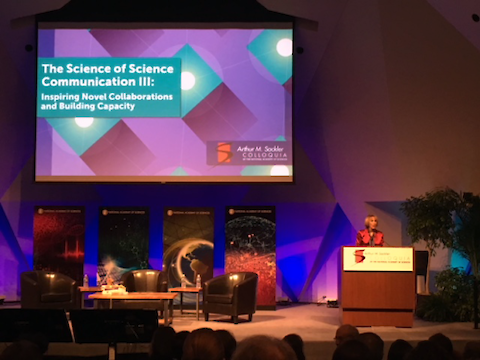
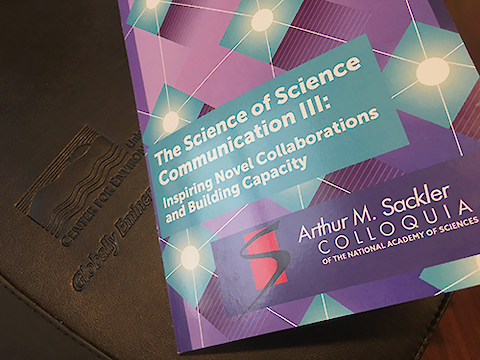
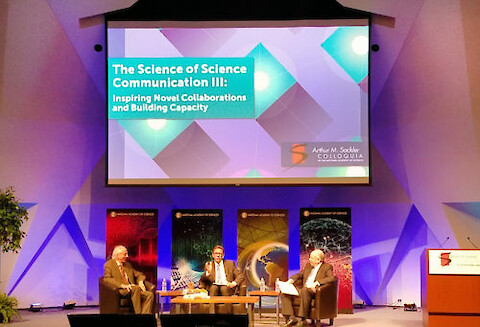
Suzi Spitzer, Vanessa Vargas and I attended the Science of Science Communication III conference hosted by the National Academy of Sciences in November 2017. The conference tackled many relevant concepts and brought social scientists into the conversation. But there were a few topics that a conference focusing on the science of science communication could have included. For future conferences there are three topics that I would like to see covered in the future:
Last month, Bill, Vanessa, and I attended the Science of Science Communication III Sackler Colloquium at the National Academy of Sciences in Washington, DC. This blog follows Vanessa’s previous post, and is the second in a series of three blogs reflecting on our experiences at this event. The conference was very information-rich and thought-provoking, and it is difficult to distill everything into even three blogs!
In November 17-18, 2017, Bill Dennison, Suzi Spitzer and I attended the Science of Science Communication III, part of the Sackler Colloquia series of the National Academy of Science. The theme was “Inspiring novel collaborations and building capacity." This theme built upon two previous colloquia in 2012 and 2014, but focused on the consensus study report Communicating Science Effectively: A Research Agenda, in particular.
Last month, several IAN staff members traveled to the National Conservation Training Center in Shepherdstown, West Virginia, to attend the Chesapeake Watershed Forum. The Forum is an annual regional conference hosted by the Alliance for the Chesapeake Bay. This year IAN was represented by Caroline, Emily, Dylan, Vanessa, and Suzi. The 2017 conference theme was Healthy Lands, Healthy Waters, Healthy People.
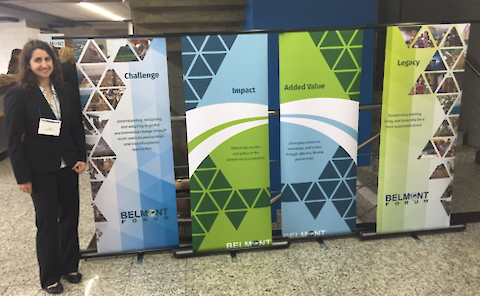
I recently traveled to Sao Paulo, Brazil to help facilitate the Belmont Forum Plenary Meetings Week, November 6-10, 2017. The Belmont Forum is a group of funders that support international transdisciplinary research. This research provides knowledge for understanding, mitigating, and adapting to global environmental change. Prior to the meetings, IAN staff created materials for the event, including the agenda, a booklet, presentation templates, videos, a song, and banners.
In 2002 The Integration and Application Network (IAN) was born. Based on a 2000 strategic plan formulated by the faculty of the University of Maryland Center for Environmental Science (UMCES), IAN was created because UMCES was concerned that its scientific effort was documenting environmental declines rather than helping create solutions to environmental problems.
As we’ve pioneered new ways to develop ecosystem health assessments and report cards, we’ve learned a few lessons on what makes them successful and what does not. The most successful projects (those that continue on after our involvement, creating lasting impact) are those in which we’ve approached the process as a true partnership with colleagues from diverse backgrounds, areas of expertise, and perspectives.
Twas Saturday morning, at Horn Point Lab Open House, Many creatures were stirring: scientists, children, and spouses. Posters were hung throughout the entire laboratory, In hopes that visitors would listen to our stories! The Horn Point Lab researchers created a unique alliance, With activities, displays, games, and compelling science. Our mission, as the Integration and Application Network, Was to lay for the public a science communication framework.
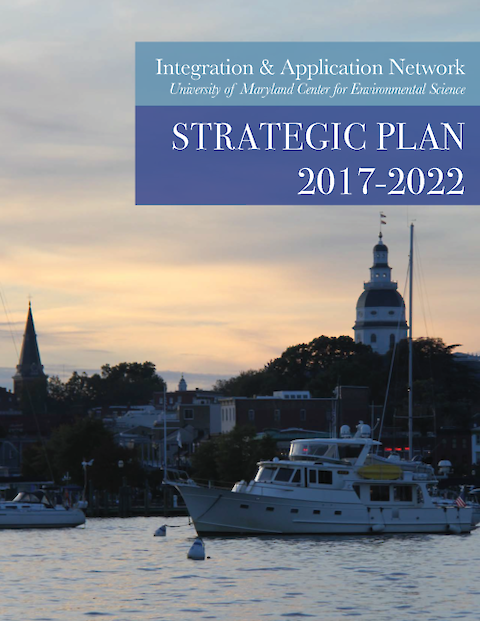
Recently, our first ever Integration and Application Network (IAN) Strategic Plan was released on IAN Press. This 16-page Strategic Plan outlines the vision, mission, and goals of the Integration and Application Network. It also identifies the IAN priorities in terms of partner engagement, social impacts and ecological outcomes. The cover of our Strategic Plan.