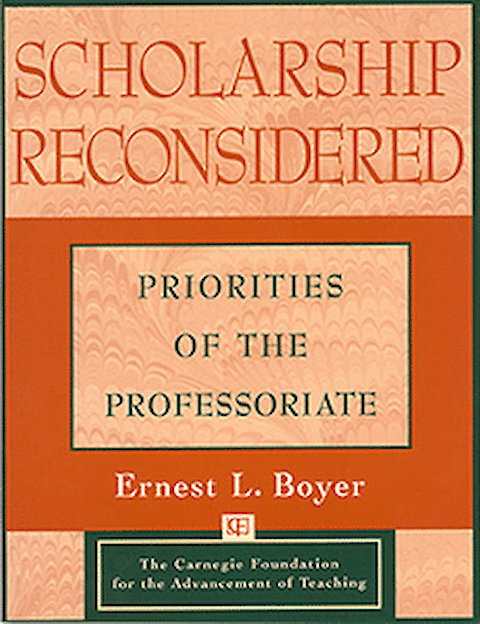
This book by Joseph Boyer, published in 1997, has stimulated a robust discussion of what constitutes academic scholarship and how to measure it.

Defining Science Application

Bill Dennison · Applying Science | 

The University of Maryland Center for Environmental Science has embraced the concept of scholarship defined as discovery, integration, application and teaching (Boyer, 1990). Discovery can be defined as learning new things; integration as putting this learning into a knowledge context; application as using this knowledge; teaching as transferring this knowledge to others. The Integration and Application Network was created to focus on the integration and application components of scholarship.

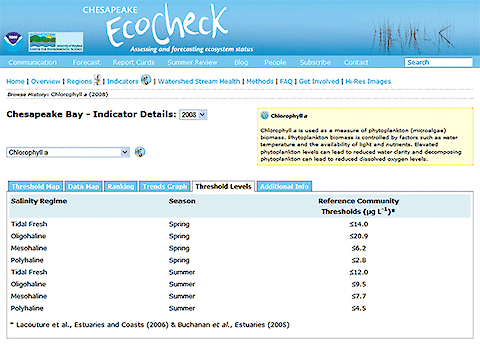
Example of thresholds used for chlorophyll a indicator from the EcoCheck web site

Environmental report card grading system

Bill Dennison · Environmental Report Cards | 

The grading system used in the EcoCheck environmental report cards is a simple, systematic ranking scale. The one hundred point scale is divided into five equal categories; A (80-100), B (80-60), C (60-40), D (40-20) and F (20-0). Furthermore, the grades have a plus and minus scale, so that the upper 5 points of the 20 point range results in a plus score and the lower 5 points of the 20 point range results in a minus score.

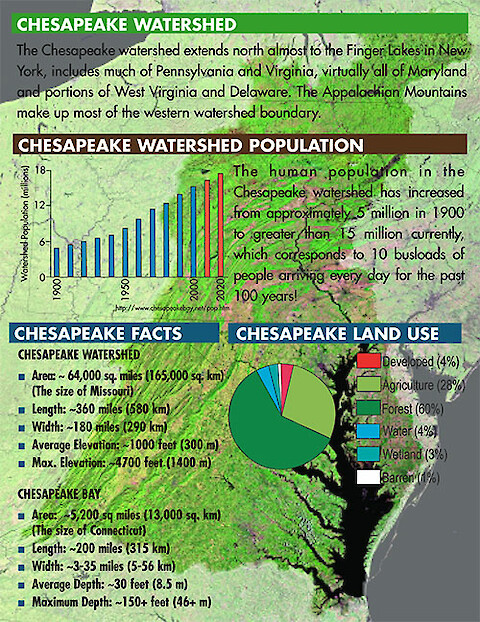
Chesapeake Bay and watershed (from IAN newsletter, Healthy Chesapeake Waterways, 2002)

Chesapeake literacy

Bill Dennison · Environmental Literacy | 

The concept of Chesapeake environmental literacy derives from a series of programs that have established various literacy principles, for example, ocean literacy (www.coexploration.org). These programs have distilled the essence of what an informed person needs to know, thus informing both formal (e.g., classroom) and informal (e.g., museums) educators.

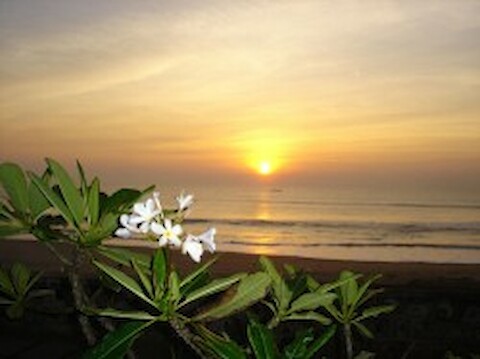
Sunrise over the beach at Mamallapuram

Thoughts on Chennai, India

Tim Carruthers · Applying Science | 

Recently, Tim Carruthers from IAN was fortunate to have the opportunity to visit Tamil Nadu in India for a LOICZ (Land Ocean Interactions of the Coastal Zone) meeting. Here are some thoughts and observations on Chennai and the surrounding country side. Having always wanted to visit India, this was a fantastic opportunity and apart from beautiful sunrises, amazing history, and a welcome break from a long northern winter, I was struck by how friendly and engaging Indian folks are.

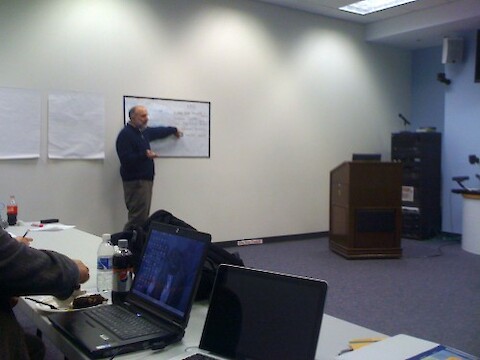
Bill Dennison presenting at the workshop

Trip to NASA Goddard Space Flight Center; 29 March 2010

Bill Dennison · Applying Science | 

"Perspectives on NASA/Goddard Space Flight Center Data and Modeling for Chesapeake Bay Research and Applications" workshop … NASA scientists initiated a meeting with Chesapeake Bay scientists to compare the remote sensing needs for Chesapeake Bay research, monitoring, modeling and management with the capabilities that NASA remote sensing programs can provide.

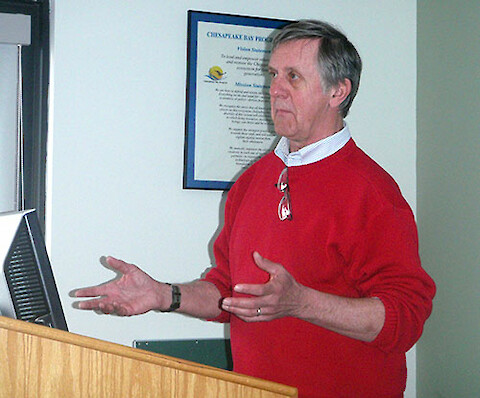
Walter Boynton giving his seminar

Discussion following Walter Boynton seminar on Corsica River estuary restoration

Bill Dennison · Learning Science | 

This blog post discusses the seminar given by Dr Walter Boynton, of the Chesapeake Biological Laboratory, at the IAN Seminar Series on March 25, 2010. If agricultural nutrient management activities like cover crops were instituted, how long would it take to see an effect in the estuary? Time lags were a topic of much discussion regarding the potential delay in restoration progress due to long groundwater residence times.

Discussion following Sara Powell seminar on Getting out of the Lake and into the Watershed: a study of volunteer monitoring efforts, water quality, and community outreach

Bill Dennison · Learning Science | 

This blog post discusses the seminar given by Sara Powell, of the Chesapeake Biological Laboratory, at the IAN Seminar Series on February 25, 2010. The issue of what constitutes a citizen scientist was discussed, and several issues regarding data quality assurance were raised. The turnover of different citizen scientists means that ongoing training was necessary. Mechanisms to cull bad data are needed with citizen scientist groups.

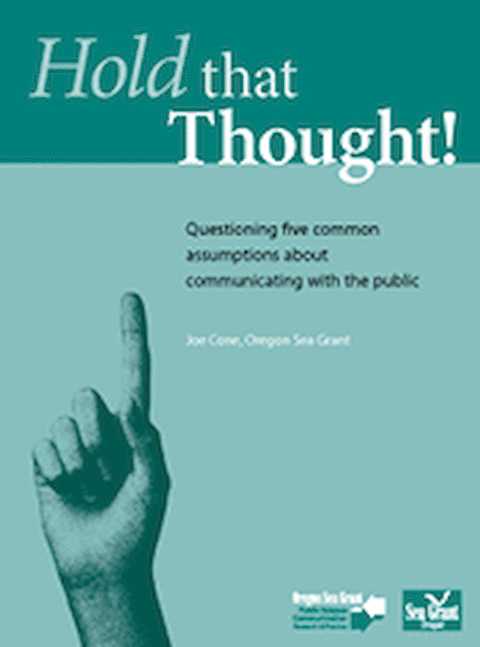
Hold that Thought

Is Science Communication an art?

Bill Dennison · Science Communication | 

A publication by Oregon Sea Grant in 2008 entitled "Hold That Thought!: Questioning five common assumptions about communicating with the public" by Joe Cone presents as one of the myths "Science communication is an art". Integration and Application Network (IAN) staff often introduce science communication principles and examples by using the title "Zen and the Art of Science Communication" which does infer that there is an art to science communication.

Recommendations by the 'Friends of the Bay' to enhance Chesapeake Bay restoration featured in the Annapolis Capital

Friends of the Bay go to Washington, D.C.

Bill Dennison · Applying Science | 

A group of concerned former politicians, scientists and riverkeepers converged on federal agencies in Washington, D.C. to discuss Chesapeake Bay restoration. This loosely associated group has been convened by Gerald Winegrad, a former Maryland state senator from Annapolis, and currently totals 38 people. The group includes two former Maryland governors, a former U.S. senator, former U.S. congressman.