Publications about Chesapeake Bay

IAN is committed to producing practical, user-centered communications that foster a better understanding of science and enable readers to pursue new opportunities in research, education, and environmental problem-solving. Our publications synthesize scientific findings using effective science communication techniques.

Summer 2005 ecological forecast technical documentation (Page 1)

Summer 2005 ecological forecast technical documentation

Jasinski D, Tango P, Williams M and Longstaff BJ ·

This document describes the rationale and methods for determining the summer ecological forecasts for dissolved oxygen, harmful algal blooms and submerged aquatic vegetation for 2005.

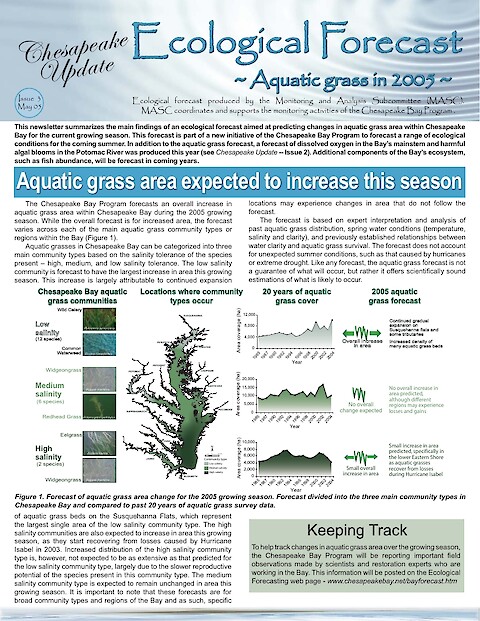
MASC Newsletter 3 - Ecological Forecast, Aquatic Grass in 2005 (Page 1)

MASC Newsletter 3 - Ecological Forecast, Aquatic Grass in 2005

Ben Longstaff ·

This newsletter summarizes the main findings of an ecological forecast aimed at predicting changes in aquatic grass area within Chesapeake Bay for the current growing season. This forecast is part of a new initiative of the Chesapeake Bay Program to forecast a range of ecological conditions for the coming summer.

MASC Newsletter 2 - Ecological Forecast, Summer 2005 (Page 1)

MASC Newsletter 2 - Ecological Forecast, Summer 2005

Ben Longstaff, David Jasinski ·

This newsletter summarizes the main findings and methods of a new initiative to forecast ecological conditions of Chesapeake Bay for the coming summer. This year’s forecast focuses on three important elements of the Bay’s health—dissolved oxygen (DO) in the Bay’s mainstem, harmful algal blooms (HABs) in the Potomac River, and changes in submerged aquatic vegetation (SAV) distribution.

Redesign of Chesapeake Bay Program indicator structure and communication strategy: Goals, rationale and products (Page 1)

Redesign of Chesapeake Bay Program indicator structure and communication strategy: Goals, rationale and products

Ben Longstaff ·

The Indicator Redesign Taskforce was assembled to provide a vision for the Chesapeake Bay Program indicators and the manner in which they are communicated. In doing so, the Indicator Redesign Taskforce is initiating and steering the necessary changes through the Monitoring and Analysis Subcommittee. This document describes the goals, approach and methods used to redesign the ecological indicators and outlines the communication strategy used to convey these changes to the public.

Chesapeake Bay Environmental Models (Page 1)

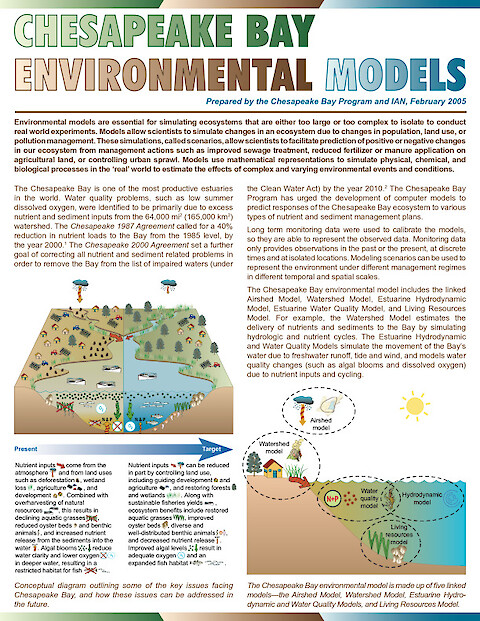
Chesapeake Bay Environmental Models

Ping Wang, Bill Dennison, Jane Thomas ·

Environmental models are essential for simulating ecosystems that are either too large or too complex to isolate to conduct real world experiments. Models allow scientists to simulate changes in an ecosystem due to changes in population, land use, or pollution management.

MASC Newsletter 1 - Water Quality 2004 (Page 1)

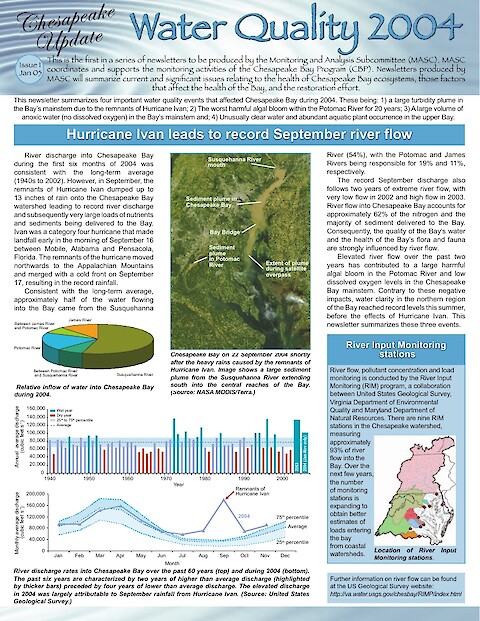
MASC Newsletter 1 - Water Quality 2004

Ben Longstaff ·

This is the first in a series of newsletters to be produced by the Monitoring and Analysis Subcommittee (MASC). MASC coordinates and supports the monitoring activities of the Chesapeake Bay Program (CBP). Newsletters produced by MASC will summarize current and significant issues relating to the health of Chesapeake Bay ecosystems, those factors that affect the health of the Bay, and the restoration effort.

Modelling phytoplankton deposition to Chesapeake Bay sediments during winter-spring: interannual variability in relation to river flow

Hagy JD, Boynton WR, and Jasinski DA ·

The often-rapid deposition of phytoplankton to sediments at the end of the spring phytoplankton bloom is an important component of benthic-pelagic coupling in temperate and high latitude estuaries and other aquatic systems. However, quantifying the flux is difficult, particularly in spatially heterogeneous environments.

Seasonal and annual variability in the spatial patterns of plankton biomass in Chesapeake Bay

Roman M, Zhang X, McGilliard C, and Boicourt W ·

We conducted high-resolution, underway sampling in April, July, and October for 6 yr (1995-2000) in the large estuary, Chesapeake Bay. This period included climatological extremes in freshwater inputs that strongly influenced both the overall stocks and spatial distribution of phytoplankton and zooplankton. Higher biomass of both phytoplankton and zooplankton occurred in springs, when freshwater input into Chesapeake Bay was above the average discharge.

Crassostrea ariakensis: Panacea or Pandora? (Page 1)

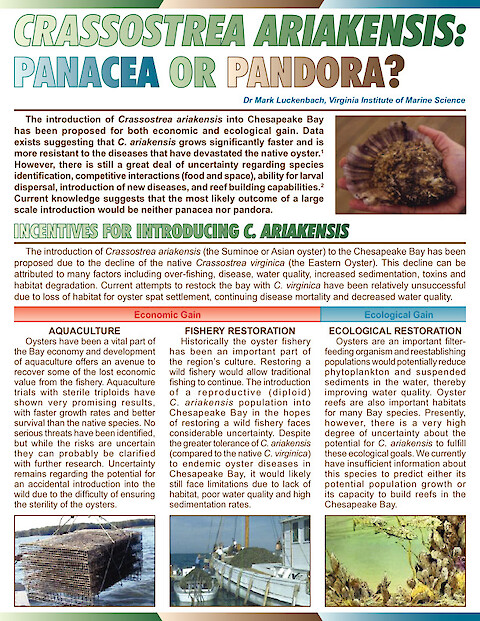
Crassostrea ariakensis: Panacea or Pandora?

Adrian Jones, Tracey Saxby ·

This newsletter is based on research conducted by Dr Mark Luckenbach and a presentation he gave at the Chesapeake Bay Seminar Series in July 2003. The introduction of Crassostrea ariakensis into Chesapeake Bay has been proposed for both economic and ecological gain. Data exists suggesting that C. ariakensis grows significantly faster and is more resistant to the diseases that have devastated the native oyster.

Nutrient Management of Delmarva Soils & Waters (Page 1)

Nutrient Management of Delmarva Soils & Waters

Jane Thomas ·

This newsletter is based on the 'Status of nutrients in Delmarva soils, groundwaters, creeks and tributaries forum', October 21, 2003. Extensive poultry operations and associated feed grain production on the Delmarva Peninsula have resulted in elevated nutrient levels in soils, groundwater, creeks and tributaries of the Chesapeake Bay.