Publications about Chesapeake Bay

IAN is committed to producing practical, user-centered communications that foster a better understanding of science and enable readers to pursue new opportunities in research, education, and environmental problem-solving. Our publications synthesize scientific findings using effective science communication techniques.
Modelling phytoplankton deposition to Chesapeake Bay sediments during winter-spring: interannual variability in relation to river flow

Hagy JD, Boynton WR, and Jasinski DA ·

The often-rapid deposition of phytoplankton to sediments at the end of the spring phytoplankton bloom is an important component of benthic-pelagic coupling in temperate and high latitude estuaries and other aquatic systems. However, quantifying the flux is difficult, particularly in spatially heterogeneous environments.

Seasonal and annual variability in the spatial patterns of plankton biomass in Chesapeake Bay

Roman M, Zhang X, McGilliard C, and Boicourt W ·

We conducted high-resolution, underway sampling in April, July, and October for 6 yr (1995-2000) in the large estuary, Chesapeake Bay. This period included climatological extremes in freshwater inputs that strongly influenced both the overall stocks and spatial distribution of phytoplankton and zooplankton. Higher biomass of both phytoplankton and zooplankton occurred in springs, when freshwater input into Chesapeake Bay was above the average discharge.

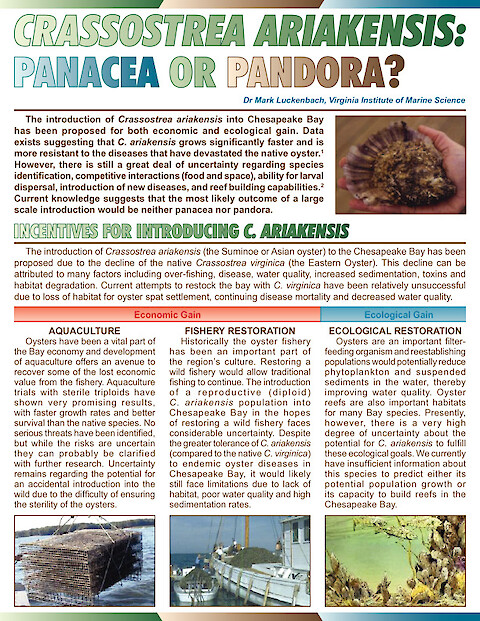
Crassostrea ariakensis: Panacea or Pandora? (Page 1)

Crassostrea ariakensis: Panacea or Pandora?

Adrian Jones, Tracey Saxby ·

This newsletter is based on research conducted by Dr Mark Luckenbach and a presentation he gave at the Chesapeake Bay Seminar Series in July 2003. The introduction of Crassostrea ariakensis into Chesapeake Bay has been proposed for both economic and ecological gain. Data exists suggesting that C. ariakensis grows significantly faster and is more resistant to the diseases that have devastated the native oyster.

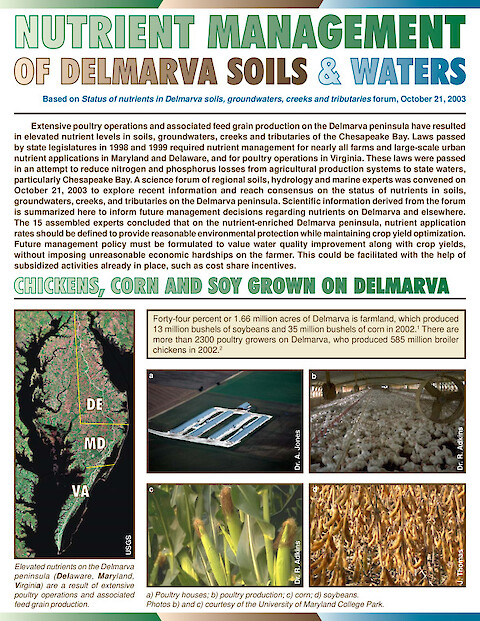
Nutrient Management of Delmarva Soils & Waters (Page 1)

Nutrient Management of Delmarva Soils & Waters

Jane Thomas ·

This newsletter is based on the 'Status of nutrients in Delmarva soils, groundwaters, creeks and tributaries forum', October 21, 2003. Extensive poultry operations and associated feed grain production on the Delmarva Peninsula have resulted in elevated nutrient levels in soils, groundwater, creeks and tributaries of the Chesapeake Bay.

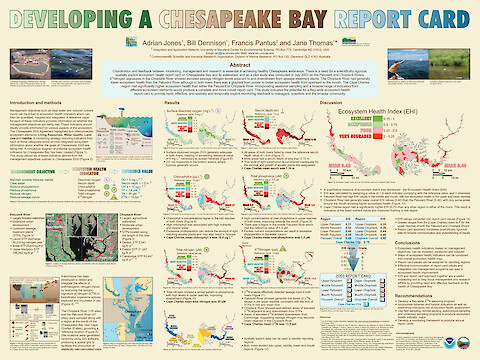
Developing a Chesapeake Bay Report Card (Page 1)

Developing a Chesapeake Bay Report Card

Adrian Jones, Bill Dennison, Jane Thomas ·

This poster details the importance of developing a scientifically rigorous, spatially explicit ecosystem health report card on Chesapeake Bay and its watershed to facilitate coordination and feedback between monitoring, management and research. A pilot study was conducted in July 2003 on the Patuxent and Choptank Rivers using a novel stable isotope technique (see "Assessing Nutrient Sources" newsletter below) together with more traditional water quality monitoring techniques.

A comparison of issues and management approaches in Moreton Bay, Australia and Chesapeake Bay, USA (Page 1)

A comparison of issues and management approaches in Moreton Bay, Australia and Chesapeake Bay, USA

Dennison WC, Carruthers TJB, Thomas JE, and Glibert PM ·

Management of coastal systems is becoming increasingly important, however understanding the process of effective management often remains elusive. This chapter contrasts examples of environmental problems and associated management in Moreton Bay, Australia, and Chesapeake Bay, USA. Targeted research in Moreton Bay identified specific issues which led to changed practices, while intense management and research in Chesapeake Bay has been unable to keep pace with increasing anthropogenic stress.

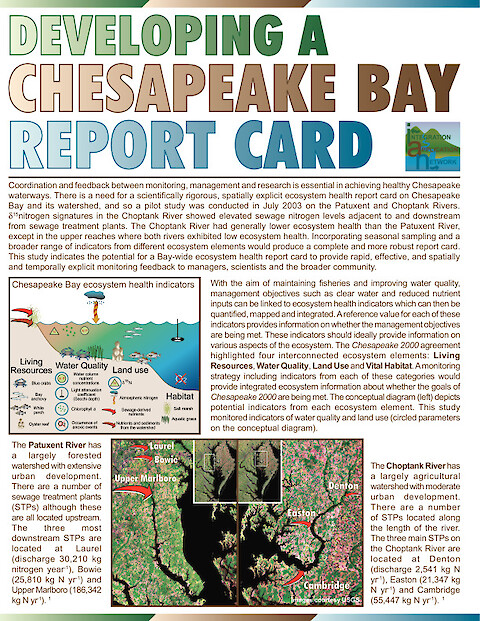
Developing a Chesapeake Bay Report Card (Page 1)

Developing a Chesapeake Bay Report Card

Adrian Jones, Jane Thomas ·

This newsletter details the importance of developing a scientifically rigorous, spatially explicit ecosystem health report card on Chesapeake Bay and its watershed to facilitate coordination and feedback between monitoring, management and research. A pilot study was conducted in July 2003 on the Patuxent and Choptank Rivers using a novel stable isotope technique (see "Assessing Nutrient Sources" newsletter below) together with more traditional water quality monitoring techniques.

Healthy Chesapeake Waterways (Page 1)

Healthy Chesapeake Waterways

Tim Carruthers ·

This science newsletter focuses on the role of the Integration and Application Network (IAN) in achieving healthy Chesapeake waterways. This is the first in a series of IAN newsletters on topical issues and is directed towards the scientific and technical audience. This newsletter identifies IAN's vision for Healthy Chesapeake Waterways and includes an overview of environmental problem solving, through transfer of data into information into knowledge and ultimately into problem solving.

Science and Site 104: Long-term Options for Dredged Sediment Placement (Page 1)

Science and Site 104: Long-term Options for Dredged Sediment Placement

Baker JE, Boesch DF, Boicourt WC, Boynton WR, Chao SY, Cornwell JC, Fisher TR, Houde ED, Kennedy VS, Mason RP, Mihursky JA, Miller TJ, Sanford LP, Secor DH, Stevenson JC and Wright DA ·

Scientists from the University of Maryland Center for Environmental Science have evaluated the scientific understanding and uncertainty related to five issues regarding the environmental effects of placement of dredged sediments at Site 104, at the head of the deep, natural channel of the Chesapeake Bay. This assessment was based on reviews of relevant studies and impact statements as well as on the scientists’ extensive knowledge and experience concerning the Chesapeake Bay ecosystem.