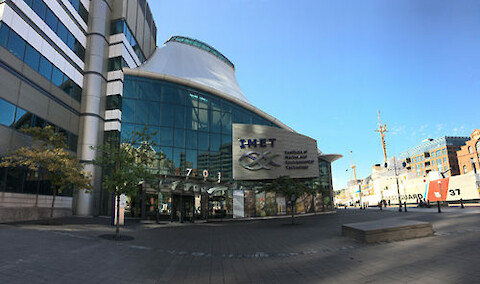
Last week on October 4-5, several of us at IAN attended the annual MEES Colloquium at the Institute of Marine and Environmental Technology (IMET), which is located along Baltimore’s Inner Harbor. IMET director Russell Hill kicked off the program with a brief welcome to the impressive multi-institutional laboratory.
Participants at the first Coastal Resilience Symposium in Mérida, Yucatán represented numerous institutions and backgrounds from Mexico, Chile, Colombia, Portugal, and the United States. Credit:
While camera phones are becoming more sophisticated with each successive generation - with increasing resolution, wider color gamut, and better depth of field - they still cannot match the image quality captured from the sensor of a DSLR (or the mirrorless cameras entering the market).
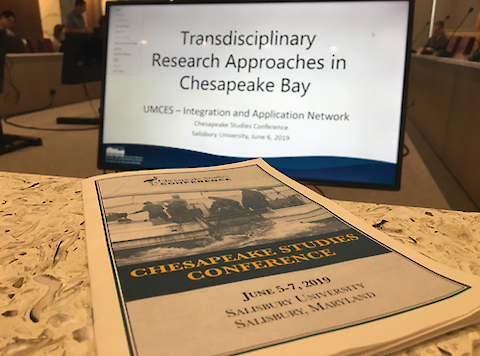
Earlier this month, several IAN team members attended the first annual Chesapeake Studies conference. This multidisciplinary conference was hosted at Salisbury University from June 5th to 7th, and was focused on the scholarly study of the Chesapeake region. It was an excellent opportunity for us to meet other Chesapeake Bay researchers, and to showcase some of IAN’s approaches for learning more about the Bay, engaging Bay stakeholders, and communicating Bay science.
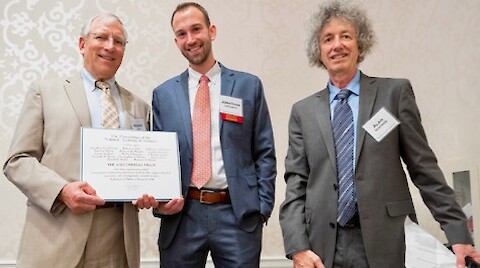
The Cozzarelli Prize, a prestigious award recognizing excellence in scientific research, was awarded to UMCES very own Bill Dennison, Rebecca Murphy, and Jeremy Testa, lead author Jon Lefcheck (Smithsonian Environmental Research Center), and their co-authors (listed below) for their study of human impacts on underwater grasses in the Chesapeake Bay. The prize recognizes 6 papers, selected by the editorial board of the Proceedings of the National Academy of Sciences , each year.
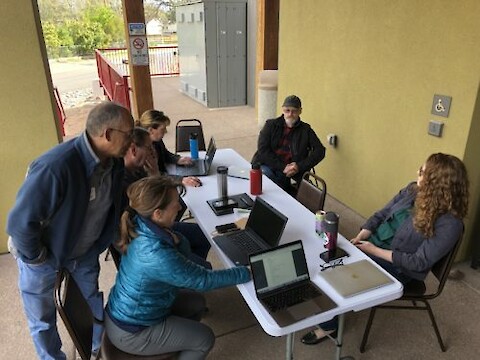
Andrew Elmore and I traveled to Toledo, Ohio to facilitate a workshop focused on indicators and thresholds for the Western Lake Erie report card project. The workshop was held on 24-25 April 2019 in the Lake Erie Center, a beautiful facility run by the University of Toledo. Sandy Bihn, the Lake Erie Riverkeeper, was our sponsor and Tom Bridgeman, University of Toledo was our host. Prior to the workshop, Andrew and I drove around the Maumee River mouth to get a feel for the region.
The Verde River flows through north-central Arizona and is a … primary water source for Phoenix. As it works its way down from its headwaters … in the Big and Little Chino Basins, the Verde provides excellent habitat for a … wide array of plants and animals. Water from the river also supports … small-scale agriculture, well-watered lawns, and accessible groundwater for … communities.
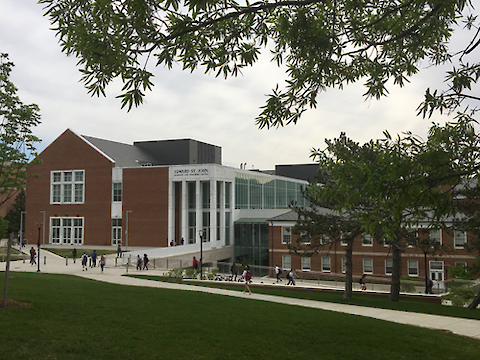
This is the second blog in a short series of posts reflecting on professional development workshops that I recently attended at the University of Maryland Teaching & Learning Transformation Center (TLTC). This second workshop was called “Planning & Facilitating Small (and Large!) Group Discussions”. The workshop was held in the Edward St.
Over the last few weeks, I attended several workshops at the University of Maryland Teaching & Learning Transformation Center (TLTC). The TLTC provides training, consultation, and various other resources to students and faculty who wish to improve their teaching. The first workshop I attended was called “Equitable and Successful Group Work”. This workshop was held in the Edward St.