IAN is committed to producing practical, user-centered communications that foster a better understanding of science and enable readers to pursue new opportunities in research, education, and environmental problem-solving. Our publications synthesize scientific findings using effective science communication techniques.

Weather extremes lead to typical conditions (Page 1)

Weather extremes lead to typical conditions

Caroline Donovan, Ben Longstaff ·

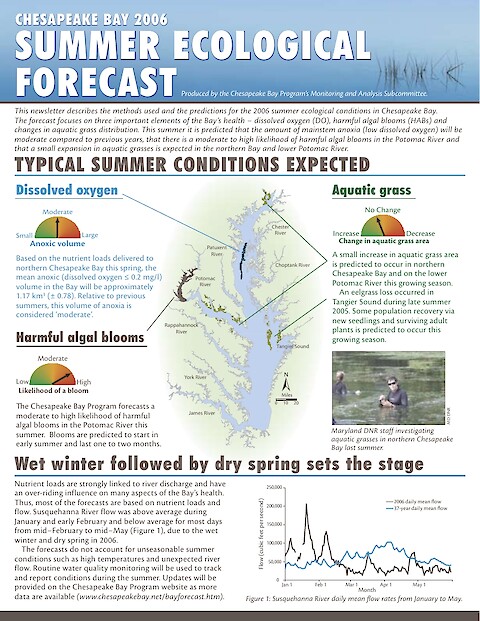
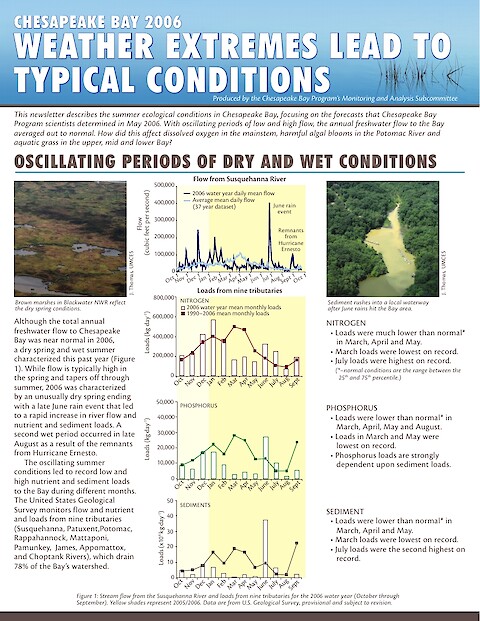
This newsletter addresses the extreme weather conditions that the Bay area experienced during the spring and summer of 2006 and how these weather conditions affected the summer ecological forecast that was released in May 2006 and other aspects of Bay health. The forecast focuses on dissolved oxygen in the mainstem, harmful algal blooms in the Potomac River and aquatic grasses in three locations in the Bay.

Investigating menhaden recruitment variability: Modeling the relationship between striped bass recovery and menhaden recruitment (Page 1)

Investigating menhaden recruitment variability: Modeling the relationship between striped bass recovery and menhaden recruitment

Zhang X, Wood RJ, Wicks EC and Longstaff BJ ·

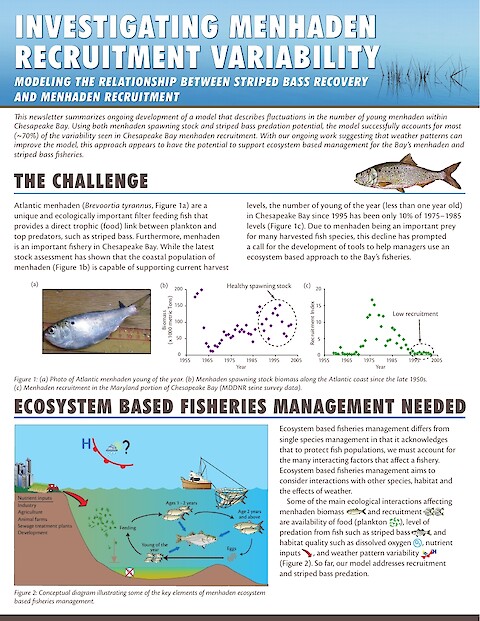
This newsletter summarizes ongoing development of a model that describes fluctuations in the number of young menhaden within Chesapeake Bay. Using both menhaden spawning stock and striped bass predation potential, the model successfully accounts for most of the variability (~70%) seen in Chesapeake Bay menhaden recruitment.

Early summer rain event (Page 1)

Early summer rain event

Caroline Donovan, Ben Longstaff ·

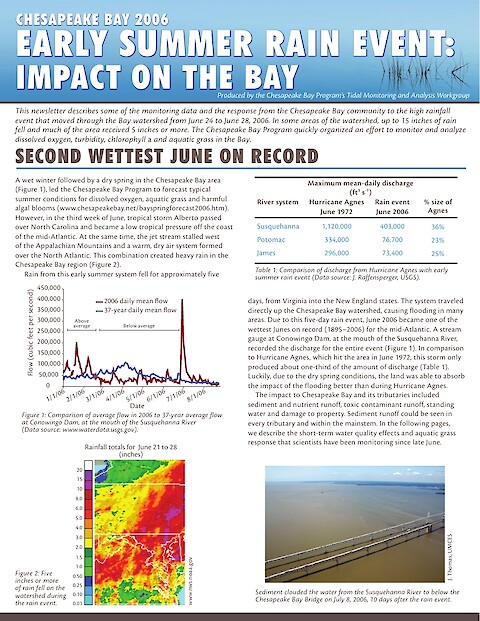
This newsletter describes some of the monitoring data and the response from the Chesapeake Bay community to the high rainfall event that moved through the Bay watershed from June 24 to June 28, 2006. In some areas of the watershed, up to 15 inches of rain fell and much of the area received 5 inches or more. The Chesapeake Bay Program quickly organized an effort to monitor and analyze dissolved oxygen, turbidity, chlorophyll a and aquatic grass in the Bay.

Enhancing Landscape Integrity in Coastal Louisiana: Water, Sediment & Ecosystems (Page 1)

Enhancing Landscape Integrity in Coastal Louisiana: Water, Sediment & Ecosystems

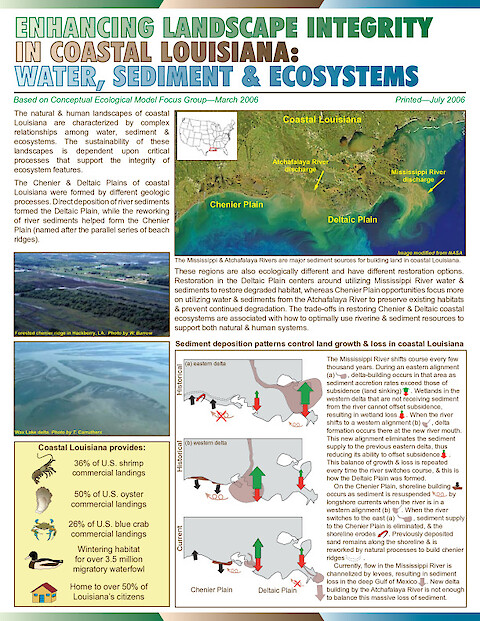
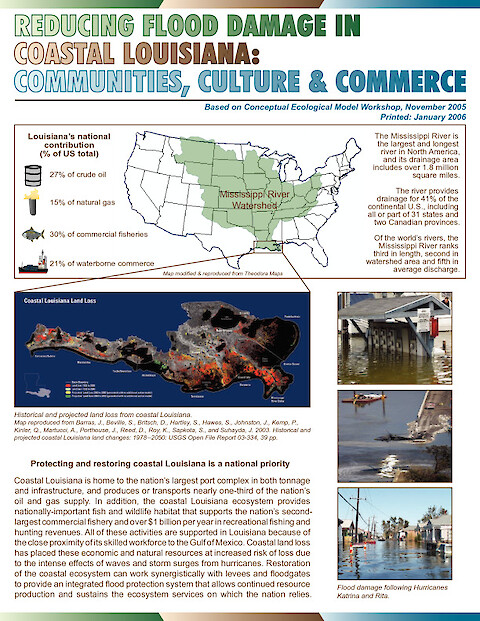
This newsletter is based on the findings of the Conceptual Ecological Model Focus Group—March 2006 and provides a number of key conclusions and recommendations. The natural & human landscapes of coastal Louisiana are characterized by complex relationships among water, sediment & ecosystems. The sustainability of these landscapes is dependent upon critical processes that support the integrity of ecosystem features.

EcoCheck (Page 1)

EcoCheck

Ben Longstaff, Caroline Donovan ·

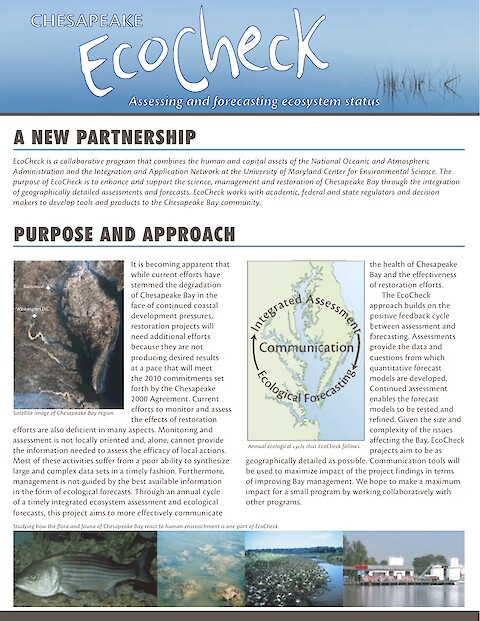
EcoCheck is a partnership between the National Oceanic and Atmospheric Administration and the University of Maryland Center for Environmental Science. This newsletter conveys their goals and approach towards improving Chesapeake Bay health. The types of projects on which EcoCheck works are also described in the newsletter.

MASC Newsletter 4 - Water Quality and Aquatic Grass Wrap Up (Page 1)

MASC Newsletter 4 - Water Quality and Aquatic Grass Wrap Up

Ben Longstaff ·

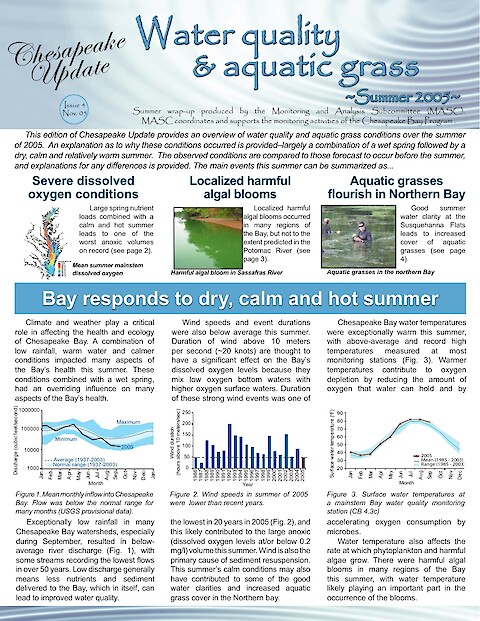
This edition of Chesapeake Update provides an overview of water quality and aquatic grass conditions over the summer of 2005. An explanation as to why these conditions occurred is provided–largely a combination of a wet spring followed by a dry, calm and relatively warm summer. The observed conditions are compared to those forecast to occur before the summer, and explanations for any differences is provided.

Bay Grass Restoration in Chesapeake Bay (Page 1)

Bay Grass Restoration in Chesapeake Bay

Bill Dennison, Tim Carruthers, Tracey Saxby ·

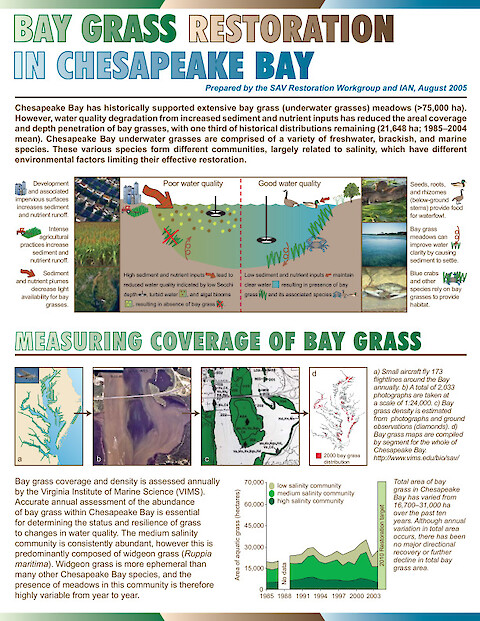
Chesapeake Bay has historically supported extensive bay grass (underwater grasses) meadows (>75,000 ha). However, water quality degradation from increased sediment and nutrient inputs has reduced the areal coverage and depth penetration of bay grasses, with one third of historical distributions remaining (21,648 ha; 1985-2004 mean). Chesapeake Bay underwater grasses are comprised of a variety of freshwater, brackish, and marine species.

Creating a framework for reporting ecological conditions: National Capital Region Network of the National Park Service (Page 1)

Creating a framework for reporting ecological conditions: National Capital Region Network of the National Park Service

Jane Hawkey ·

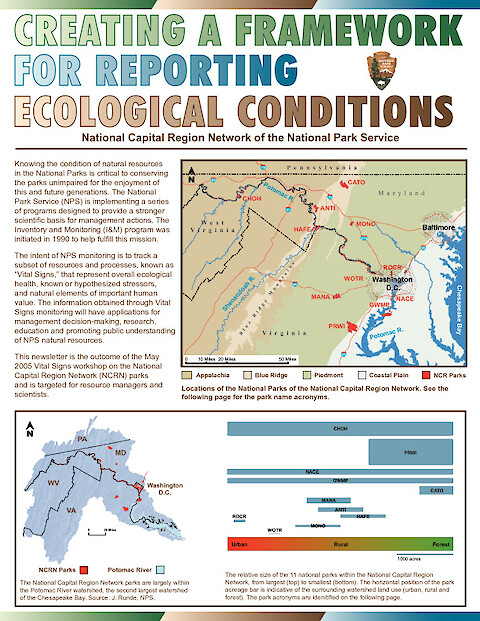
This newsletter is the product of the May 2005 Vital Signs workshop, with participants from each of the 11 National Parks within the NCRN. The National Park Service (NPS) is implementing a series of programs designed to provide a stronger scientific basis for management actions. The Inventory and Monitoring (I&M) program was initiated in 1990 to help fulfill this mission.