IAN is committed to producing practical, user-centered communications that foster a better understanding of science and enable readers to pursue new opportunities in research, education, and environmental problem-solving. Our publications synthesize scientific findings using effective science communication techniques.

MASC Newsletter 3 - Ecological Forecast, Aquatic Grass in 2005 (Page 1)

MASC Newsletter 3 - Ecological Forecast, Aquatic Grass in 2005

Ben Longstaff ·

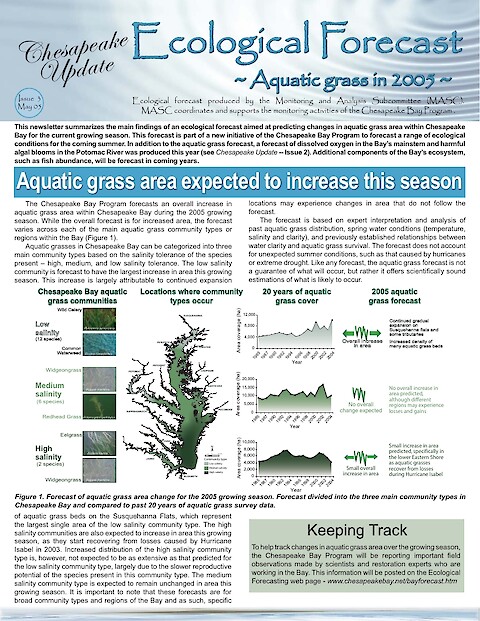
This newsletter summarizes the main findings of an ecological forecast aimed at predicting changes in aquatic grass area within Chesapeake Bay for the current growing season. This forecast is part of a new initiative of the Chesapeake Bay Program to forecast a range of ecological conditions for the coming summer.

MASC Newsletter 2 - Ecological Forecast, Summer 2005 (Page 1)

MASC Newsletter 2 - Ecological Forecast, Summer 2005

Ben Longstaff, David Jasinski ·

This newsletter summarizes the main findings and methods of a new initiative to forecast ecological conditions of Chesapeake Bay for the coming summer. This year’s forecast focuses on three important elements of the Bay’s health—dissolved oxygen (DO) in the Bay’s mainstem, harmful algal blooms (HABs) in the Potomac River, and changes in submerged aquatic vegetation (SAV) distribution.

Chesapeake Bay Environmental Models (Page 1)

Chesapeake Bay Environmental Models

Ping Wang, Bill Dennison, Jane Thomas ·

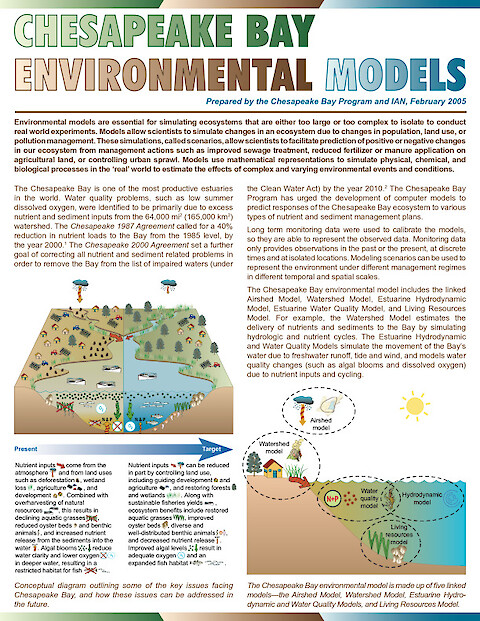
Environmental models are essential for simulating ecosystems that are either too large or too complex to isolate to conduct real world experiments. Models allow scientists to simulate changes in an ecosystem due to changes in population, land use, or pollution management.

MASC Newsletter 1 - Water Quality 2004 (Page 1)

MASC Newsletter 1 - Water Quality 2004

Ben Longstaff ·

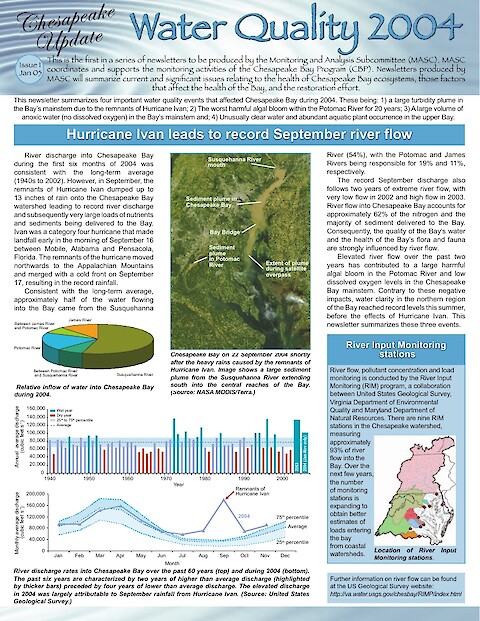
This is the first in a series of newsletters to be produced by the Monitoring and Analysis Subcommittee (MASC). MASC coordinates and supports the monitoring activities of the Chesapeake Bay Program (CBP). Newsletters produced by MASC will summarize current and significant issues relating to the health of Chesapeake Bay ecosystems, those factors that affect the health of the Bay, and the restoration effort.

Crassostrea ariakensis: Panacea or Pandora? (Page 1)

Crassostrea ariakensis: Panacea or Pandora?

Adrian Jones, Tracey Saxby ·

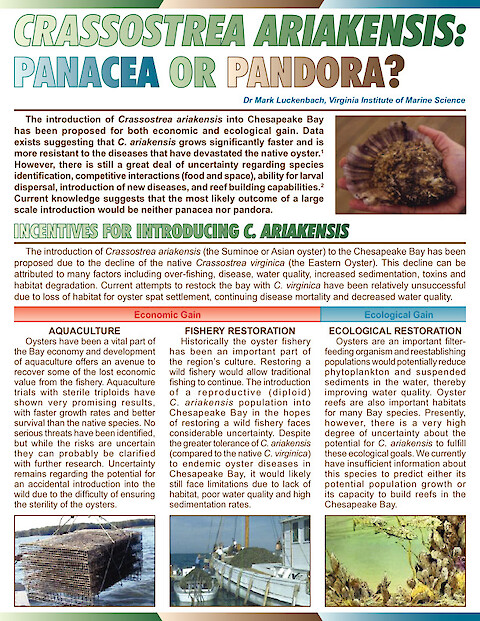
This newsletter is based on research conducted by Dr Mark Luckenbach and a presentation he gave at the Chesapeake Bay Seminar Series in July 2003. The introduction of Crassostrea ariakensis into Chesapeake Bay has been proposed for both economic and ecological gain. Data exists suggesting that C. ariakensis grows significantly faster and is more resistant to the diseases that have devastated the native oyster.

Nutrient Management of Delmarva Soils & Waters (Page 1)

Nutrient Management of Delmarva Soils & Waters

Jane Thomas ·

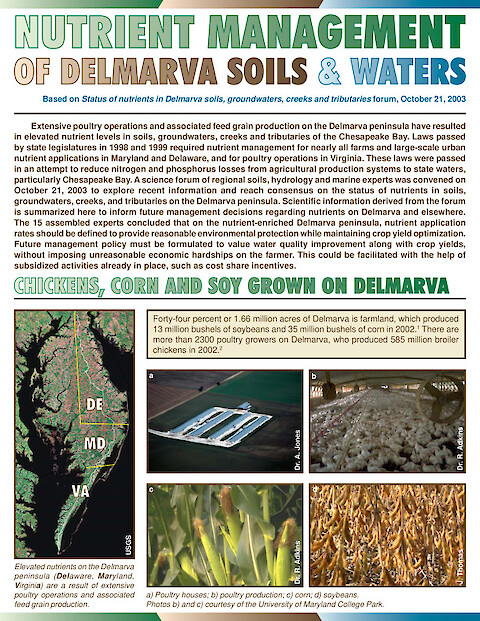
This newsletter is based on the 'Status of nutrients in Delmarva soils, groundwaters, creeks and tributaries forum', October 21, 2003. Extensive poultry operations and associated feed grain production on the Delmarva Peninsula have resulted in elevated nutrient levels in soils, groundwater, creeks and tributaries of the Chesapeake Bay.

Developing a Chesapeake Bay Report Card (Page 1)

Developing a Chesapeake Bay Report Card

Adrian Jones, Jane Thomas ·

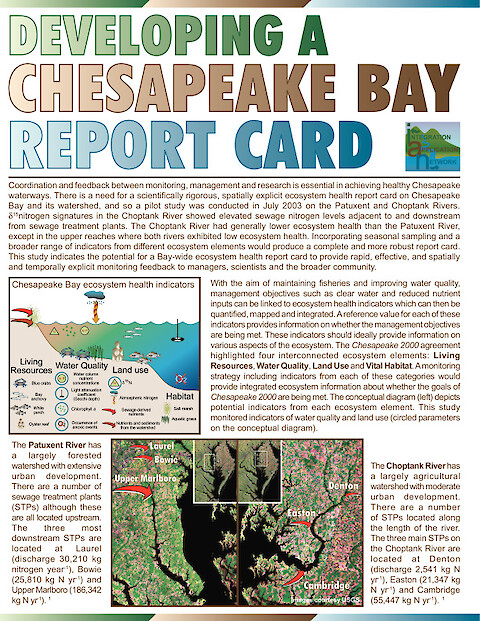
This newsletter details the importance of developing a scientifically rigorous, spatially explicit ecosystem health report card on Chesapeake Bay and its watershed to facilitate coordination and feedback between monitoring, management and research. A pilot study was conducted in July 2003 on the Patuxent and Choptank Rivers using a novel stable isotope technique (see "Assessing Nutrient Sources" newsletter below) together with more traditional water quality monitoring techniques.

Phragmites: Native or Introduced (Page 1)

Phragmites: Native or Introduced

Tracey Saxby ·

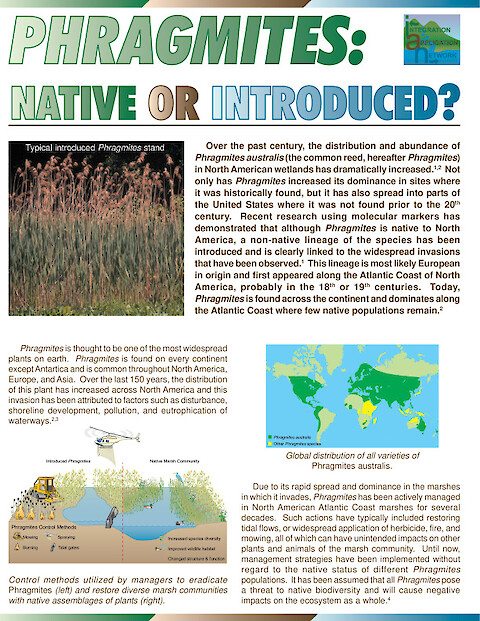
This newsletter describes the historical distributions of both native and introduced Phragmites. It details the invasion of the introduced type in North America (determined through genetic analysis), and morphological differences between the native and introduced types, as well as some commonly used control methods and their associated problems. Phragmites is thought to be one of the most widespread plants on earth.

Conceptual Diagrams: Tools for Science Communication (Page 1)

Conceptual Diagrams: Tools for Science Communication

Adrian Jones, Tracey Saxby ·

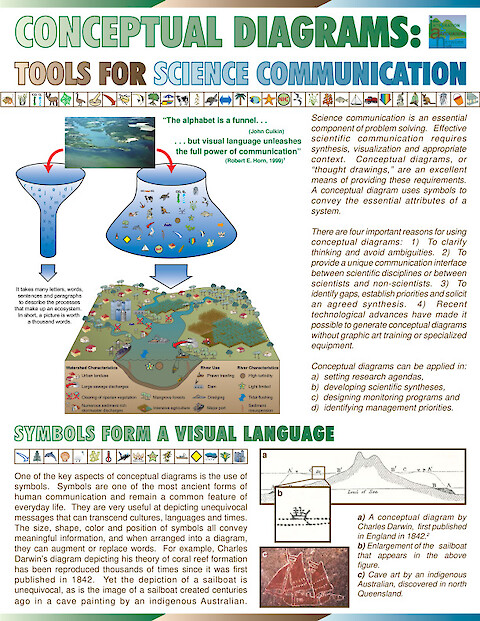
This newsletter details the use of symbols as a visual language. Symbols are useful for depicting unequivocal messages that transcend cultures, languages and times. The use of symbols to contruct conceptual diagrams ('thought drawings') can be an effective tool for science communication and problem solving. Conceptual diagrams help to clarify thinking and provide a communication interface between scientists and non-scientists.