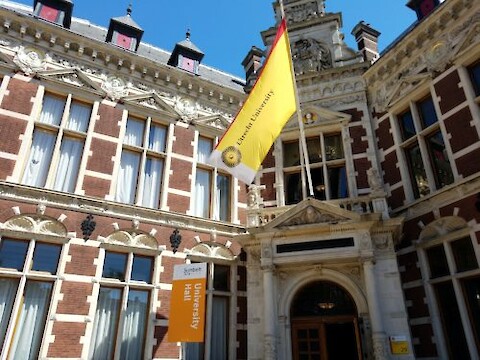
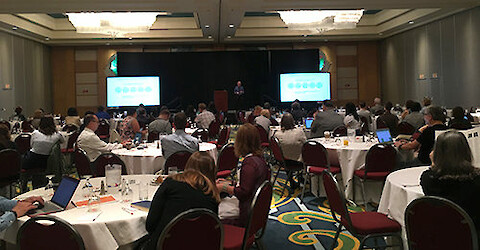
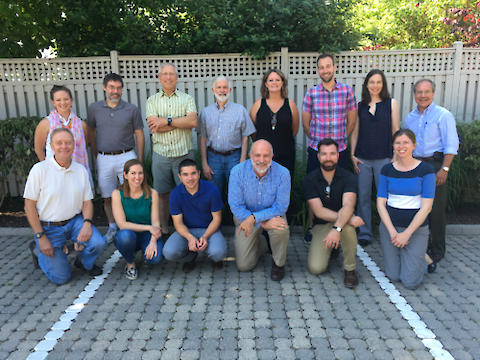
Last June 26th-July 1st, 2018, I had the opportunity to attend and present at the 38th International Sunbelt Social Network Conference in Utrecht, the Netherlands. The Sunbelt Conference is the official conference of the International Network for Social Network Analysis (INSNA), the foremost professional academic association of researchers and practitioners of social network analysis (SNA).
An existential appeal to "Shake things up" in socioecological systems research … Earlier this month, I attended a three-day international symposium called "Boundary Spanning: Advances in Socio-Environmental Systems Research," which was hosted by the National Socio-Environmental Synthesis Center (SESYNC) in Annapolis.
I recently had the opportunity to attend the International Science of Team Science Conference in Galveston, Texas, from May 21-23. This conference was unique in that it convened researchers and practitioners from all professions and academic backgrounds who share the goals of "understanding and enhancing the processes and outcomes of collaborative, team-based research." As an interdisciplinary scholar who is interested in collaborative learning and science engagement…
As part of our Submerged Aquatic Vegetation synthesis effort (SAV SYN), the paper “Long-term nutrient reductions lead to the unprecedented recovery of a temperate coastal region” was published online today in the Proceedings of the National Academy of Science (PNAS). Jon Lefcheck from the Bigelow Laboratory for Ocean Sciences, formerly at the Virginia Institute of Marine Science, was the first author, with our entire SAV SYN team as co-authors:
One of my favorite quotes is by Wilbur Wright, from Dayton, Ohio. He said “If I were giving a young man advice as to how he might succeed in life, I would say to him, pick out a good father and mother, and begin life in Ohio.” I was incredibly fortunate to do exactly that.
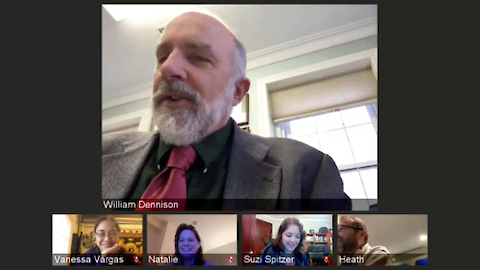
Last semester, Heath Kelsey and I taught a Marine Estuarine and Environmental Science (MEES) course titled “Transdisciplinary Science For Environmental Problem Solving." Our three Integration and Application Network students, Suzi Spitzer, Vanessa Vargas and Natalie Peyronnin enrolled in the 2 credit course. Professor Michael “Dougo” Douglas from the University of Western Australia attended most classes, in spite of the fact that it was 10 pm - 12 am in Perth, Australia.
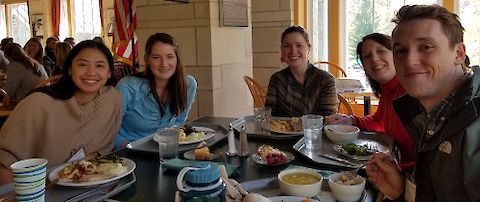
Last month, several IAN staff members traveled to the National Conservation Training Center in Shepherdstown, West Virginia, to attend the Chesapeake Watershed Forum. The Forum is an annual regional conference hosted by the Alliance for the Chesapeake Bay. This year IAN was represented by Caroline, Emily, Dylan, Vanessa, and Suzi. The 2017 conference theme was Healthy Lands, Healthy Waters, Healthy People.
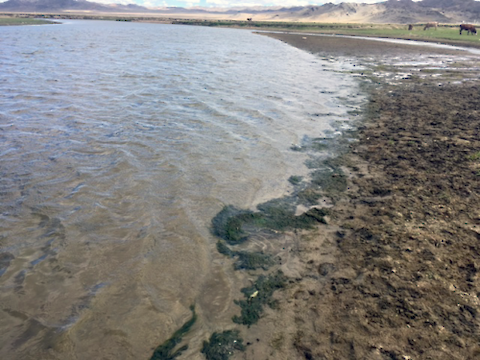
Downstream Tuul River … On the second day of field trips before our Tuul River report card workshop, we headed downstream to visit two mines: one recently built with a history of environmental protections, the other an old soviet mine with no apparent environmental regulation.
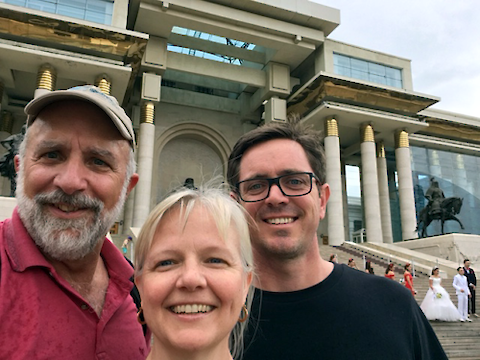
From July 2nd- 4th, 2017, Simon Costanzo, Michele Thieme and I took a day to walk around the capital of Mongolia, Ulaanbaatar (Ulan Bator) and two days on driving tours to see both upstream and downstream sections of the Tuul River. This blog installment provides the first part of a synopsis of these field trips in anticipation of our Tuul River report card workshop. Ulaanbaatar … Ulaanbaatar centers around a large public square. Behind this square is Parliament House.
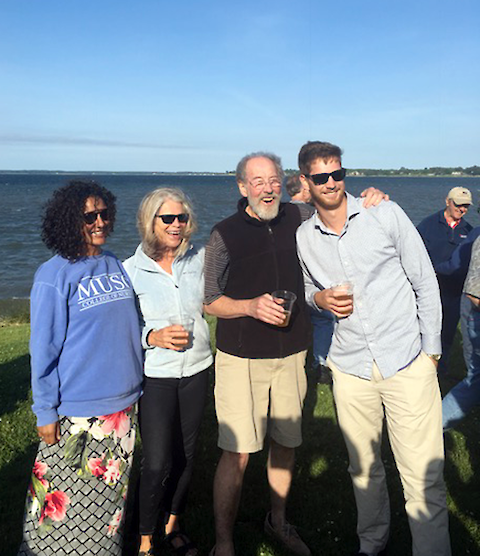
On May 20th, 2017, two former students of Michael Kemp, Jeremy Testa and Cassie Gurbisz, surprised him with a retirement party. For the venue, they chose the the pavilion at Horn Point Laboratory, which is part of the University of Maryland Center for Environmental Science. His son Cullen Murray-Kemp and daughter-in-law Marissa Joiner drove up from Charleston, South Carolina to surprise him.